Video & Multimedia
In reply to the discussion: Hillary Clinton and Bill de Blasio make a cringeworthy “colored people time” joke at New York... [View all]
appalachiablue
(44,029 posts)No need to 'say' slow, late, lazy and simple-minded. It was clear with this trash 'joke' ?!
-------
- Stereotypes of African Americans: From Wikipedia, the free encyclopedia
Stereotypes and generalizations about African Americans and their culture have evolved within American society dating back to the colonial years of settlement, particularly after slavery became a racial institution that was heritable. The early blackface minstrel shows of the 19th century portrayed blacks as joyous, naive, superstitious, ignorant, and musically inclined—characteristics related to the way slaveholders in earlier years believed them to be.
Such scholars as Patricia A. Turner note "stereotyping objects in popular culture that depict blacks as servile, primitive, or simpleminded and explains how the subtle influences of such seemingly harmless images reinforce anti-black attitudes".[1] As with every other identifiable group, stereotypes continue today. African Americans are often portrayed as violent, lazy and very religious. They also are portrayed as having a love of fried chicken, watermelon, corn bread, Kool-Aid, waffles, sweet tea, and grape drink.[2]
The idea of race in the United States is based on physical characteristics and skin color. It played an essential part in shaping American society even before the nation existed independently.[3] The perception of black people has been closely tied to their place in the social strata of the United States.[4]
Historical archetypes[edit]
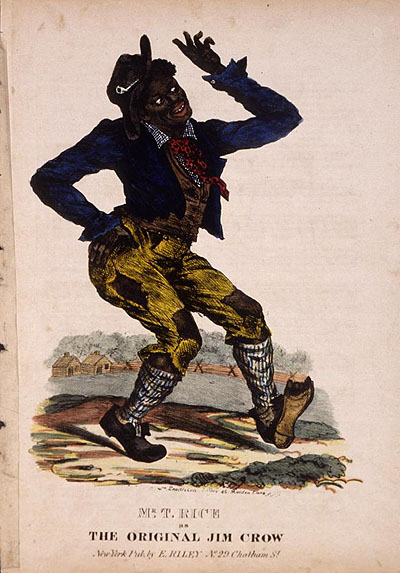
~ Cover to an early edition of Jump Jim Crow sheet music (c. 1832) ~
- Main article: Blackface
Minstrel shows portrayed and lampooned black people in stereotypical and often disparaging ways, as ignorant, lazy, buffoonish, superstitious, joyous, and musical. Blackface is a style of theatrical makeup that originated in the United States, used to effect the countenance of an iconic, racist American archetype — that of the darky or coon. White blackface performers in the past used burnt cork and later greasepaint or shoe polish to blacken their skin and exaggerate their lips, often wearing woolly wigs, gloves, tailcoats, or ragged clothes to complete the transformation.
*The best known stock character of this sort is Jim Crow, featured in innumerable stories, minstrel shows, and early films.
- Sambo, Golliwog, and pickaninny[edit]
Main articles: Sambo (racial term), Gollywog and Pickaninny
The Sambo stereotype gained notoriety through the 1898 children's book The Story of Little Black Sambo by Helen Bannerman. It told the story of a boy named Sambo who outwitted a group of hungry tigers. "Sambo" refers to black men that were considered very happy, usually laughing, lazy, irresponsible, or carefree. This depiction of black people was displayed in films of the early 20th century. The original text suggested that Sambo lived in India, but this fact may have escaped many readers. The book has often been considered to be a slur against Africans,[5] and "Sambo" as a slur has certainly been used this way, though the US restaurant chain Sambo's, surviving until 1982, used iconography more in tune with a Jungle Book view of 19th-century India.
Gollywog is a similarly enduring caricature, most often represented as a blackface doll, and dates to American children's books of the late 19th century. The character found great favor among the Whites of Great Britain and Australia as well, into the late 20th century. Notably, as with Sambo, the term as an insult crosses ethnic lines; the derived Commonwealth English epithet Wog is applied more often to people from the Arabian Peninsula and Indian Subcontinent than to Africans, though "Golly dolls" still in production mostly retain the look of the stereotypical blackface minstrel.
The term pickaninny, reserved for children, has a similarly broadened pattern of use; while it originated in a Portuguese word for 'small child' in general, it was applied especially to African-American children in the United States, then later to Australian Aboriginal children. Although not usually used alone as a character name, the pickaninny became a mainstream stock character in White-dominated fiction, music, theater and early film in the United States and beyond. *Continued, https://en.wikipedia.org/wiki/Stereotypes_of_African_Americans
Edit history
Recommendations
0 members have recommended this reply (displayed in chronological order): = new reply since forum marked as read
Highlight:
NoneDon't highlight anything
5 newestHighlight 5 most recent replies
RecommendedHighlight replies with 5 or more recommendations
= new reply since forum marked as read
Highlight:
NoneDon't highlight anything
5 newestHighlight 5 most recent replies
RecommendedHighlight replies with 5 or more recommendations