Last edited Sun Jul 16, 2023, 10:22 PM - Edit history (1)
which is very unlikely:
Carbon targets seen off by a mile as ambitions fall short, Axios Generate, 6/9/23
... new analysis finds little reason to believe most countries will fulfill their aggressive emissions pledges.
Driving the news: The research in Science analyzed countries' net-zero commitments, assigning a "confidence score" of higher, lower, or much lower.
It's based on whether they're legally binding, have "credible" policy plans, and whether near-term policies put emissions on a downward path.
MORE: https://www.msn.com/en-us/money/markets/carbon-targets-seen-off-by-a-mile-as-ambitions-fall-short/ar-AA1ckVDO
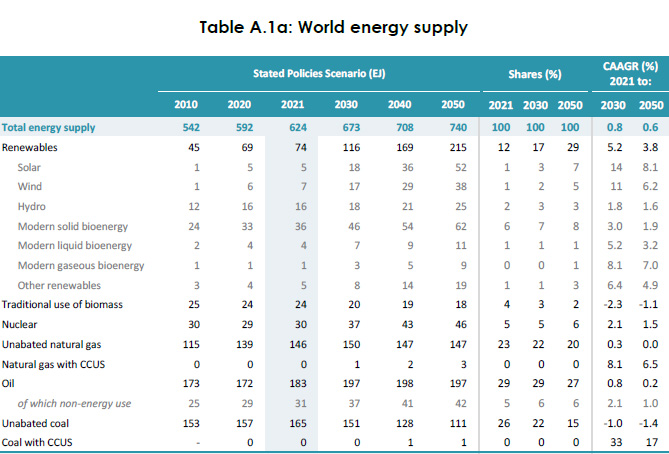
The most recent release by the International Energy Agency (IEA) shows
solar and wind produced just 12 Exajoules on a planet consuming 624 Exajoules per year (12/624 =
1.9%).
Taken from:
https://www.democraticunderground.com/10143033959#post14 (scroll to bottom half of post)
I did a little math exercise to see how much the WEO's "stated policies" scenario (shown in the above table) would reduce fossil fuel for energy use by 2050, the last year in the table.
Fossil fuel supply from IEA WEO 2022. 2021 and 2050 under stated policies scenario,
ExaJoules (EJ).
Subtracting "abated with CCUS" (CCUS=Carbon Capture Utilization and Storage) and subtracting non-energy use oil (since the table is titled World ENERGY Supply), the following is the estimated unabated fossil fuel usage for energy:
2021: 146 - 0 + 183 - 31 + 165 - 0 = 463 EJ . Total energy supply: 624 EJ. % of total energy that is fossil: 74.1%
2050: 147 - 3 + 197 - 42 + 111 - 1 = 409 EJ . Total energy supply: 740 EJ. % of total energy that is fossil: 55.3%
Total fossil supply for energy, % change in EJ from 2021 to 2050 (from 463 to 409 EJ) : -11.7%, or -12% rounded
So unless the world goes beyond the "stated policies" in the above table (a 7.5 fold increase in wind and solar exajoules), we'll reduce fossil fuel consumption by only 12% in 29 years (counting from 2021).
I think we're going to hit some serious resource limits before we get to 7.5-fold increase in solar and wind, and even if that is achieved (
see this about resource intensity ), it only makes a small dent (12%) in the fossil fuel problem as explained just above.
The key graphic from the resource intensity link above (and this doesn't even mention the special minerals like cobalt and lithium among many others that are needed, as discussed in the OP's video):
Materials needed for different forms of power generation, tons per TWh of energy

See also a hint at
the amount of battery storage required and its resource intensity to break away from fossil fuel backup of solar and wind. And that doesn't include the amount needed for electric vehicles.
Another example is the humble metal nickle:
EV Makers Confront the 'Nickel Pickle' 6/4/23
https://www.democraticunderground.com/1016353383
And then there's the water requirement of lithium mining, often in arid areas...

 = new reply since forum marked as read