Welcome to DU!
The truly grassroots left-of-center political community where regular people, not algorithms, drive the discussions and set the standards.
Join the community:
Create a free account
Support DU (and get rid of ads!):
Become a Star Member
Latest Breaking News
Editorials & Other Articles
General Discussion
The DU Lounge
All Forums
Issue Forums
Culture Forums
Alliance Forums
Region Forums
Support Forums
Help & Search
The DU Lounge
In reply to the discussion: IN PICS: The assault ship USS Kearsarge arrives in Stockholm [View all]
Celerity
(55,545 posts)20. Amphibious assault ship
https://en.wikipedia.org/wiki/Amphibious_assault_ship
An amphibious assault ship is a type of amphibious warfare ship employed to land and support ground forces on enemy territory by an amphibious assault. The design evolved from aircraft carriers converted for use as helicopter carriers (and, as a result, are often mistaken for conventional fixed-wing aircraft carriers). Modern ships support amphibious landing craft, with most designs including a well deck. Coming full circle, some amphibious assault ships also support V/STOL fixed-wing aircraft, now having a secondary role as aircraft carriers.
The role of the amphibious assault ship is fundamentally different from that of a standard aircraft carrier: its aviation facilities have the primary role of hosting helicopters to support forces ashore rather than to support strike aircraft. However, some are capable of serving in the sea-control role, embarking aircraft like Harrier or the new F-35B variant of the Lightning II fighters for combat air patrol and helicopters for anti-submarine warfare or operating as a safe base for large numbers of STOVL fighters conducting air support for an expeditionary unit ashore. Most of these ships can also carry or support landing craft, such as air-cushioned landing craft (hovercraft) or LCUs.
The largest fleet of these types is operated by the United States Navy, including the Wasp class dating back to 1989 and the very similar America-class ships that entered service in 2014. Amphibious assault ships are also operated by the Royal Australian Navy, the Brazilian Navy, the Chinese People's Liberation Army Navy, the Egyptian Navy, the French Navy, the Italian Navy, the Republic of Korea Navy (South Korea) and the Spanish Navy.
The term amphibious assault ship is often used interchangeably with other ship classifications. It applies to all large-deck amphibious ships such as the landing platform helicopter (LPH), landing helicopter assault (LHA), and landing helicopter dock (LHD).
snip
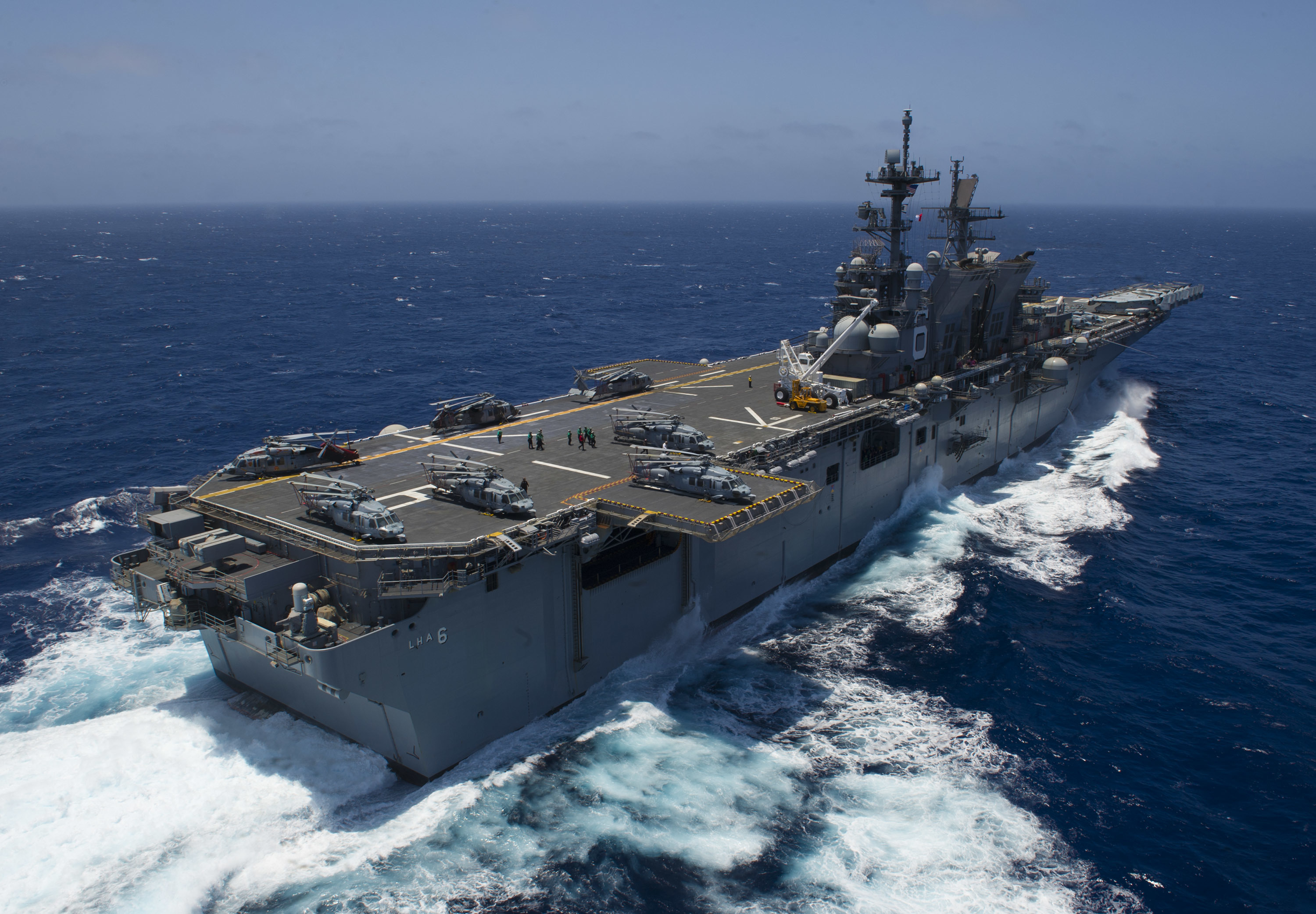
Well deck of USS Iwo Jima (sister ship of the USS Kearsarge, they are in the Wasp Class) seen from a deployed landing craft
Wasp Class

USS Kearsarge in Stockholm
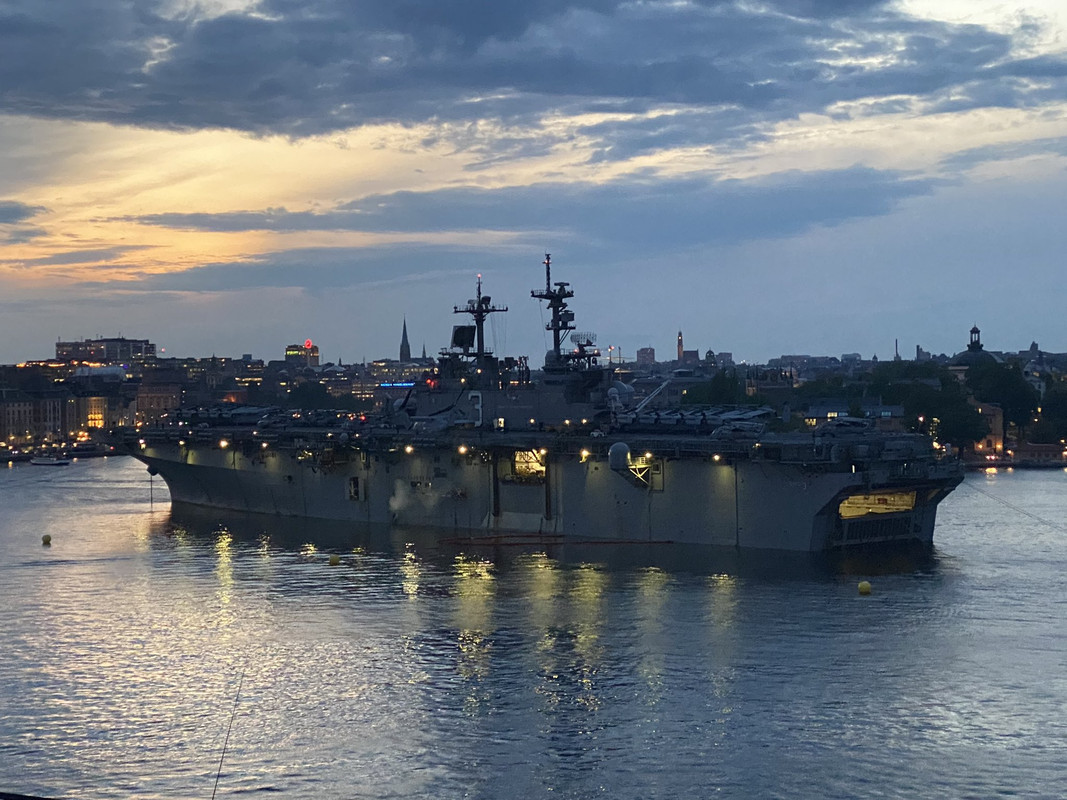
America-class amphibious assault ship
https://en.wikipedia.org/wiki/America-class_amphibious_assault_ship
The America class (formerly the LHA(R) class) is a ship class of landing helicopter assault (LHA) type amphibious assault ships of the United States Navy (USN). The class is designed to put ashore a Marine Expeditionary Unit using helicopters and MV-22B Osprey V/STOL transport aircraft, supported by AV-8B Harrier II or F-35 Lightning II V/STOL aircraft and various attack helicopters. The first of these warships was commissioned by the U.S. Navy in 2014 to replace USS Peleliu of the Tarawa class; as many as eleven will be built. The design of the America class is based on that of USS Makin Island, the last ship of the Wasp class, but the "Flight 0" ships of the America class will not have well decks, and they have smaller on-board hospitals in order to give more space for aviation uses.
Although they only carry helicopters and V/STOL aircraft, USS America, with a displacement of about 45,000 long tons (46,000 t), is similar in size to the French Charles de Gaulle and the Indian Vikramaditya fixed-wing aircraft carriers. Also, while more than 124 feet (38 m) shorter, they are of comparable displacement to the former US Navy Midway-class aircraft carriers.
USS America can be used as a small aircraft carrier with a squadron of jet fighters plus several multipurpose helicopters, such as the MH-60 Seahawk. They can carry about 20 to 25 AV-8B, F-35Bs, or a mixture of the two, but the future ships of this class, starting with USS Bougainville (LHA-8), will have smaller aircraft hangars to leave room for larger amphibious warfare well decks.
snip



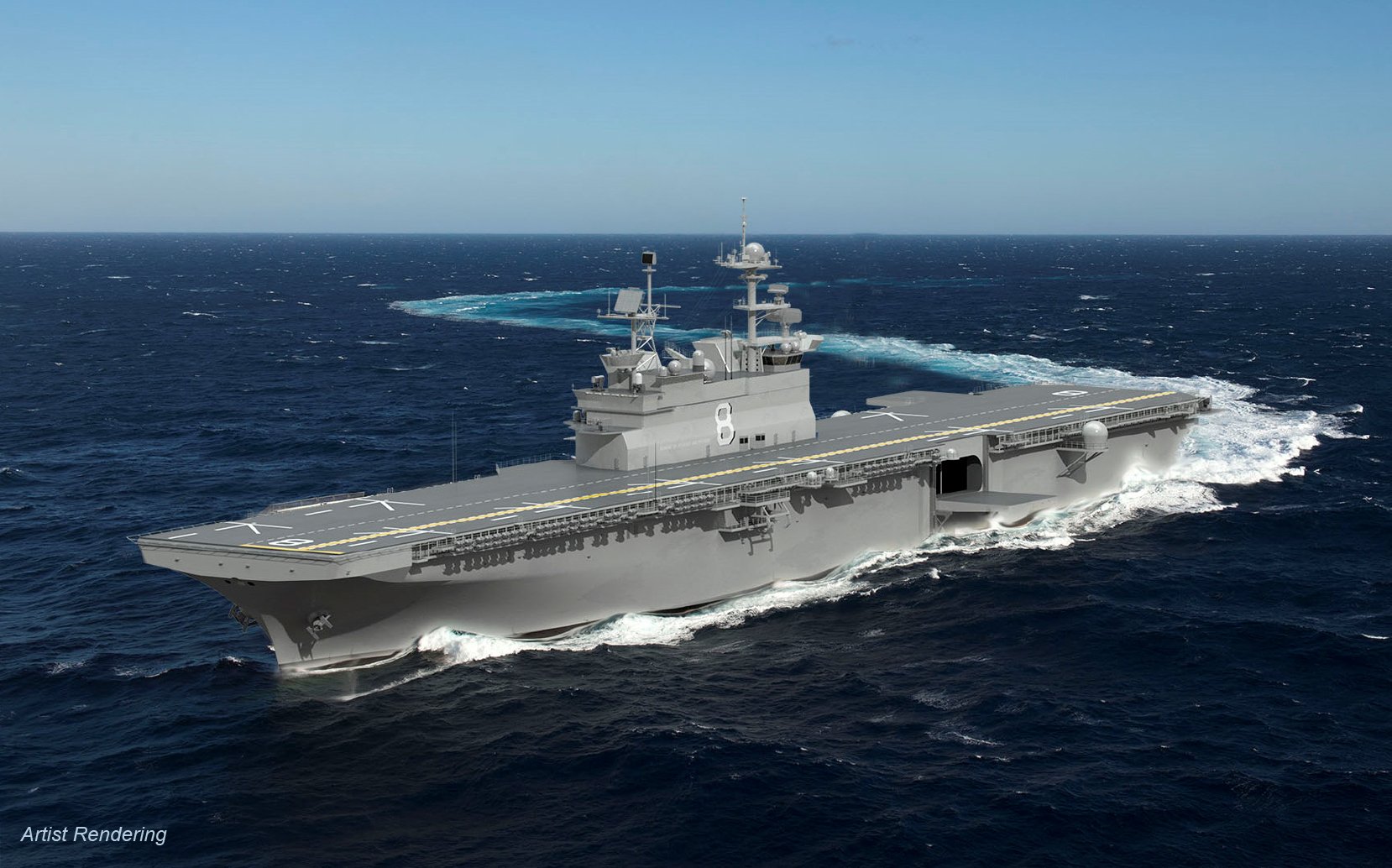
Coming in 2024: The U.S. Navy's Deadliest America-Class Amphibious Assault Ship
The now-under-construction USS Bougainville will incorporate an ability to launch two Landing Craft Air Cushions (LCACs) or Landing Craft Utility (LCU) vehicles.
https://nationalinterest.org/blog/reboot/coming-2024-us-navys-deadliest-america-class-amphibious-assault-ship-186907
Here's What You Need to Know: The U.S. Navy continues to prepare for future war.
The 3rd U.S. Navy America-class amphibious assault ship will feature a return of the much anticipated well-deck configuration, a known design enabling ship-to-shore maritime transport, surveillance, and attack.
“The Bougainville will retain the aviation capability of the America-class design while adding the surface connector capability of a well deck,” a Huntington Ingalls official told The National Interest in a written statement.
Slated to arrive in 2024, the now-under-construction future USS Bougainville will incorporate an ability to house and launch two Landing Craft Air Cushions (LCACs) or Landing Craft Utility (LCU) vehicles for ship-to-shore amphibious missions.
The first two of the America-class, the USS America and USS Tripoli, were both described to me several years ago by the America-class program manager as “aviation centric,” meaning they did not include a well deck. The thinking was of course to leverage the emerging advantages brought to maritime warfare by the F-35B and Osprey aircraft. The ships include more hangar space for aircraft, a specially configured flight deck and a dedicated mission to enable the then first-of-its-kind 5th Gen amphibious attack aircraft.
The rationale, it seems clear, was also to build ships within modern concepts of operations (CONOPS) which call for an increase in aerial surveillance, transport, and power projection in response to the threat environment. The USS America, for example, has deployed with as many as 13 F-35s, a circumstance that clearly changes the tactical dynamics associated with amphibious combat missions.
An amphibious assault ship is a type of amphibious warfare ship employed to land and support ground forces on enemy territory by an amphibious assault. The design evolved from aircraft carriers converted for use as helicopter carriers (and, as a result, are often mistaken for conventional fixed-wing aircraft carriers). Modern ships support amphibious landing craft, with most designs including a well deck. Coming full circle, some amphibious assault ships also support V/STOL fixed-wing aircraft, now having a secondary role as aircraft carriers.
The role of the amphibious assault ship is fundamentally different from that of a standard aircraft carrier: its aviation facilities have the primary role of hosting helicopters to support forces ashore rather than to support strike aircraft. However, some are capable of serving in the sea-control role, embarking aircraft like Harrier or the new F-35B variant of the Lightning II fighters for combat air patrol and helicopters for anti-submarine warfare or operating as a safe base for large numbers of STOVL fighters conducting air support for an expeditionary unit ashore. Most of these ships can also carry or support landing craft, such as air-cushioned landing craft (hovercraft) or LCUs.
The largest fleet of these types is operated by the United States Navy, including the Wasp class dating back to 1989 and the very similar America-class ships that entered service in 2014. Amphibious assault ships are also operated by the Royal Australian Navy, the Brazilian Navy, the Chinese People's Liberation Army Navy, the Egyptian Navy, the French Navy, the Italian Navy, the Republic of Korea Navy (South Korea) and the Spanish Navy.
The term amphibious assault ship is often used interchangeably with other ship classifications. It applies to all large-deck amphibious ships such as the landing platform helicopter (LPH), landing helicopter assault (LHA), and landing helicopter dock (LHD).
snip
Well deck of USS Iwo Jima (sister ship of the USS Kearsarge, they are in the Wasp Class) seen from a deployed landing craft
Wasp Class
USS Kearsarge in Stockholm
America-class amphibious assault ship
https://en.wikipedia.org/wiki/America-class_amphibious_assault_ship
The America class (formerly the LHA(R) class) is a ship class of landing helicopter assault (LHA) type amphibious assault ships of the United States Navy (USN). The class is designed to put ashore a Marine Expeditionary Unit using helicopters and MV-22B Osprey V/STOL transport aircraft, supported by AV-8B Harrier II or F-35 Lightning II V/STOL aircraft and various attack helicopters. The first of these warships was commissioned by the U.S. Navy in 2014 to replace USS Peleliu of the Tarawa class; as many as eleven will be built. The design of the America class is based on that of USS Makin Island, the last ship of the Wasp class, but the "Flight 0" ships of the America class will not have well decks, and they have smaller on-board hospitals in order to give more space for aviation uses.
Although they only carry helicopters and V/STOL aircraft, USS America, with a displacement of about 45,000 long tons (46,000 t), is similar in size to the French Charles de Gaulle and the Indian Vikramaditya fixed-wing aircraft carriers. Also, while more than 124 feet (38 m) shorter, they are of comparable displacement to the former US Navy Midway-class aircraft carriers.
USS America can be used as a small aircraft carrier with a squadron of jet fighters plus several multipurpose helicopters, such as the MH-60 Seahawk. They can carry about 20 to 25 AV-8B, F-35Bs, or a mixture of the two, but the future ships of this class, starting with USS Bougainville (LHA-8), will have smaller aircraft hangars to leave room for larger amphibious warfare well decks.
snip
Coming in 2024: The U.S. Navy's Deadliest America-Class Amphibious Assault Ship
The now-under-construction USS Bougainville will incorporate an ability to launch two Landing Craft Air Cushions (LCACs) or Landing Craft Utility (LCU) vehicles.
https://nationalinterest.org/blog/reboot/coming-2024-us-navys-deadliest-america-class-amphibious-assault-ship-186907
Here's What You Need to Know: The U.S. Navy continues to prepare for future war.
The 3rd U.S. Navy America-class amphibious assault ship will feature a return of the much anticipated well-deck configuration, a known design enabling ship-to-shore maritime transport, surveillance, and attack.
“The Bougainville will retain the aviation capability of the America-class design while adding the surface connector capability of a well deck,” a Huntington Ingalls official told The National Interest in a written statement.
Slated to arrive in 2024, the now-under-construction future USS Bougainville will incorporate an ability to house and launch two Landing Craft Air Cushions (LCACs) or Landing Craft Utility (LCU) vehicles for ship-to-shore amphibious missions.
The first two of the America-class, the USS America and USS Tripoli, were both described to me several years ago by the America-class program manager as “aviation centric,” meaning they did not include a well deck. The thinking was of course to leverage the emerging advantages brought to maritime warfare by the F-35B and Osprey aircraft. The ships include more hangar space for aircraft, a specially configured flight deck and a dedicated mission to enable the then first-of-its-kind 5th Gen amphibious attack aircraft.
The rationale, it seems clear, was also to build ships within modern concepts of operations (CONOPS) which call for an increase in aerial surveillance, transport, and power projection in response to the threat environment. The USS America, for example, has deployed with as many as 13 F-35s, a circumstance that clearly changes the tactical dynamics associated with amphibious combat missions.
Edit history
Please sign in to view edit histories.
Recommendations
0 members have recommended this reply (displayed in chronological order):
26 replies
 = new reply since forum marked as read
Highlight:
NoneDon't highlight anything
5 newestHighlight 5 most recent replies
RecommendedHighlight replies with 5 or more recommendations
= new reply since forum marked as read
Highlight:
NoneDon't highlight anything
5 newestHighlight 5 most recent replies
RecommendedHighlight replies with 5 or more recommendations
= new reply since forum marked as read
Highlight:
NoneDon't highlight anything
5 newestHighlight 5 most recent replies
RecommendedHighlight replies with 5 or more recommendations
Most of those pics are right near the inner city area, not the main seaports (we have 5 throughout
Celerity
Jun 2022
#5
It must have been challenging to maneuver that big ship through the archipelago.
Ocelot II
Jun 2022
#3
They picked a superb time if year to visit. Sweden is so lush and green right now, with nice
Celerity
Jun 2022
#8