Welcome to DU!
The truly grassroots left-of-center political community where regular people, not algorithms, drive the discussions and set the standards.
Join the community:
Create a free account
Support DU (and get rid of ads!):
Become a Star Member
Latest Breaking News
Editorials & Other Articles
General Discussion
The DU Lounge
All Forums
Issue Forums
Culture Forums
Alliance Forums
Region Forums
Support Forums
Help & Search
Music Appreciation
In reply to the discussion: On January 12, 2005, WHFS dropped its alternative programming and became "El Zol 99.1 FM." [View all]
mahatmakanejeeves
(70,986 posts)5. the view from suburbia: Dead Kennedys, Washington DC, 6-5-83
Musical Urbanism
Blogging at the intersection of urban studies and popular music
the view from suburbia: Dead Kennedys, Washington DC, 6-5-83
by Leonard Nevarez on Jun 4, 2013 • 10:59 am
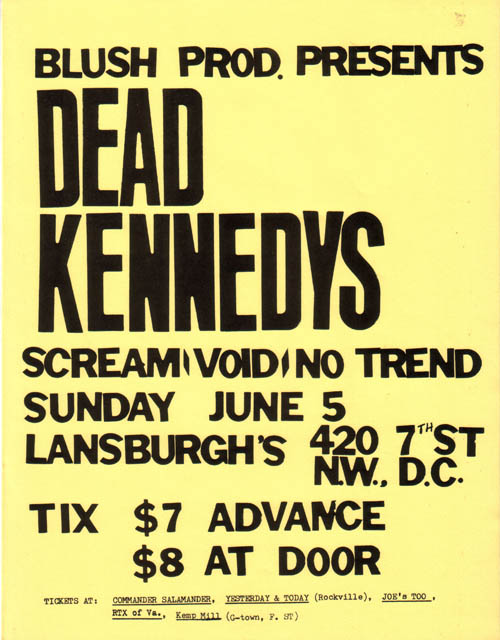
It’s been said 14 is the influential age in the development of our musical tastes. That was the case for me: I find I regularly return to the music that I explored and embraced as my own back around 1983. It wasn’t just what I heard that has shaped my ideas about ‘good’ music, though, but how and where I heard it.
Suburban lessons in DC hardcore
When I was 14 years old, I was a freshman at McLean High School in McLean, Virginia, a suburb of Washington, D.C. At the time, McLean was well-to-do but not yet submerged into the extended Northern Virginia sprawl that now characterizes the Washington metropolitan area. For instance, the town’s major shopping mall, Tyson’s Corner, didn’t yet have the retail/office expansion for which journalist Joel Garreau would deem it the ur-Edge City. A number of our parents worked “inside the Beltway” at government jobs, but otherwise high school kids lived lives roughly familiar to the teenage life depicted in “Dazed and Confused”: jocks and preppies, long-hairs smoking cigarettes in the parking lot (“fleabags,” we called this group), and the unquestioned hegemony of rock radio from stations like WAVA and DC-101.
Something musically exciting was happening in the city, but as a freshman too young for a driver’s license, I could only get glimpses of it. Legendary alternative-radio station WHFS broadcasted with a weak signal back then that I couldn’t really tune into from where I lived. Family excursions into the Georgetown neighborhood (the most visible scene for DC’s first wave of gentrification) were infrequent, but a couple of trips to the new wave boutique Commander Salamander there were tremendously exciting for me. And most famously, hardcore punk was raging in DC in 1983, maybe the last year in its golden age marked by the career of Minor Threat.
My musical tastes were already evolving to reflect British new wave and postpunk in my freshman year. I was really affected by acquiring and, separately, going into record stores to buy albums like the Clash’s Combat Rock, the Psychedelic Furs’ Forever Now, ABC’s Lexicon of Love, the Human League’s Dare (actually, that was taped off a full-album broadcast on FM radio), Devo’s Oh No It’s Devo, and Duran Duran’s Rio. (The influence of the suits that Duran Duran wore on the back cover of Rio is the subject of another blog some day.) But DC hardcore was in the ether at my high school back then, if you knew where to look, or who to look at.
The guys who played in the high school’s unofficial ultimate frisbee team (the Flipping Lids) looked not too dissimilar from the fleabags — shaggy hair, flannel shirts, the scent of some kind of smoke wafting from their cars. But then I saw a few of them play a mangy version of “Louie Louie” at a high school talent show with an alternate lyric: “Who needs love when you’ve got a gun/Who needs love to have any fun.” I soon learned they played Black Flag’s version of “Louie Louie.” Or then there were the kids involved in theater — the “drama queers”, they were called — that I ran with thanks to working on the tech crew for “Fiddler on the Roof.” From them I discovered Fear’s debut album The Record and danced (if that’s what you called my G-rated spazzout) to “Beef Baloney” at a theater party.
Yet I really have Nils Ahlgren to blame/thank for showing me the world of DC hardcore. Nils was a problem child, if I recall correctly: smart but disruptive in class, verbally dismissive of the popular kids, a little uncomfortable-looking in his nondescript clothes. I don’t recall how we latched on to each other freshman year, but he found a willing and impressionable comrade in me. He came over to my house one day with three LPs that showed me a new world of sound and style: the Ramones’ Subterranean Jungle, Public Image Limited’s Flowers of Romance and the Alternative Tentacles compilation of North American hardcore Let Them Eat Jellybeans. In Spanish class, we would go to the library’s language lab, where he would eject the Spanish exercise cassette and pop in homemade tapes of DC music that he had collected, such as hardcore heroes Government Issue or local weirdoes 9353. (This is how we shared music in the pre-Internet age, kids.)
{snip}
Blogging at the intersection of urban studies and popular music
the view from suburbia: Dead Kennedys, Washington DC, 6-5-83
by Leonard Nevarez on Jun 4, 2013 • 10:59 am
It’s been said 14 is the influential age in the development of our musical tastes. That was the case for me: I find I regularly return to the music that I explored and embraced as my own back around 1983. It wasn’t just what I heard that has shaped my ideas about ‘good’ music, though, but how and where I heard it.
Suburban lessons in DC hardcore
When I was 14 years old, I was a freshman at McLean High School in McLean, Virginia, a suburb of Washington, D.C. At the time, McLean was well-to-do but not yet submerged into the extended Northern Virginia sprawl that now characterizes the Washington metropolitan area. For instance, the town’s major shopping mall, Tyson’s Corner, didn’t yet have the retail/office expansion for which journalist Joel Garreau would deem it the ur-Edge City. A number of our parents worked “inside the Beltway” at government jobs, but otherwise high school kids lived lives roughly familiar to the teenage life depicted in “Dazed and Confused”: jocks and preppies, long-hairs smoking cigarettes in the parking lot (“fleabags,” we called this group), and the unquestioned hegemony of rock radio from stations like WAVA and DC-101.
Something musically exciting was happening in the city, but as a freshman too young for a driver’s license, I could only get glimpses of it. Legendary alternative-radio station WHFS broadcasted with a weak signal back then that I couldn’t really tune into from where I lived. Family excursions into the Georgetown neighborhood (the most visible scene for DC’s first wave of gentrification) were infrequent, but a couple of trips to the new wave boutique Commander Salamander there were tremendously exciting for me. And most famously, hardcore punk was raging in DC in 1983, maybe the last year in its golden age marked by the career of Minor Threat.
My musical tastes were already evolving to reflect British new wave and postpunk in my freshman year. I was really affected by acquiring and, separately, going into record stores to buy albums like the Clash’s Combat Rock, the Psychedelic Furs’ Forever Now, ABC’s Lexicon of Love, the Human League’s Dare (actually, that was taped off a full-album broadcast on FM radio), Devo’s Oh No It’s Devo, and Duran Duran’s Rio. (The influence of the suits that Duran Duran wore on the back cover of Rio is the subject of another blog some day.) But DC hardcore was in the ether at my high school back then, if you knew where to look, or who to look at.
The guys who played in the high school’s unofficial ultimate frisbee team (the Flipping Lids) looked not too dissimilar from the fleabags — shaggy hair, flannel shirts, the scent of some kind of smoke wafting from their cars. But then I saw a few of them play a mangy version of “Louie Louie” at a high school talent show with an alternate lyric: “Who needs love when you’ve got a gun/Who needs love to have any fun.” I soon learned they played Black Flag’s version of “Louie Louie.” Or then there were the kids involved in theater — the “drama queers”, they were called — that I ran with thanks to working on the tech crew for “Fiddler on the Roof.” From them I discovered Fear’s debut album The Record and danced (if that’s what you called my G-rated spazzout) to “Beef Baloney” at a theater party.
Yet I really have Nils Ahlgren to blame/thank for showing me the world of DC hardcore. Nils was a problem child, if I recall correctly: smart but disruptive in class, verbally dismissive of the popular kids, a little uncomfortable-looking in his nondescript clothes. I don’t recall how we latched on to each other freshman year, but he found a willing and impressionable comrade in me. He came over to my house one day with three LPs that showed me a new world of sound and style: the Ramones’ Subterranean Jungle, Public Image Limited’s Flowers of Romance and the Alternative Tentacles compilation of North American hardcore Let Them Eat Jellybeans. In Spanish class, we would go to the library’s language lab, where he would eject the Spanish exercise cassette and pop in homemade tapes of DC music that he had collected, such as hardcore heroes Government Issue or local weirdoes 9353. (This is how we shared music in the pre-Internet age, kids.)
{snip}
Edit history
Please sign in to view edit histories.
Recommendations
0 members have recommended this reply (displayed in chronological order):
10 replies
 = new reply since forum marked as read
Highlight:
NoneDon't highlight anything
5 newestHighlight 5 most recent replies
RecommendedHighlight replies with 5 or more recommendations
= new reply since forum marked as read
Highlight:
NoneDon't highlight anything
5 newestHighlight 5 most recent replies
RecommendedHighlight replies with 5 or more recommendations
= new reply since forum marked as read
Highlight:
NoneDon't highlight anything
5 newestHighlight 5 most recent replies
RecommendedHighlight replies with 5 or more recommendations
On January 12, 2005, WHFS dropped its alternative programming and became "El Zol 99.1 FM." [View all]
mahatmakanejeeves
Jan 2025
OP
That was a sad, sad day! Even though WHFS was only a shadow of its old self by then.
50 Shades Of Blue
Jan 2025
#1
Do you remember when it was? I'm wracking my brain and can't come up with more than early-ish '80's.
50 Shades Of Blue
Jan 2025
#3
I can't recall with certainty either, but it must have been at a Penguin Feather or a Kemp Mill Records.
mahatmakanejeeves
Jan 2025
#4
In the DC area, "The Gamut," which I have on now in the next room, comes really close to sounding like WHFS.
mahatmakanejeeves
Jan 2025
#7
Thanks, I had not heard of them! I don't have an HD radio either so I will try it a different way.
50 Shades Of Blue
Jan 2025
#8
Thanks for the info -- I had no idea this even existed until now! Kinda reminds of when I was a kid
50 Shades Of Blue
Jan 2025
#10