named "La Oroya," whose owner has been living in what used to be the most expensive personal home in the U.S., on Long Island, New York, USA.
[center]
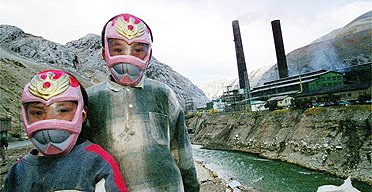


La Oroya
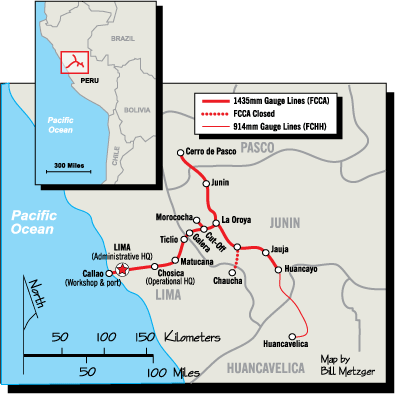

Cerro de Pasco

"Deep Burial" translated title of this film.
Sounds very convincing, doesn't it?
 [/center]
Found this article looking for photos of this tragic town:
Cerro de Pasco, Peru: Mining, Red Lakes, and Piles of Waste
Written by Thomas Quirynen, Translation by Johan Van de Wauw
Friday, 22 May 2009 06:50
http://upsidedownworld.org/main/news-briefs-archives-68/1872-cerro-de-pasco-peru-mining-red-lakes-and-piles-of-waste
[center]~ ~ ~[/center]
Polly, didn't know, until seeing your post that there was another town suffering at least as much as La Oroya, Peru.
It's so important to know all about this horrendous crime against humans, animals, and every living thing. New ways have to be found, as the greedy monsters among us are destroying life on this planet. New, safe ways which won't kill everyone and everything while the pigs grab their money and run to a safe distance to roll in it, need to be found.
[center] 
[font size=1]
Belinda Elida Barja holds one of her sons in her living room in the town of La Oroya, Peru. Most of La Oroya’s children suffer elevated lead levels,
according to the Peruvian government. Parents say some have symptoms, all consistent with lead poisoning, that include anemia, convulsions,
stunted growth, mental retardation, and more. Photographer: Meridith Kohut/Bloomberg
[/font][/center]
Coup d’Etat to Trade Seen in Billionaire Toxic Lead Fight
by Andrew Martin
May 10, 2013 — 1:22 PM CDT
Across the river from Belinda Elida Barja’s two-room apartment, the lead and zinc smelters of Doe Run Peru spread smoke and dust in the mountain town of La Oroya.
Her 9-year-old son Kenyi has headaches, memory loss, stomach ailments and difficulty concentrating, Barja said. The lead in his blood measured 41 micrograms per deciliter in a 2007 test -- eight times the level the U.S. government considers a cause for action. Barja blames Doe Run Peru.
“They just think about making money,” she said.
Most of La Oroya’s children suffer elevated lead levels, according to the Peruvian government. Parents say some have symptoms -- consistent with lead poisoning -- that include anemia, convulsions, stunted growth, mental retardation and the ills Barja said her son suffers.
The question of responsibility is at the center of a high-stakes clash between Peru and U.S. billionaire Ira Rennert, who owned Doe Run Peru for more than a decade through Renco Group Inc. Far from defensive, Renco is demanding $800 million from Peru because it ordered a costly pollution clean-up that the company says forced Doe Run Peru into bankruptcy in 2010. Renco has said it’s not responsible for the children’s ailments.
More:
http://www.bloomberg.com/news/articles/2013-05-09/rennert-800-million-toxic-lead-fight-roils-global-trade
[center]
Ira Rennert, and his home by the ocean, Long Island

Rennert, with his wife, standing behind him. [/center]
A Mine Erodes
an Andean City
By Andrew Boryga Jan. 13, 2015
New York Times
In the heart of Cerro de Pasco, a Peruvian city perched 14,000 feet in the Andes, a mile-wide mine pit smolders. For residents, the growls of heavy machinery are background noise. Just as ever-present is the hazardous cocktail of smoke and lead that seeps into their air and water. “As the mine grows in diameter, it eats away at the city and its residents little by little,” said the photographer Paccarik Orue.
The Spanish found silver in the caverns of Cerro de Pasco 500 years ago, and through the 20th century its mines enriched many — including prominent Americans. The caverns were opened in 1956, a move that unleashed a host of environmental hazards and has since posed a dilemma for residents whose disdain for the pit is as intense as their pride in the culture surrounding it.
“There is a beautiful contrast of environmental disaster and rich tradition,” Mr. Orue said. “I was intrigued by how both coexist.”
El Muqui, a folkloric goblin, best represents this coexistence. The two-foot-tall dwarf endures in old tales and traditional festivals where children don his garb and dance in the streets. He is many things: a lost miner who lingers in dark passages; a prankster; a guiding force. Legend has it he can point you in the direction of minerals that will make you rich.

[font size=1]
Houses and mining tailings in Paragsha. Cerro de Pasco, Peru. Viviendas y desmonte.
El Muqui series. 2013.Credit Paccarik Orue
[/font]
More:
http://lens.blogs.nytimes.com/2015/01/13/a-mine-erodes-an-andean-city/?_r=0#

 = new reply since forum marked as read