by DR. MAYA JIMÉNEZ
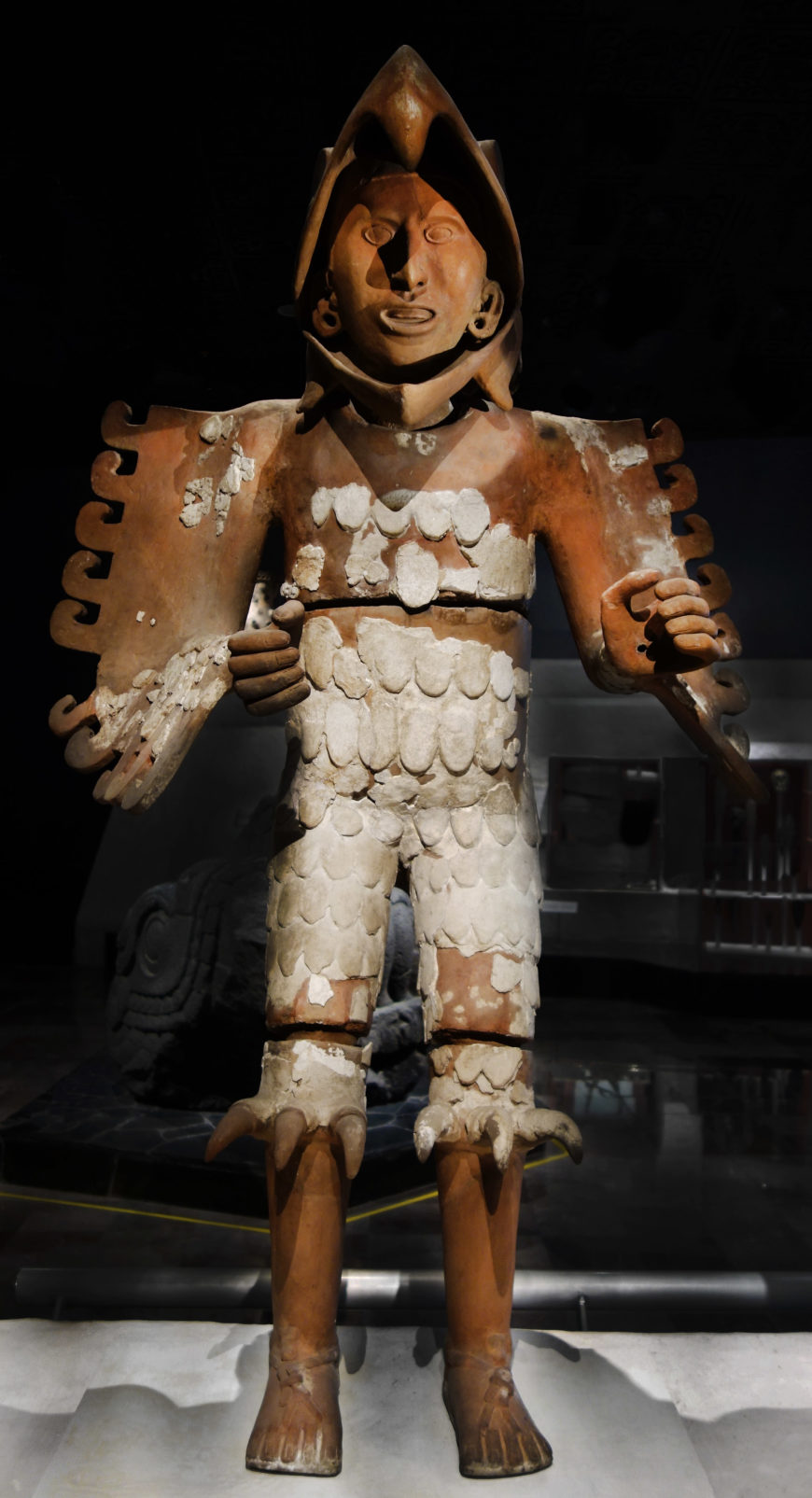
Eagle Warrior from the House of the Eagles, c. 1400–1521 C.E., Tenochtitlan (today, Mexico City) (photo: Steven Zucker, CC BY-NC-SA 2.0)
Eagle Warrior is a life-sized ceramic sculpture made by Mexica (sometimes called Aztec) artists that shows a warrior dressed in an eagle costume. Made of terracotta, a type of earthenware known for its reddish color, the life-sized Eagle Warrior was originally painted and adorned with feathers and weapons. His outstretched wings and arms suggest a gesture of flight. This sculpture was discovered during excavations at the main Mexica temple, called the Templo Mayor. This temple was located in the ceremonial center of Tenochtitlan, the capital city of the Mexica empire. The Templo Mayor consisted of a twin-towered stepped pyramid dedicated to Tlaloc, the god of Rain, and Huitzilopochtli, the patron god of the Mexica, usually associated with war and fire.
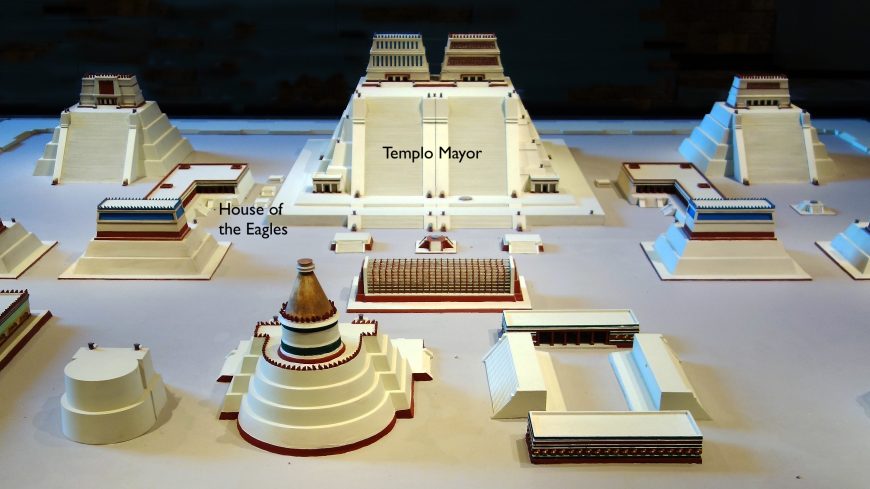
Model of the Sacred Precinct in the Mexica capital of Tenochtitlan, today, Mexico City (photo: Steven Zucker, CC BY-NC-SA 2.0)
The sculpture was recovered at the House of the Eagles, the meeting place of eagle and jaguar warriors, two of the most prestigious of the Mexica military classes. The House of the Eagles was just beside to the Templo Mayor, and highlighted the association of the Mexica’s most important temple with warfare. The Templo Mayor itself symbolized warfare in its combination of Tlaloc and Huitzilopochtli.
House of the Eagles, c. 1400–1521 C.E., Tenochtitlan (today, Mexico City) (photo: Steven Zucker, CC BY-NC-SA 2.0)
For the Mexica, the symbol for war was water and fire, called the atl-tlachinolli in Nahuatl, the language of the Mexica. A meeting space for eagle and jaguar warriors next to the Templo Mayor advertised the important role that the military classes played in Mexica culture more generally and in maintaining Mexica power over conquered peoples.
Warrior ranks
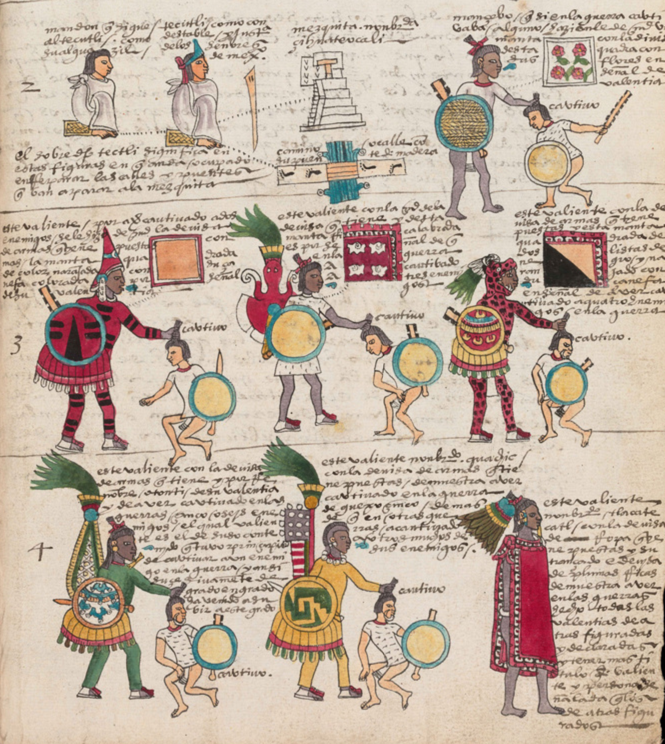
Warriors, Codex Mendoza, Viceroyalty of New Spain, c. 1541–1542, pigment on paper
(© Bodleian Libraries, University of Oxford)
While the Mexica had no standing army, they did have elite warriors with extensive military and martial arts training who fought in “flowery wars,” a ritualistic form of warfare that consisted of capturing victims and sacrificing them to the gods.
Our understanding of the role of the eagle warriors is largely based on colonial sources (or written sources made after the Spanish conquest in 1521), including the Codex Mendoza, (c. 1541–42). This book documents pre-invasion Mexica culture but was commissioned by Antonio de Mendoza, the first viceroy of New Spain. It should be kept in mind though that the Codex Mendoza, while a critical historical document, is not politically nor culturally neutral. According to this source the goal of the eagle warrior was to capture the greatest number of captives, who would then be sacrificed to the Mexica gods. Warriors rose in rank according to the number of captives they acquired. This ranking system is documented in the Codex Mendoza, which illustrates the different military ranks and their corresponding war suits, determined by the number of captives.
In the second to last register, for example, the warrior in the red suit is credited for capturing two victims, while the jaguar warrior at the far right captured four. In the last register, the warrior at right is of the highest rank, yet he is dressed in civilian clothes, a reference to his aristocratic ancestry. While all warriors were equipped with shields and obsidian weapons, their war suits identified their military rank and social status.
More:
https://smarthistory.org/eagle-warrior-mexica/

 = new reply since forum marked as read