Latin America
In reply to the discussion: Bolivia: 13 More Individuals Arrested for Massacres During Coup [View all]
Judi Lynn
(164,067 posts)05 MAY 2021
After receiving the document, the international organization urged Bolivia to investigate the violations committed by Jeanine Áñez’s facto government. These crimes remain unpunished to this day.
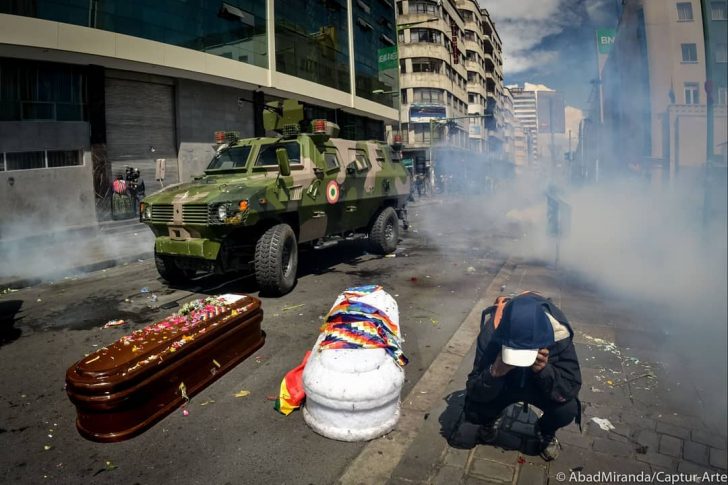
In response to the lack of progress in justice and reparations for the victims of the abuses carried out under the Añez government, the undersigned organizations have decided to make public the report we submitted to the United Nations Special Rapporteur on extrajudicial, summary or arbitrary executions on August 10, 2020. Based on thorough documentation carried out in Bolivia, this report details the events that took place during the Sacaba and Senkata massacres. It also highlights additional abuses carried out by members of the Áñez government, including security forces and judicial authorities, in the days and months following the massacres.
On September 21, 2020 after receiving detailed reports based on witness testimonies, photo and video evidence, and other forms of documentary evidence, the UN Special Rapporteur on extrajudicial, summary or arbitrary executions, in conjunction with five other UN bodies, published a statement condemning the massacres in Sacaba and Senkata and urging the Bolivian government to investigate human rights violations carried out by the de facto Añez regime.
The Special Rapporteur called for “immediate action.” UN experts on arbitrary detentions; freedom of expression; freedom of assembly and association; the promotion and protection of human rights and fundamental freedoms while countering terrorism; and truth, justice, reparation and guarantees of non-recurrence further urged the State to adopt “all the necessary measures to investigate, process and impose appropriate punishment to any person responsible of the violations reported,” as well as to take “effective measures to keep these incidents from occurring again.” Yet, despite the experts’ calls for accountability, the Áñez government repeatedly blocked efforts for justice, and as of today no person has been held accountable for the killings.
This report is one of many cataloguing the human rights violations that took place during this period. The report remained confidential according to the practices of the special rapporteurs to protect victims and witnesses. We have received authorization from the victims to make public the information shared in the report, though the identities of some witnesses have been redacted for security reasons.
More:
https://www.cels.org.ar/web/en/2021/05/bolivia-human-rights-organizations-publish-report-to-un-on-the-sacaba-and-senkata-massacres/
~ ~ ~
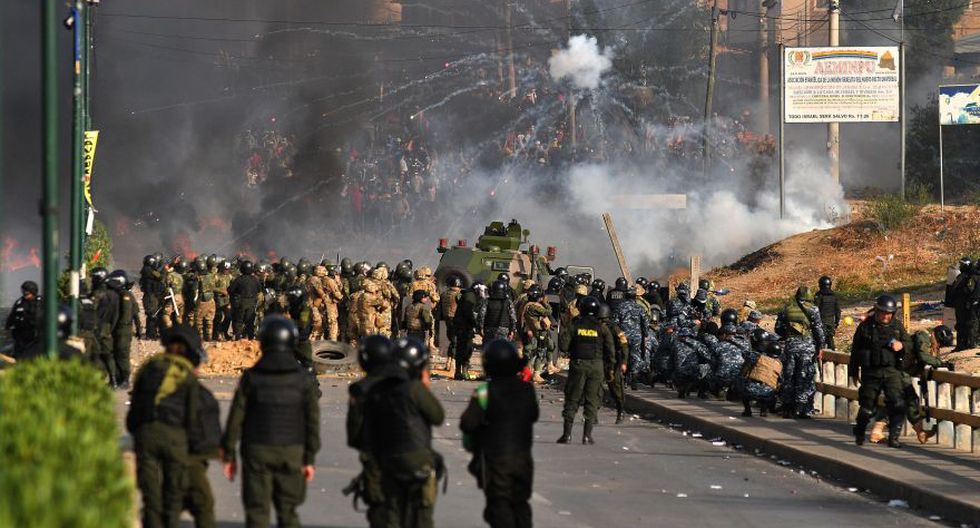
Bolivian legislature investigation: All deaths in Sacaba and Senkata traceable to security forces’ weapons
OCTOBER 21, 2020 CARWIL BJORK-JAMES
A months-long investigation by the Bolivian legislature of killings during last year’s political crisis has found that the twenty gunshot victims in Sacaba (November 15) and Sacaba (November 19) were all killed by weapons used exclusively by Bolivia’s military or police forces. The commission, led by Deputy Víctor Borda, will make its formal report on Monday, October 26, but issued advance statements to the press today.
Before the dust had settled in either massacre, the interim government of Jeanine Áñez issued blanket denials of any responsibility for the shootings of scores of protesters before hundreds of witnesses including members of the press. Those denials were buttressed by claims that protesters shot one another, that bullet wounds were in the back (and therefore “must” have been from the protesters’ side), and that the weapons involve did not correspond to military weapons. Defense Minister Luis Fernando López claimed, “In November, in the worst epoch of our democracy, the Armed Forces did not fire a single cartridge; not one death is due to the Police or the Armed Forces.” The legislative commission now rejects all these points, which had always strained credibility.
Its report is based on visits to the massacre sides, reports from prosecutors and the forensic institute, and over 150 witness declarations. Among its conclusions disclosed today by Borda: “We have not received a single forensic medical certificate from any injured police officer or soldier.” Borda further identified three calibers of ammunition fired: 5.5mm used in light weapons given to officers, but not soldiers, of the Armed Forces, 7.62mm used in automatic weapons by the military, and 22 caliber used by the police.
Borda signalled that the report will also consider deaths in La Paz, Montero, and Betanzos during the 2019 crisis.
Photo above: Sacaba clashes as viewed from behind the military lines (AFP).
https://woborders.blog/2020/10/21/sacaba-senkata-security-forces/
(Sounds very similar to the bogus charges launched by the Venezuelan anti-Chavists attacking the bridge in Caracas, doesn't it?)
~ ~ ~
DECEMBER 19, 2019
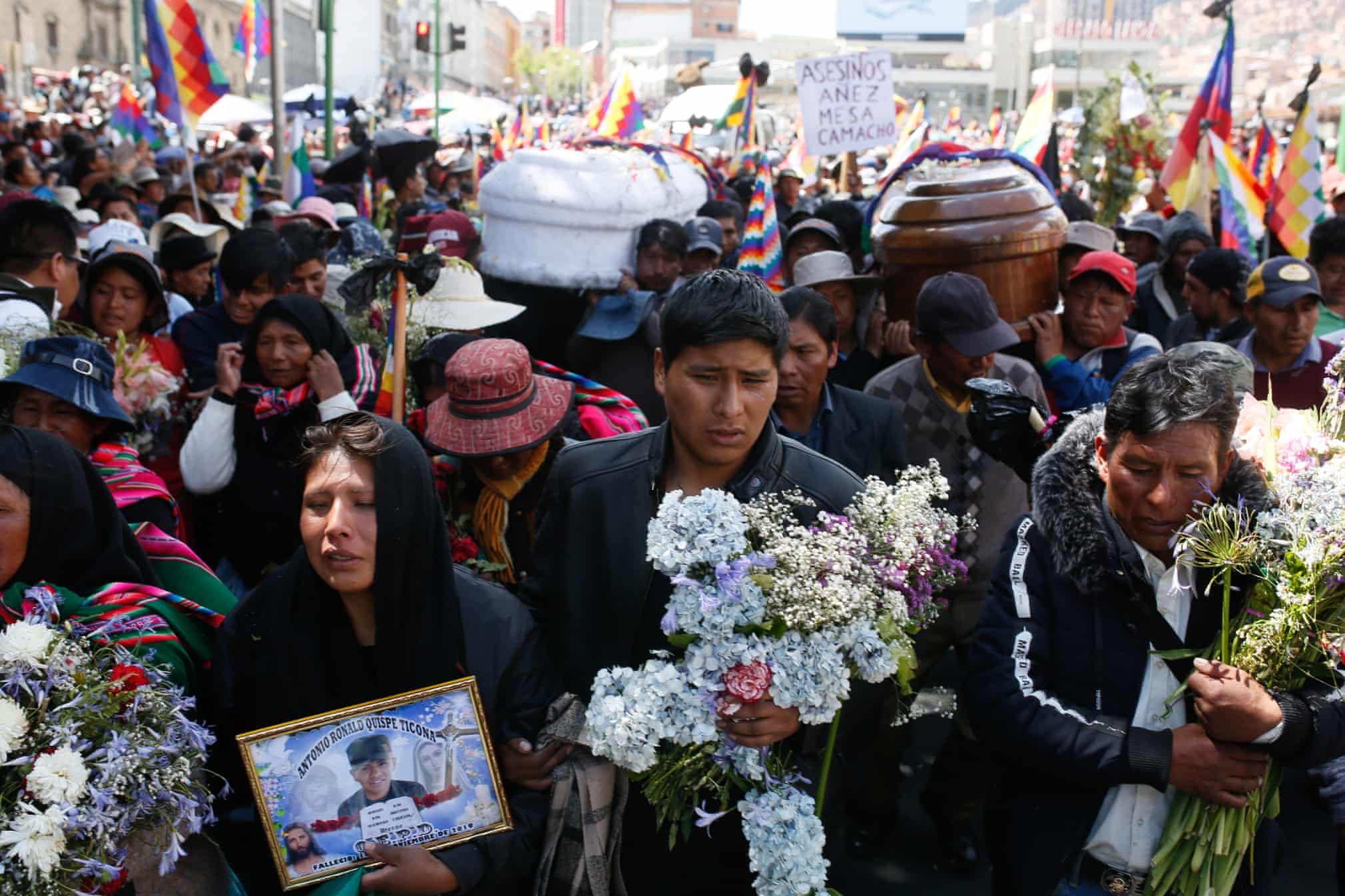
The Inter-American Commission on Human Rights, which visited Bolivia November 22 to 25, has released a visually and emotionally arresting video that highlights the testimony of survivors of the Bolivian government’s massacres of protesters in the town of Sacaba and the El Alto neighborhood of Senkata. The video interweaves survivors’ pleas with crowd shouts for “justice” and does far more to humanize the participants in protests than nearly any coverage in the mainstream Bolivian press. (Click on “CC” for English subtitles, and on “vimeo” to see a larger version.)
The Commission’s report on its visit, currently available only in Spanish, includes extensive discussion of these two massacres. What follows is my translation of a relevant portion of their text:
Massacres and murders
In the context of the crisis, and as of November 27, the IACHR received news of 36 people who lost their lives in Bolivia. During its visit, the IACHR delegation received abundant information about two massacres committed in Sacaba and in Senkata, on November 15 and 19, respectively, in which at least 18 people lost their lives.
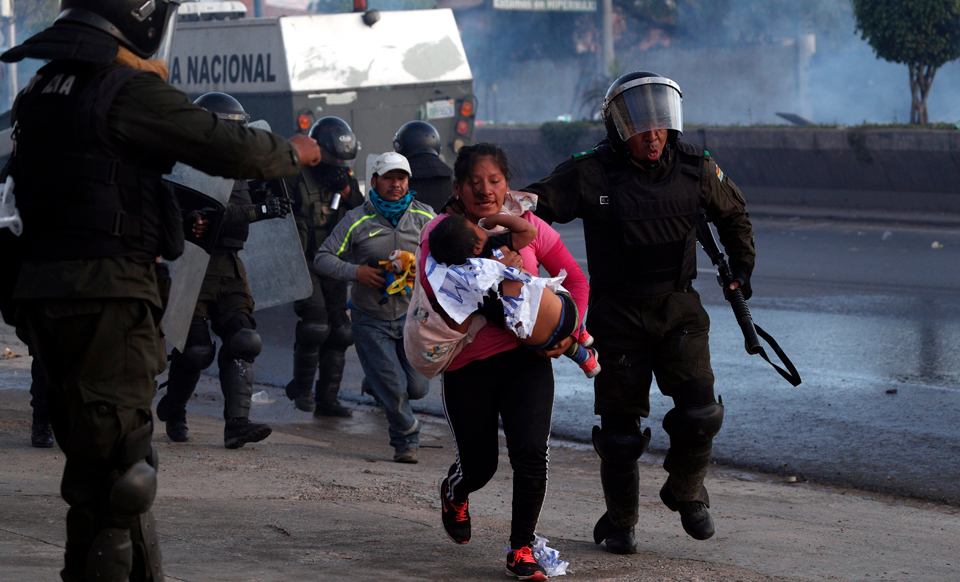
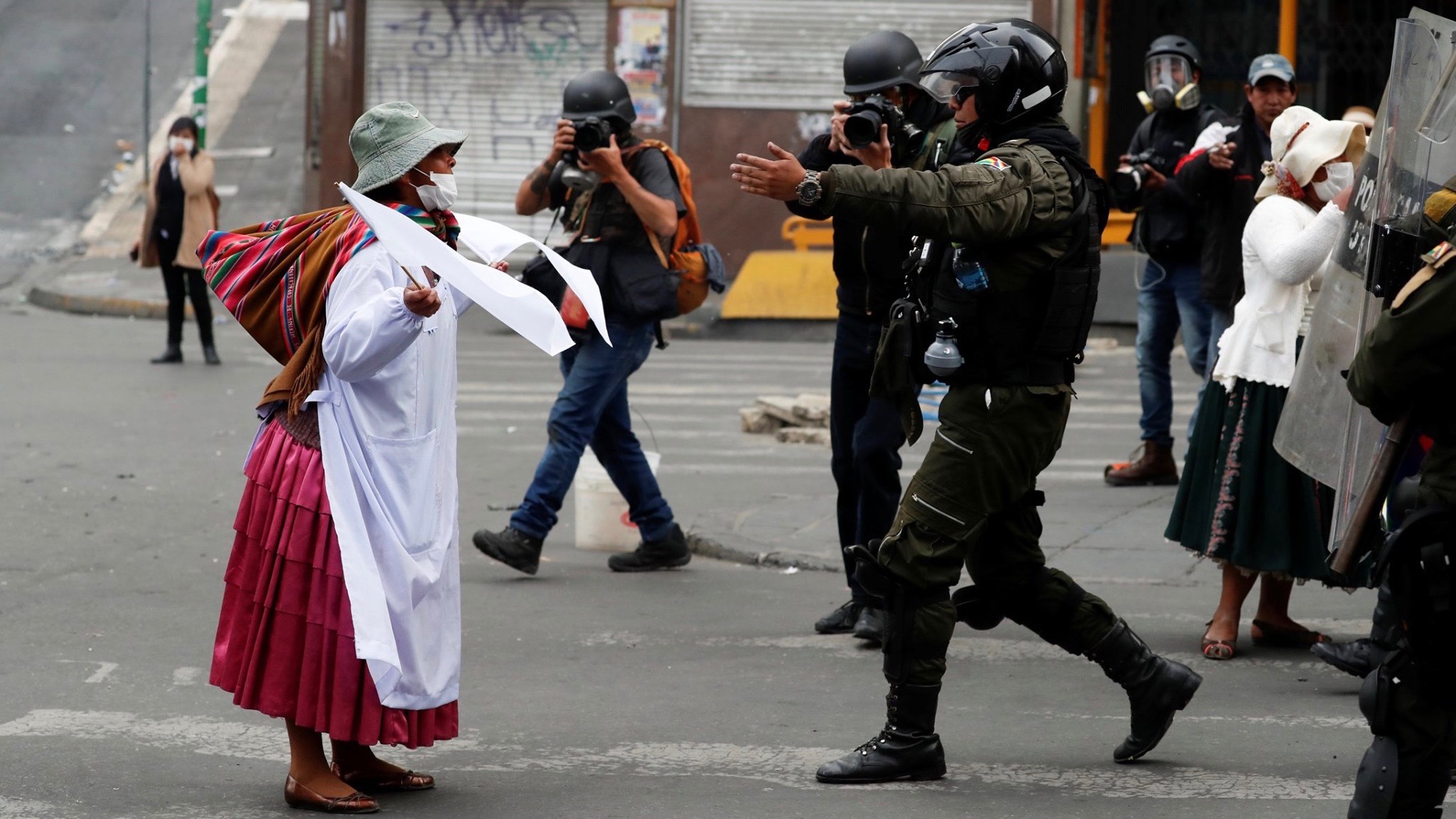
The Sacaba massacre occurred on November 15. The Commission received information from witnesses, according to which members of the Six Federations of the Tropic of Cochabamba arrived in a peaceful demonstration to the Sacaba municipality, demanding the return of Evo Morales to the government and recject the interim government. At the Huayllani bridge, located at kilometer 10 of the highway from Cochabamba, the combined forces of the Police and Armed Forces had established a security cordon. At the moment the demonstrators attempted to pass through, they were first contained and told verbally that the Human Rights Ombudsman’s Office (Defensoría del Pueblo) was on its way to mediate; nevertheless, according to information received, a few moments later the police and military agents would open fire against the civilian population gathered there, which they also would attack with tear gas, beatings, and kicks. In these acts, nine people were killed: Omar Calle, César Sipe, Juan López, Emilio Colque, Lucas Sánchez, Plácido Rojas Delgadillo, Armando Carvallo Escobar, Marco Vargas Martínez, and Roberto Sejas. Numerous people were wounded, including by bullets, who were received by various hospitals in Sacaba and Cochabamba.
The commission takes note of the existence of different versions of how these events unfolded. On one hand, some state authorities, including the Forensic Investigation Unit (Instituto de Investigaciones Forenses; IDIF) and the police command, have accused the demonstrators of having shot one another, proposing reasons such as the caliber of the bullets that were recovered from the bodies of the dead and wounded. On the other hand, the numerous testimonies received by the IACHR are consistent in indicating that the demonstrating people were unarmed, advanced peacefully by their own initiative, and were attacked with fire arms, teargas canisters, batons, and other weapons by the security forces, in a sudden and surprising manner. Security force helicopters participated in the operation, as even the Police Commander of Cochabamba testified before the IACHR.
The Senkata massacre occurred on November 19. According to information received, a group of partisans of the MAS carried out a blockade around the oil and gas plant of the Senkata sector, in El Alto. That morning, sixty container trucks of gasoline and natural gas were allowed to leave the plant, after which the demonstrators had knocked down one of the walls on the perimeter of the plant, at which time they were contained by the firearms of the combined forces of the Police and Army. In these acts, nine people were killed by gunshots: Devi Posto Cusi, Pedro Quisberth Mamani, Edwin Jamachi Paniagua, José Colque Patty, Juan José Tenorio Mamani, Antonio Ronald Quispe, Clemente Mamani Santander, Rudy Cristian Vásquez Condori, and Calixto Huanacu Aguilar. Among those who were killed are several people who do not seem to have participated in the blockade, but rather were simply passing through the zone on the way to their homes or workplaces. There were also numerous people wounded by gunshots, beatings, inhalation of gas, and other related causes, who were attended in various hospitals in El Alto. Just as in the Sacaba massacre, some public functionaries, both forensic and police, have questioned whether the bullets that killed these citizens had been shot by the regulation weapons of the security forces. With respect to that, according to public declarations and those made before the IACHR, insistently reiterated by the victims themselves, these people were publicly demonstrating without violence and were the object of repression by state agents using firearms. There have also been public denunciations of the disappearance over various lifeless bodies of people who had died in the the same massacre, which would have been taken by state agents so that no one would have word of these dead people. In particular, cases of [such disappearances] denounced before the IACHR include that of a peasant woman, and of a girl around 12 years old, among others. The victims of this massacre consistently signal that the number of those killed is much more than the nine that have been reported up to now.
The Inter-American Commission on Human Rights emphatically condemns the massacres of Sacaba and Senkata, in which [the perpetrators] incurred in grave violations of human rights. According to the Commission’s criteria, these acts can be characterized as massacres given the number of people who lost their lives in the same way, time, and place, and because they were committed against a specific group of people. In addition, the patterns of the wounds that have been recorded offer serious indications of practices of extrajudicial execution. The right to life, protected under the American Convention [on Human Rights], is inviolable, and due to its essential character is the precondition for the exercise of all other human rights. The organs of the Inter-American System [of Human Rights] have reiterated that the use of force by the state must be bound by the principles of exceptionality, legality, necessity, and proportionality. As well, the Bolivian state is reminded that lethal force many not be used merely to maintain or re-institute public order; only protection of life itself and physical integrity against imminent and real threats is a legitimate objective for the application of deadly force by state agents. In this sense, the IACHR urges the [Bolivian] state to immediately and urgently implement mechanisms to prohibit and effectively impede the use of lethal force as a control measure for public order in cases of public demonstrations. The Commission also reiterates that firearms and their munitions must be excluded from control operations of social protest, and that police or military functionaries that may enter into contact with a demonstration should not carry fire arms or other lethal weapons. Additionally, the Commission urges the state to rapidly carry out its international obligation to investigate, judge, and sanction those responsible for these criminal acts.
https://woborders.blog/2019/12/19/iachr-sacaba-senkata-massacres/
~ ~ ~




Edit history
Recommendations
0 members have recommended this reply (displayed in chronological order): = new reply since forum marked as read
Highlight:
NoneDon't highlight anything
5 newestHighlight 5 most recent replies
RecommendedHighlight replies with 5 or more recommendations
= new reply since forum marked as read
Highlight:
NoneDon't highlight anything
5 newestHighlight 5 most recent replies
RecommendedHighlight replies with 5 or more recommendations