
Augusto Pinochet Ugarte, 18 September, 1973. Photo credit: Flickr.
| Augusto Pinochet Ugarte | MR OnlineAugusto Pinochet Ugarte, 18 September, 1973. Photo credit: Flickr.
Chile: in memory of Carlos and Pinochet’s caravan of death
Originally published: Resumen: Latinoamericano and the Third World on February 22, 2023 by Ariel Dorfman (more by Resumen: Latinoamericano and the Third World) (Posted Feb 27, 2023)
Every dawn, during my daily walk to the foothills of the Andes, I pass by the Tobalaba Aerodrome, a facility that caters to a wide variety of private aircraft. For most residents of La Reina, the Santiago neighborhood where my wife and I have a home, this is an attractive and benign open space in a congested city, a guarantee that no skyscraper will blur the skyline. For me, in a year marking the 50th anniversary of the coup against the democratically elected government of Salvador Allende, that airport arouses less affable feelings.
It was from there, just weeks after the military uprising of September 11, 1973, that a huge Puma helicopter took off, crammed with Chilean army officers on a mission entrusted to them by General Augusto Pinochet to ensure that Allende supporters who had already been given light sentences by local military courts in the south and north of the country were summarily executed. Among the 97 political prisoners killed by what came to be called the Caravan of Death was a friend of mine, a young communist named Carlos Berger.
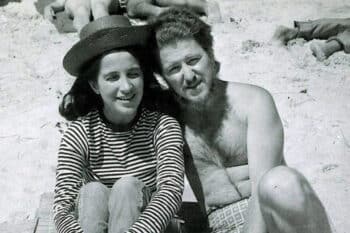
Carlos Berger with his wife Carmen Hertz
Carlos and I had been colleagues at the state publishing house, Quimantú, which published popular magazines and millions of books at very low prices. I remember him as handsome and serious and sometimes mischievous, but above all I remember his intense commitment to the peaceful revolution that Allende had inaugurated when he won the presidency in 1970. The last time we met, Carlos told me, with overflowing emotion, that his wife, Carmen Hertz, had given birth to a son, Germán, who would grow up, he added, in a country without exploitation, without injustice. Carlos himself was leaving Santiago to run a radio station in Calama, known as the Mining Capital of Chile. He could not have known that this move to the north of the country would mean, at the age of thirty, his death sentence.
Despite not having offered violent resistance to the coup, he was sentenced to 70 days in prison, a sentence that had been commuted to a fine. He was then about to be released when the Caravan of Death arrived in that Puma helicopter, with a lethal result: on October 19, Carlos and 25 other political prisoners were loaded, hooded, onto a truck that was lost in the wastelands of the Atacama Desert, where their guts were eviscerated with corvos before they were shot at point-blank range. The mutilated corpses were buried under the anonymous sands of that place, the driest in the world.
Years later, this tragedy would claim new victims. Carlos’ parents, Julio and Dora, ended up committing suicide. As for Carlos’ remains, his widow Carmen had to wait until 2014 for a mock funeral to be held, when forensic scientists identified some small human fragments found in a dune as belonging to the missing husband.
More:
https://mronline.org/2023/02/27/chile-in-memory-of-carlos-and-pinochets-caravan-of-death/


 = new reply since forum marked as read