Welcome to DU!
The truly grassroots left-of-center political community where regular people, not algorithms, drive the discussions and set the standards.
Join the community:
Create a free account
Support DU (and get rid of ads!):
Become a Star Member
Latest Breaking News
Editorials & Other Articles
General Discussion
The DU Lounge
All Forums
Issue Forums
Culture Forums
Alliance Forums
Region Forums
Support Forums
Help & Search
Economy
In reply to the discussion: Weekend Economists Waiting for FDR July 13-15, 2012 [View all]Demeter
(85,373 posts)38. America’s Broken Jobs Engine
http://www.nakedcapitalism.com/2012/07/americas-broken-jobs-engine.html?utm_source=feedburner&utm_medium=email&utm_campaign=Feed%3A+NakedCapitalism+%28naked+capitalism%29
...........................
As for the June employment figures, the internals provided by the household survey were more dismal than the headline number. The net source of job growth was the 16-19 year-old cohort (even after seasonal adjustment that corrects for normal summer hiring). Employment among workers over 20 years of age actually fell, with a 136,000 plunge in the 25-54 year-old cohort offset by gains in the number of workers over the age of 55. Among those counted as employed, 277,000 workers shifted to the classification “Part-time for economic reasons: slack work or business conditions.”
But as much as analysts desperately pour over the entrails of new data to make prognostications, it seems that many forecasters keep making comparisons to past recoveries, when typical recessions are inventory-driven (more than 100% of the change in GDP is change in inventories). As we are often reminded, the aftermath of a financial crisis, particularly a global financial crisis with a concerted effort to protect banks, is a very different beast. Some analysts do incorporate that perspective, but they still seem to be in the minority. “This time it’s different” is much more popular on the upside than downside...
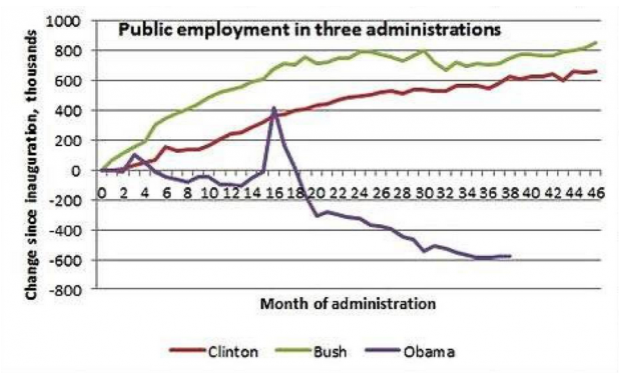
...increasingly, when I see the Wall Street Journal interview the owner/operators of small or medium-sized businesses, a surprising number display contempt towards workers (you’ll see it particularly when they complain that they can’t find enough good workers, which in the overwhelming majority of cases means they aren’t willing to pay up for the sort of people they’d like to hire). There is similarly more than a bit of inside the Beltway detachment from what is happening in the heartlands, in part due to the fact that the DC area is holding up well thanks to the rising tide of lobbyist dollars. For instance, I recall Gene Sperling making the case that the Administration had created a lot of good middle class jobs, and I realized there was something discordant about his remarks. I realized later that Sperling’s “middle class” was an abstraction, people like construction workers, not the sort he really knew personally. And the Administration’s has not only failed to offset the shrinkage of state and local positions, it’s managed to destroy jobs all on its own. This chart is from Warren Mosler (hat tip Cullen Roche):
...Readers are welcome to disagree, but our high unemployment isn’t just due to the aftermath of a global financial crisis. Japan went for a model of shared sacrifice. Top executives and middle managers, who weren’t all that well paid to begin with, took wage cuts in order to preserve jobs. By contrast, we’d seen CEO (and presumably C level pay with it) rise even as the economy has flagged. If jobs were seen as the glue of society, as they are in Japan, there would be more pressure on executives and government officials to be doing more to provide work for ordinary citizens. The current unemployment rate at least in part reflects a tacit acceptance of a new order, one that is not to our collective advantage, and that deserves to be challenged.
...........................
As for the June employment figures, the internals provided by the household survey were more dismal than the headline number. The net source of job growth was the 16-19 year-old cohort (even after seasonal adjustment that corrects for normal summer hiring). Employment among workers over 20 years of age actually fell, with a 136,000 plunge in the 25-54 year-old cohort offset by gains in the number of workers over the age of 55. Among those counted as employed, 277,000 workers shifted to the classification “Part-time for economic reasons: slack work or business conditions.”
But as much as analysts desperately pour over the entrails of new data to make prognostications, it seems that many forecasters keep making comparisons to past recoveries, when typical recessions are inventory-driven (more than 100% of the change in GDP is change in inventories). As we are often reminded, the aftermath of a financial crisis, particularly a global financial crisis with a concerted effort to protect banks, is a very different beast. Some analysts do incorporate that perspective, but they still seem to be in the minority. “This time it’s different” is much more popular on the upside than downside...
...increasingly, when I see the Wall Street Journal interview the owner/operators of small or medium-sized businesses, a surprising number display contempt towards workers (you’ll see it particularly when they complain that they can’t find enough good workers, which in the overwhelming majority of cases means they aren’t willing to pay up for the sort of people they’d like to hire). There is similarly more than a bit of inside the Beltway detachment from what is happening in the heartlands, in part due to the fact that the DC area is holding up well thanks to the rising tide of lobbyist dollars. For instance, I recall Gene Sperling making the case that the Administration had created a lot of good middle class jobs, and I realized there was something discordant about his remarks. I realized later that Sperling’s “middle class” was an abstraction, people like construction workers, not the sort he really knew personally. And the Administration’s has not only failed to offset the shrinkage of state and local positions, it’s managed to destroy jobs all on its own. This chart is from Warren Mosler (hat tip Cullen Roche):
...Readers are welcome to disagree, but our high unemployment isn’t just due to the aftermath of a global financial crisis. Japan went for a model of shared sacrifice. Top executives and middle managers, who weren’t all that well paid to begin with, took wage cuts in order to preserve jobs. By contrast, we’d seen CEO (and presumably C level pay with it) rise even as the economy has flagged. If jobs were seen as the glue of society, as they are in Japan, there would be more pressure on executives and government officials to be doing more to provide work for ordinary citizens. The current unemployment rate at least in part reflects a tacit acceptance of a new order, one that is not to our collective advantage, and that deserves to be challenged.
Edit history
Please sign in to view edit histories.
Recommendations
0 members have recommended this reply (displayed in chronological order):
69 replies
 = new reply since forum marked as read
Highlight:
NoneDon't highlight anything
5 newestHighlight 5 most recent replies
RecommendedHighlight replies with 5 or more recommendations
= new reply since forum marked as read
Highlight:
NoneDon't highlight anything
5 newestHighlight 5 most recent replies
RecommendedHighlight replies with 5 or more recommendations
= new reply since forum marked as read
Highlight:
NoneDon't highlight anything
5 newestHighlight 5 most recent replies
RecommendedHighlight replies with 5 or more recommendations
Corporations Dodge LIBOR Scandal Bullet: It’s banks and hedge funds that look like the losers.
Demeter
Jul 2012
#34
Unfortunately, they're probabaly right that it'll take a long time to sort out the consequences; but
snot
Jul 2012
#59
How Out-of-Control Credit Markets Threaten Liberty, Democracy and Economic Security By Ed Harrison
Demeter
Jul 2012
#30
The Great Capitalist Heist: How Paris Hilton’s Dogs Ended Up Better Off Than You
Demeter
Jul 2012
#35
Another "this should be a separate thread", and what of the outcome for this repeat? I'd love to
mother earth
Jul 2012
#39