Welcome to DU!
The truly grassroots left-of-center political community where regular people, not algorithms, drive the discussions and set the standards.
Join the community:
Create a free account
Support DU (and get rid of ads!):
Become a Star Member
Latest Breaking News
Editorials & Other Articles
General Discussion
The DU Lounge
All Forums
Issue Forums
Culture Forums
Alliance Forums
Region Forums
Support Forums
Help & Search
Economy
In reply to the discussion: STOCK MARKET WATCH -- Wednesday, 26 December 2012 [View all]
xchrom
(108,903 posts)34. Germany's austerity plans will beggar Europe
http://www.guardian.co.uk/commentisfree/2012/dec/26/germany-austerity-beggar-europe-eurozone
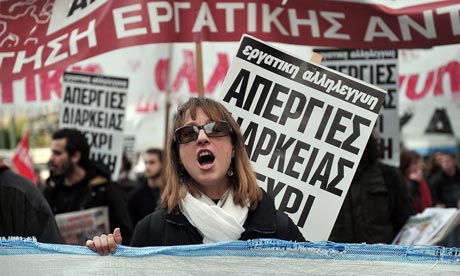
Greeks protest against austerity measures outside the parliament in Athens. Photograph: Louisa Gouliamaki/AFP/Getty Images
Has the eurozone crisis ended? Many politicians in Europe, including France's president François Hollande, seem to think so. Well, not so fast. Far from ending, the crisis is yet to reach its most difficult phase.
It is easy to see why politicians claim the crisis is over. Greece has just been promised another €50bn, provided it accepts still more austerity, deregulation and privatisation. Elsewhere in the periphery, Ireland is in its sixth year of recession, Portugal is heading for major economic contraction, and Spain is going from bad to worse – but their governments are imposing austerity, and people appear to be putting up with it. Even core countries, including Italy and France, have accepted the need for balanced budgets. Across the eurozone, there is no effective opposition to the mantra of austerity emanating from Berlin.
The financial markets, meanwhile, have been placid since September when Mario Draghi, chairman of the European Central Bank, announced that he would buy the debt of countries in difficulties provided they accepted bailout conditions. The spreads on Italian and Spanish debt have tumbled by 250 basis points. The official launch of the European Stability Mechanism has also helped, since the ESM is fortified with €500bn. The calculation of bond markets is transparent: for the moment it is not profitable to borrow money to speculate against the debt of weaker European countries.
But austerity and calmer financial markets do not amount to ending the crisis. Rather, they point to the emergence of a German eurozone. Commentators who have protested that crisis leadership in the eurozone has been weak have been wide of the mark. In practice, austerity is transforming the periphery into a vast East Germany: a zone of weak growth, low wages, poverty and no economic dynamism. There will not even be some of the fiscal transfers, amounting to perhaps €60bn annually, that have supported East Germany.
Greeks protest against austerity measures outside the parliament in Athens. Photograph: Louisa Gouliamaki/AFP/Getty Images
Has the eurozone crisis ended? Many politicians in Europe, including France's president François Hollande, seem to think so. Well, not so fast. Far from ending, the crisis is yet to reach its most difficult phase.
It is easy to see why politicians claim the crisis is over. Greece has just been promised another €50bn, provided it accepts still more austerity, deregulation and privatisation. Elsewhere in the periphery, Ireland is in its sixth year of recession, Portugal is heading for major economic contraction, and Spain is going from bad to worse – but their governments are imposing austerity, and people appear to be putting up with it. Even core countries, including Italy and France, have accepted the need for balanced budgets. Across the eurozone, there is no effective opposition to the mantra of austerity emanating from Berlin.
The financial markets, meanwhile, have been placid since September when Mario Draghi, chairman of the European Central Bank, announced that he would buy the debt of countries in difficulties provided they accepted bailout conditions. The spreads on Italian and Spanish debt have tumbled by 250 basis points. The official launch of the European Stability Mechanism has also helped, since the ESM is fortified with €500bn. The calculation of bond markets is transparent: for the moment it is not profitable to borrow money to speculate against the debt of weaker European countries.
But austerity and calmer financial markets do not amount to ending the crisis. Rather, they point to the emergence of a German eurozone. Commentators who have protested that crisis leadership in the eurozone has been weak have been wide of the mark. In practice, austerity is transforming the periphery into a vast East Germany: a zone of weak growth, low wages, poverty and no economic dynamism. There will not even be some of the fiscal transfers, amounting to perhaps €60bn annually, that have supported East Germany.
Edit history
Please sign in to view edit histories.
Recommendations
0 members have recommended this reply (displayed in chronological order):
50 replies
 = new reply since forum marked as read
Highlight:
NoneDon't highlight anything
5 newestHighlight 5 most recent replies
RecommendedHighlight replies with 5 or more recommendations
= new reply since forum marked as read
Highlight:
NoneDon't highlight anything
5 newestHighlight 5 most recent replies
RecommendedHighlight replies with 5 or more recommendations
= new reply since forum marked as read
Highlight:
NoneDon't highlight anything
5 newestHighlight 5 most recent replies
RecommendedHighlight replies with 5 or more recommendations
Prof.Krassimir Petrov, econ., finance: US, Ireland, Bulgaria, Saudi Arabia, Bahrain, Taiwan, Macau
Demeter
Dec 2012
#2
Hospital ‘Facility Fees’ Boosting Medical Bills, and Not Just For Hospital Care By Fred Schulte
Demeter
Dec 2012
#7
NPR - Wall Street Wiretaps: Investigators Use Insiders' Own Words To Convict Them
DemReadingDU
Dec 2012
#33
OMFG - Starbuck's CEO "urging" workers to support "Fix the Debt" campaign
bread_and_roses
Dec 2012
#45