Welcome to DU!
The truly grassroots left-of-center political community where regular people, not algorithms, drive the discussions and set the standards.
Join the community:
Create a free account
Support DU (and get rid of ads!):
Become a Star Member
Latest Breaking News
Editorials & Other Articles
General Discussion
The DU Lounge
All Forums
Issue Forums
Culture Forums
Alliance Forums
Region Forums
Support Forums
Help & Search
Economy
In reply to the discussion: Weekend Economists Host a Lion July 5-7, 2013 [View all]Demeter
(85,373 posts)16. Deflation By Any Other Name Would Smell As Foul AUTOMATIC EARTH
http://www.theautomaticearth.com/Finance/deflation-by-any-other-name-would-smell-as-foul.html
Over the past two weeks or so, we've been seeing a very clear portrait of how sick our economies are. Not that you would know it from reading the press. The term deflation pops up only very cautiously. Could that be because people don't understand what's going on? Or are they simply afraid of the word? This is the real thing, guys. And it's going to hurt. Money (actually: credit) has shifted out of emerging markets by the trillions. So where did it go? Not into bonds, stocks or precious metals. Money shifted out of there too, and also by the trillions. Money isn't going anywhere, it's going "poof". It's vanishing and will never be seen again.
Markets may still rise at times to some extent, but only if and when more stimulus is flooded into the system, or people think it will be. Markets have simply been undead for the past 5 years - or so -, as long as central banks have issued stimulus. Take that away and all you're left with is zombies. And even if markets rise, or "normalize", a little in the future, this genie's out of the bottle and won't get back in: bond yields and interest rates will not go back to the extremely low levels of the past few years. Central banks' longer term control of either has always been no more than an illusion. And as for another illusion: you can't call something a "recovery" if you pay for it with more debt, that doesn't make nearly enough sense.
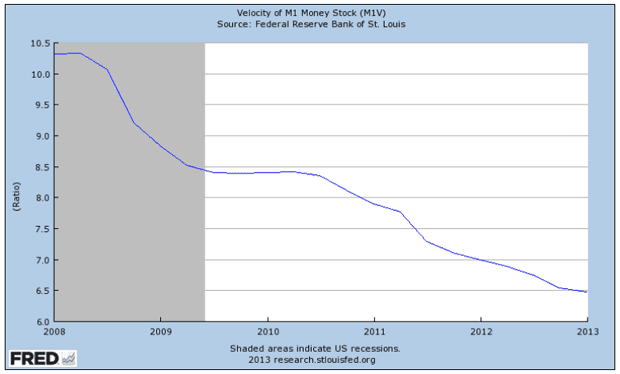
People think they can find the reason behind the vanishing trillions in money/credit in things Ben Bernanke may or may not have said, and perhaps in a hard stance by the Chinese central bank. But they are merely small parts of a bigger story. The problem is not that the Fed hints at tapering, it's that the US economy is too sick to stand up straight without constant and/or increasing credit infusions. A zombie economy propped up with zombie money. And that can't last. It never could. Nothing Ben does, whether it's issuing stimulus or hinting at less stimulus, represents real value. And that, to many people focused on the illusion of value, may have become clear only when Abenomics appeared on stage, seemed a success at first and then showed its true colors in a substantial Nikkei crash. Abenomics is the Fed's QE on steroids; both follow the same trajectory, but it's a matter of the harder they come, the harder they fall. Japan wanted too much too fast, and ended up shattering the stimulus illusion worldwide...How much money/credit has evaporated into thin air in the last few weeks? It's impossible to even estimate, and nobody's trying, maybe because of a fear of some kind, but it's certainly multiple trillions. A Reuters article over the weekend stated that "global equity markets lost $1 trillion on Thursday alone". And Thursday was by no means the worst of the lot. The biggest losses have come not in stock markets, but in the bond markets, and these losses will continue. Not only did central banks never have control here, what's crucial is that nobody believes anymore that they have...Perhaps the clearest, most down to earth and black and white illustration of deflation comes from two graphs that Ambrose Evans-Pritchard posted overnight . Remember, deflation does not equal falling prices, they're just a consequence. Deflation is the combination of the money and credit supply with the velocity of money. We know what that means for Japan, where velocity is extremely low, and PM Abe finds out that he can try to increase the money supply, but he has no control over the velocity. Here are M1 and velocity for the US: -

- See more at: http://www.theautomaticearth.com/Finance/deflation-by-any-other-name-would-smell-as-foul.html#sthash.075seJHR.dpuf
Over the past two weeks or so, we've been seeing a very clear portrait of how sick our economies are. Not that you would know it from reading the press. The term deflation pops up only very cautiously. Could that be because people don't understand what's going on? Or are they simply afraid of the word? This is the real thing, guys. And it's going to hurt. Money (actually: credit) has shifted out of emerging markets by the trillions. So where did it go? Not into bonds, stocks or precious metals. Money shifted out of there too, and also by the trillions. Money isn't going anywhere, it's going "poof". It's vanishing and will never be seen again.
Markets may still rise at times to some extent, but only if and when more stimulus is flooded into the system, or people think it will be. Markets have simply been undead for the past 5 years - or so -, as long as central banks have issued stimulus. Take that away and all you're left with is zombies. And even if markets rise, or "normalize", a little in the future, this genie's out of the bottle and won't get back in: bond yields and interest rates will not go back to the extremely low levels of the past few years. Central banks' longer term control of either has always been no more than an illusion. And as for another illusion: you can't call something a "recovery" if you pay for it with more debt, that doesn't make nearly enough sense.
People think they can find the reason behind the vanishing trillions in money/credit in things Ben Bernanke may or may not have said, and perhaps in a hard stance by the Chinese central bank. But they are merely small parts of a bigger story. The problem is not that the Fed hints at tapering, it's that the US economy is too sick to stand up straight without constant and/or increasing credit infusions. A zombie economy propped up with zombie money. And that can't last. It never could. Nothing Ben does, whether it's issuing stimulus or hinting at less stimulus, represents real value. And that, to many people focused on the illusion of value, may have become clear only when Abenomics appeared on stage, seemed a success at first and then showed its true colors in a substantial Nikkei crash. Abenomics is the Fed's QE on steroids; both follow the same trajectory, but it's a matter of the harder they come, the harder they fall. Japan wanted too much too fast, and ended up shattering the stimulus illusion worldwide...How much money/credit has evaporated into thin air in the last few weeks? It's impossible to even estimate, and nobody's trying, maybe because of a fear of some kind, but it's certainly multiple trillions. A Reuters article over the weekend stated that "global equity markets lost $1 trillion on Thursday alone". And Thursday was by no means the worst of the lot. The biggest losses have come not in stock markets, but in the bond markets, and these losses will continue. Not only did central banks never have control here, what's crucial is that nobody believes anymore that they have...Perhaps the clearest, most down to earth and black and white illustration of deflation comes from two graphs that Ambrose Evans-Pritchard posted overnight . Remember, deflation does not equal falling prices, they're just a consequence. Deflation is the combination of the money and credit supply with the velocity of money. We know what that means for Japan, where velocity is extremely low, and PM Abe finds out that he can try to increase the money supply, but he has no control over the velocity. Here are M1 and velocity for the US: -
- See more at: http://www.theautomaticearth.com/Finance/deflation-by-any-other-name-would-smell-as-foul.html#sthash.075seJHR.dpuf
Edit history
Please sign in to view edit histories.
Recommendations
0 members have recommended this reply (displayed in chronological order):
61 replies
 = new reply since forum marked as read
Highlight:
NoneDon't highlight anything
5 newestHighlight 5 most recent replies
RecommendedHighlight replies with 5 or more recommendations
= new reply since forum marked as read
Highlight:
NoneDon't highlight anything
5 newestHighlight 5 most recent replies
RecommendedHighlight replies with 5 or more recommendations
= new reply since forum marked as read
Highlight:
NoneDon't highlight anything
5 newestHighlight 5 most recent replies
RecommendedHighlight replies with 5 or more recommendations
So far the only compelling argument I've heard that in fact comprehensive public surveillance is true
Hugin
Jul 2013
#20
Taxpayer money where someone somewhere is making a 20% guaranteed profit for doing nothing.
Hugin
Jul 2013
#47
What Did These Idiots Think Would Happen If We Hired Contractors To Handle Spying?
Demeter
Jul 2013
#27
Other than people who read forums, who pays attention to what is going on anyway?
DemReadingDU
Jul 2013
#35
Crisis Chronicles: 300 Years of Financial Crises (1620–1920) James Narron and David Skeie
Demeter
Jul 2013
#15
Ex-official: CIA Helped Jail Mandela By Joseph Albright and Marcia Kunstel, Cox News Service.
Demeter
Jul 2013
#41
What's it going to take to get most Americans in the streets like in Egypt, or Turkey, or Brazil
DemReadingDU
Jul 2013
#60