Welcome to DU!
The truly grassroots left-of-center political community where regular people, not algorithms, drive the discussions and set the standards.
Join the community:
Create a free account
Support DU (and get rid of ads!):
Become a Star Member
Latest Breaking News
Editorials & Other Articles
General Discussion
The DU Lounge
All Forums
Issue Forums
Culture Forums
Alliance Forums
Region Forums
Support Forums
Help & Search
Economy
In reply to the discussion: STOCK MARKET WATCH - Friday, 27 January 2012 [View all]Demeter
(85,373 posts)13. Philip Pilkington: ‘Does Capitalism Have a Future?’
Philip Pilkington: ‘Does Capitalism Have a Future?’ – Why the Financial Times Asks All the Wrong Questions to Avoid the Real Issues
http://www.nakedcapitalism.com/2012/01/philip-pilkington-%E2%80%98does-capitalism-have-a-future%E2%80%99-%E2%80%93-why-the-financial-times-asks-all-the-wrong-questions-to-avoid-the-real-issues.html
...During the Great Depression – indeed, even after WWI – there was a serious alternative to capitalism. During the depression years the Soviet economy, under Stalin’s iron fist, was moving briskly, if brutally toward development and increased growth. Should social forces have begun to move in this direction in the West the elites had a ‘panic button’ that they could push. They could, if they were so inclined, move toward instituting a fascist system. Hitlerite economic policies – a peacetime Keynesianism never before or since matched in the Western world – were remarkably successfully and had largely warded off the German depression by 1936. Unpalatable as it may have been to many it was certainly looming in the background in the 1930s – and should the spectre of Communism have truly risen the elite would probably have reluctantly moved in this direction rather than see themselves expropriated (and perhaps not so reluctantly, since Hitler had quite a few fans in the British upper class prior to 1939). Figures such as Henry Ford in the US were keenly aware of what might have to be done to maintain the order of things in the event of large-scale social unrest.
Yes, this was a very different time; real and seemingly viable challenges to capitalism existed. No such challenges exist today...Various commentators run pieces that are… well… largely irrelevant. They assure us that capitalism will survive because there are no alternatives...realistically where is the Western capitalist system headed? Because this is a question that is as important as it is answerable.
...There’s a myth that goes around Keynesian and progressive circles that runs something like this: In November 1932, after three years of failed austerity policies by President Herbert Hoover, Franklin Delano Roosevelt was elected. FDR increased government spending, ushered in the New Deal era of Big Government and created America’s welfare state. These developments gave rise to a new sort of mixed economy that was to prove immune from depressions until it came under stress in the 1970s thanks to Vietnam-induced deficit spending and was taken apart by Reagan and the nefarious financial industry starting in 1980s.
Nice story. Pity it’s not remotely true. If one looks at the actual history one finds that FDR’s anti-depression policies were a palliative at best. Roosevelt was terrified of unbalancing the budget too much and hostile to Keynes’ actual ideas. Indeed, after meeting FDR Keynes commented that he hoped the man would be better versed in economics. In 1937 FDR became scared of the unbalanced budget and withdrew spending – leading, predictably, to a massive recession. FDR’s public works programs were excellent, far beyond anything a US president seems capable of today. And he took a lot of flak from the business community for initiating them. But they did not open the deficits nearly enough to pull the economy out of recession. Just look at the actual deficits run by the FDR administration in the 1930s – they were smaller than the today’s deficits! In truth – and as the shrewd reader will already have seen clearly in the above graph – it was WWII that ended the depression. WWII gave politicians and policymakers the gall to unbalance the budget sufficiently to restore the economy. It also gave them the space to rejig the taxation system in a way that made it far more sustainable. If anyone objected, well, they were moving against the war effort, anti-patriotic and hence excluded from the debate.
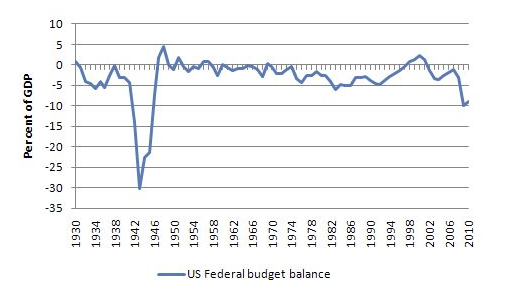
MORE HISTORY AND ANALYSIS AT LINK...GOOD READ AND RESOURCE
http://www.nakedcapitalism.com/2012/01/philip-pilkington-%E2%80%98does-capitalism-have-a-future%E2%80%99-%E2%80%93-why-the-financial-times-asks-all-the-wrong-questions-to-avoid-the-real-issues.html
...During the Great Depression – indeed, even after WWI – there was a serious alternative to capitalism. During the depression years the Soviet economy, under Stalin’s iron fist, was moving briskly, if brutally toward development and increased growth. Should social forces have begun to move in this direction in the West the elites had a ‘panic button’ that they could push. They could, if they were so inclined, move toward instituting a fascist system. Hitlerite economic policies – a peacetime Keynesianism never before or since matched in the Western world – were remarkably successfully and had largely warded off the German depression by 1936. Unpalatable as it may have been to many it was certainly looming in the background in the 1930s – and should the spectre of Communism have truly risen the elite would probably have reluctantly moved in this direction rather than see themselves expropriated (and perhaps not so reluctantly, since Hitler had quite a few fans in the British upper class prior to 1939). Figures such as Henry Ford in the US were keenly aware of what might have to be done to maintain the order of things in the event of large-scale social unrest.
Yes, this was a very different time; real and seemingly viable challenges to capitalism existed. No such challenges exist today...Various commentators run pieces that are… well… largely irrelevant. They assure us that capitalism will survive because there are no alternatives...realistically where is the Western capitalist system headed? Because this is a question that is as important as it is answerable.
...There’s a myth that goes around Keynesian and progressive circles that runs something like this: In November 1932, after three years of failed austerity policies by President Herbert Hoover, Franklin Delano Roosevelt was elected. FDR increased government spending, ushered in the New Deal era of Big Government and created America’s welfare state. These developments gave rise to a new sort of mixed economy that was to prove immune from depressions until it came under stress in the 1970s thanks to Vietnam-induced deficit spending and was taken apart by Reagan and the nefarious financial industry starting in 1980s.
Nice story. Pity it’s not remotely true. If one looks at the actual history one finds that FDR’s anti-depression policies were a palliative at best. Roosevelt was terrified of unbalancing the budget too much and hostile to Keynes’ actual ideas. Indeed, after meeting FDR Keynes commented that he hoped the man would be better versed in economics. In 1937 FDR became scared of the unbalanced budget and withdrew spending – leading, predictably, to a massive recession. FDR’s public works programs were excellent, far beyond anything a US president seems capable of today. And he took a lot of flak from the business community for initiating them. But they did not open the deficits nearly enough to pull the economy out of recession. Just look at the actual deficits run by the FDR administration in the 1930s – they were smaller than the today’s deficits! In truth – and as the shrewd reader will already have seen clearly in the above graph – it was WWII that ended the depression. WWII gave politicians and policymakers the gall to unbalance the budget sufficiently to restore the economy. It also gave them the space to rejig the taxation system in a way that made it far more sustainable. If anyone objected, well, they were moving against the war effort, anti-patriotic and hence excluded from the debate.
MORE HISTORY AND ANALYSIS AT LINK...GOOD READ AND RESOURCE
Edit history
Please sign in to view edit histories.
Recommendations
0 members have recommended this reply (displayed in chronological order):
69 replies
 = new reply since forum marked as read
Highlight:
NoneDon't highlight anything
5 newestHighlight 5 most recent replies
RecommendedHighlight replies with 5 or more recommendations
= new reply since forum marked as read
Highlight:
NoneDon't highlight anything
5 newestHighlight 5 most recent replies
RecommendedHighlight replies with 5 or more recommendations
= new reply since forum marked as read
Highlight:
NoneDon't highlight anything
5 newestHighlight 5 most recent replies
RecommendedHighlight replies with 5 or more recommendations
The MF Global Bankruptcy Filing: Did the Regulators Sell Out the Public for JP Morgan?
Demeter
Jan 2012
#3
$175 Billion in Loan Losses Not Allocated to Mortgage Backed Securities (Another $300 Billion TO GO)
Demeter
Jan 2012
#9
Tom Ferguson on SOTU: New Financial Fraud Commision Could Actually Slow Down Investigations
Demeter
Jan 2012
#12
Without an educated populace, would the Occupation have come out the way it did?
Demeter
Jan 2012
#47