Welcome to DU!
The truly grassroots left-of-center political community where regular people, not algorithms, drive the discussions and set the standards.
Join the community:
Create a free account
Support DU (and get rid of ads!):
Become a Star Member
Latest Breaking News
Editorials & Other Articles
General Discussion
The DU Lounge
All Forums
Issue Forums
Culture Forums
Alliance Forums
Region Forums
Support Forums
Help & Search
Weekend Economists Examine (E)sc(h)atology January 24-26, 2014 [View all]
WEE are What?

...Karl Quilter spent much of his life carefully and painstakingly sculpting out of clay the mold for what would eventually be cast into the golden angel perched atop The Church of Jesus Christ of Latter-day Saints temples. All but an estimated 10 or so Angel Moroni sculptures on temples worldwide are Quilter’s work, said his daughter, Elizabeth Quilter Finlinson...
http://www.huffingtonpost.com/2013/12/03/karl-a-quilter-dead_n_4378019.html

This beautiful grieving angel, draped over the grave of Emelyn Story, was the last work of her husband, the American sculptor, William W. Story, created in 1895 in her memory in the same year of her death.
Eschatology is a part of theology concerned with what are believed to be the final events of history, or the ultimate destiny of humanity. This concept is commonly referred to as the "end of the world" or "end time".
The word arises from the Greek ἔσχατος/ἐσχάτη/ἔσχατον, eschatos/eschatē/eschaton meaning "last" and -logy meaning "the study of", first used in English around 1550. The Oxford English Dictionary defines eschatology as "The department of theological science concerned with ‘the four last things: death, judgment, heaven and hell’."
In the context of mysticism, the phrase refers metaphorically to the end of ordinary reality and reunion with the Divine. In many religions it is taught as an existing future event prophesied in sacred texts or folklore. More broadly, eschatology may encompass related concepts such as the Messiah or Messianic Age, the end time, and the end of days.
History is often divided into "ages" (Gk. aeons), which are time periods each with certain commonalities. One age comes to an end and a new age, where different realities are present, begins. When such transitions from one age to another are the subject of eschatological discussion, the phrase, "end of the world", is replaced by "end of the age", "end of an era", or "end of life as we know it". Much apocalyptic fiction does not deal with the "end of time" but rather with the end of a certain period of time, the end of life as it is now, and the beginning of a new period of time. It is usually a crisis that brings an end to current reality and ushers in a new way of living, thinking, or being. This crisis may take the form of the intervention of a deity in history, a war, a change in the environment, or the reaching of a new level of consciousness.
Most modern eschatology and apocalypticism, both religious and secular, involve the violent disruption or destruction of the world; whereas Christian and Jewish eschatologies view the end times as the consummation or perfection of God's creation of the world. For example, according to ancient Hebrew belief, life takes a linear (and not cyclical) path; the world began with God and is constantly headed toward God’s final goal for creation, which is the world to come.
Eschatologies vary as to their degree of optimism or pessimism about the future. In some eschatologies, conditions are better for some and worse for others, e.g. "heaven and hell"...
Not to be confused with Scatology....
http://en.wikipedia.org/wiki/Eschatology
The word arises from the Greek ἔσχατος/ἐσχάτη/ἔσχατον, eschatos/eschatē/eschaton meaning "last" and -logy meaning "the study of", first used in English around 1550. The Oxford English Dictionary defines eschatology as "The department of theological science concerned with ‘the four last things: death, judgment, heaven and hell’."
In the context of mysticism, the phrase refers metaphorically to the end of ordinary reality and reunion with the Divine. In many religions it is taught as an existing future event prophesied in sacred texts or folklore. More broadly, eschatology may encompass related concepts such as the Messiah or Messianic Age, the end time, and the end of days.
History is often divided into "ages" (Gk. aeons), which are time periods each with certain commonalities. One age comes to an end and a new age, where different realities are present, begins. When such transitions from one age to another are the subject of eschatological discussion, the phrase, "end of the world", is replaced by "end of the age", "end of an era", or "end of life as we know it". Much apocalyptic fiction does not deal with the "end of time" but rather with the end of a certain period of time, the end of life as it is now, and the beginning of a new period of time. It is usually a crisis that brings an end to current reality and ushers in a new way of living, thinking, or being. This crisis may take the form of the intervention of a deity in history, a war, a change in the environment, or the reaching of a new level of consciousness.
Most modern eschatology and apocalypticism, both religious and secular, involve the violent disruption or destruction of the world; whereas Christian and Jewish eschatologies view the end times as the consummation or perfection of God's creation of the world. For example, according to ancient Hebrew belief, life takes a linear (and not cyclical) path; the world began with God and is constantly headed toward God’s final goal for creation, which is the world to come.
Eschatologies vary as to their degree of optimism or pessimism about the future. In some eschatologies, conditions are better for some and worse for others, e.g. "heaven and hell"...
Not to be confused with Scatology....
http://en.wikipedia.org/wiki/Eschatology

To spare you the need to Google it:
Scatology
In medicine and biology, scatology or coprology is the study of feces.
Scatological studies allow one to determine a wide range of biological information about a creature, including its diet (and thus where it has been), healthiness, and diseases such as tapeworms. The word derives from the Greek σκώρ (genitive σκατός, modern σκατό, pl. σκατά
 meaning "feces".
http://en.wikipedia.org/wiki/Scatology
We'll explore on both sides of this pair....for what else is Economics, but a combination of the two?
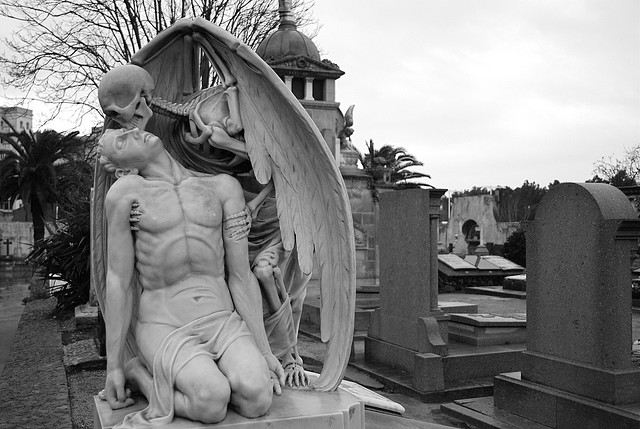
This astonishing sculpture forms part of Barcelona’s Poblenou Cemetery. The Kiss of Death (El Petó de la Mort in Catalan and El beso de la muerte in Spanish) dates back to 1930. A winged skeleton bestows a kiss on the forehead of a handsome young man: is it ecstasy on his face or resignation? Little wonder the sculpture elicits strong and varying responses from whoever gazes upon it....
http://www.kuriositas.com/2012/03/kiss-of-death.html
82 replies
 = new reply since forum marked as read
Highlight:
NoneDon't highlight anything
5 newestHighlight 5 most recent replies
= new reply since forum marked as read
Highlight:
NoneDon't highlight anything
5 newestHighlight 5 most recent replies
= new reply since forum marked as read
Highlight:
NoneDon't highlight anything
5 newestHighlight 5 most recent replies
U.S. stocks tumble; Dow drops 318 points; Indexes post worst weekly losses in more than a year
Demeter
Jan 2014
#18
Tsunami of Retail Store Closings and Downsizings Coming; Expect Layoffs and Shorter Hours
Demeter
Jan 2014
#20
Low-Wage Workers Have far More Education than They Did in 1968, yet They Make far Less
Demeter
Jan 2014
#21
Crippled eurozone to face fresh debt crisis this year, warns ex-ECB strongman Axel Weber
Demeter
Jan 2014
#64
Here's What Emerging-Market Leaders Are Saying And Doing As Their Currencies Burn
xchrom
Jan 2014
#42
Investors Poured Billions Of Dollars Into The Stock Market Last Week Even As Prices Fell
xchrom
Jan 2014
#43