Welcome to DU!
The truly grassroots left-of-center political community where regular people, not algorithms, drive the discussions and set the standards.
Join the community:
Create a free account
Support DU (and get rid of ads!):
Become a Star Member
Latest Breaking News
Editorials & Other Articles
General Discussion
The DU Lounge
All Forums
Issue Forums
Culture Forums
Alliance Forums
Region Forums
Support Forums
Help & Search
Weekend Economists American Bad Boys Part 1 July 12-13, 2014 [View all]
Sorry for the delay...I have contracted a cold or flu in Boston, and I was sneezing my head off during euchre. This evidently broke the opponents' concentration....my partner and I split 2nd and 3rd place. We would have split 1st and 2nd, except another player got one point more...it was an exciting night...no doubt heightened by flashes of fever.
Catching up with life after a vacation is exhausting. I'm going to need another vacation.
So, onto the Weekend Topic: Bad Boys
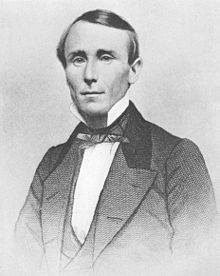
William Walker (May 8, 1824 – September 12, 1860) was an American lawyer, journalist and adventurer, who organized several private military expeditions into Latin America, with the intention of establishing English-speaking colonies under his personal control, an enterprise then known as "filibustering." Walker became president of the Republic of Nicaragua in 1856 and ruled until 1857, when he was defeated by a coalition of Central American armies. He was executed by the government of Honduras in 1860.
Early life
Walker was born in Nashville, Tennessee in 1824 to James Walker and his wife Mary Norvell. His father was a son of a Scottish immigrant. His mother was a daughter of Lipscomb Norvell, an American Revolutionary War officer from Virginia. One of Walker's maternal uncles was John Norvell, a US Senator from Michigan and founder of The Philadelphia Inquirer.
William Walker graduated summa cum laude from the University of Nashville at the age of fourteen. At the age of 19, he received a medical degree from the University of Pennsylvania and practiced briefly in Philadelphia before moving to New Orleans to study law.
He practiced law for a short time, and then quit to become co-owner and editor of the New Orleans Crescent. In 1849, he moved to San Francisco, where he was a journalist and fought three duels; he was wounded in two of them. Walker then conceived the idea of conquering vast regions of Latin America and create new slave states to join those already part of the United States. These campaigns were known as filibustering or freebooting.
Expedition to Mexico
In the summer of 1853, Walker traveled to Guaymas, seeking a grant from the government of Mexico to create a colony, using the pretext that it would serve as a fortified frontier, protecting US soil from Indian raids. Mexico refused, and Walker returned to San Francisco determined to obtain his colony, regardless of Mexico's position. He began recruiting from amongst American supporters of slavery and the Manifest Destiny Doctrine, mostly inhabitants of Kentucky and Tennessee. His intentions then changed from forming a buffer colony to establishing an independent Republic of Sonora, which might eventually take its place as a part of the American Union (as had been the case previously with the Republic of Texas). He funded his project by "selling scrips which were redeemable in lands of Sonora."
On October 15, 1853, Walker set out with 45 men to conquer the Mexican territories of Baja California and Sonora. He succeeded in capturing La Paz, the capital of sparsely populated Baja California, which he declared the capital of a new Republic of Lower California, with himself as president and his partner, Watkins, as vice president; he then put the region under the laws of the American state of Louisiana, which made slavery legal. Fearful of attacks by Mexico, Walker moved his headquarters twice over the next three months, first to Cabo San Lucas, and then further north to Ensenada to maintain a more secure position of operations. Although he never gained control of Sonora, less than three months later, he pronounced Baja California part of the larger Republic of Sonora. Lack of supplies and strong resistance by the Mexican government quickly forced Walker to retreat.
Back in California, he was put on trial for conducting an illegal war, in violation of the Neutrality Act of 1794. However, in the era of Manifest Destiny, his filibustering project was popular in the southern and western United States and the jury took eight minutes to acquit him.
Conquest of Nicaragua

Walker's Nicaragua map
Since there was no inter-oceanic route joining the Atlantic and Pacific Oceans at the time, and the transcontinental railway had not been completed, a major trade route between New York City and San Francisco ran through southern Nicaragua. Ships from New York entered the San Juan River from the Atlantic and sailed across Lake Nicaragua. People and goods were then transported by stagecoach over a narrow strip of land near the city of Rivas, before reaching the Pacific and being shipped to San Francisco. The commercial exploitation of this route had been granted by Nicaragua to the Accessory Transit Company, controlled by Wall Street tycoon Cornelius Vanderbilt (see also Nicaragua Canal).
In 1854, a civil war erupted in Nicaragua between the Legitimist Party (also called the Conservative Party), based in the city of Granada, and the Democratic Party (also called the Liberal Party), based in León. The Democratic Party sought military support from Walker who, to circumvent U.S. neutrality laws, obtained a contract from Democratic president Francisco Castellón to bring as many as three hundred "colonists" to Nicaragua. These mercenaries received the right to bear arms in the service of the Democratic government. Walker sailed from San Francisco on May 3, 1855, with approximately 60 men. Upon landing, the force was reinforced by 170 locals and about 100 Americans, including the well-known explorer and journalist Charles Wilkins Webber and the English adventurer Charles Frederick Henningsen, a veteran of the First Carlist War, the Hungarian Revolution, and the war in Circassia.
With Castellón's consent, Walker attacked the Legitimists in the town of Rivas, near the trans-isthmian route. He was driven off, but not without inflicting heavy casualties. On September 4, during the Battle of La Virgen, Walker defeated the Legitimist army. On October 13, he conquered the Legitimist capital of Granada and took effective control of the country. Initially, as commander of the army, Walker ruled Nicaragua through provisional President Patricio Rivas. U.S. President Franklin Pierce (ANCESTOR TO BARBARA BUSH, FOR THOSE WHO SEE SOME CONSPIRACY HERE) recognized Walker's regime as the legitimate government of Nicaragua on May 20, 1856. Walker's first ambassadorial appointment, Colonel Parker H. French, was refused recognition.

Walker's flag of Nicaragua
Meanwhile, C. K. Garrison and Charles Morgan, subordinates of Cornelius Vanderbilt's Accessory Transit Company, provided financial and logistic assistance to the filibusters in exchange for Walker, as ruler of Nicaragua, seizing the Company's property (on the pretext of a charter violation) and turning it over to Garrison and Morgan. Outraged, Vanderbilt dispatched two secret agents to the Costa Rican government with detailed plans on how to deal a death blow to the filibusters. They would help regain control of Vanderbilt's steamboats which had become a logistical lifeline for Walker's army.
Walker had also scared his neighbors and potential American and European investors with talk of further military conquests in Central America. Juan Rafael Mora, President of Costa Rica, rejected Walker's diplomatic overtures and instead declared war on his regime, the Campaign of 1856–57. Walker organized a battalion of four companies, of which one was composed by Germans the other by French and the other two by Americans totaling 240 men placed under the command of Colonel Schlessinger to invade Costa Rica in a preemptive action, but this advance force was defeated at the Battle of Santa Rosa in March 20, 1856. In April 1856, Costa Rican troops entered into Nicaraguan territory and inflicted a defeat on Walker's men at the Second Battle of Rivas, in which Juan Santamaría, later to be recognized as one of Costa Rica's national heroes, played a key role.
From the north, President José Santos Guardiola sent Honduran troops who went side by side with Salvadoran troops to fight William Walker under the leadership of the Xatruch brothers. Florencio Xatruch was named General-in-Chief of the Allied Armies of Central America. He also led the combat against the filibusters in la Puebla, Rivas. Later, for political reasons, Juan Rafael Mora was left in charge. Several Central American countries recognized Xatruch as Brigade and Division General. On June 12, 1857, Xatruch made a triumphant entrance to Comayagua, which was then the capital of Honduras, after Walker surrendered. The nickname by which Hondurans are known popularly still today, Catracho, and the more infamous nickname Salvadorans are known today, Salvatrucho are derived from Xatruch's figure and successful campaign as leader of the Allied Armies of Central America, as the troops of El Salvador and Honduras were national heroes, that played a key role, fighting side by side as Central American brothers against William Walker's troops. As the general and his soldiers returned from battle, some Nicaraguans affectionately yelled out "¡Vienen los xatruches!", meaning "Here come Xatruch's boys!" However, Nicaraguans had so much trouble pronouncing the general's last name (a Catalan last name) that they altered the phrase to "los catruches" and ultimately settled on "los catrachos".
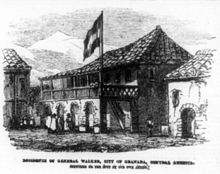
Walker's house in Granada
Walker took up residence in Granada and set himself up as President of Nicaragua, after conducting a fraudulent election. He was inaugurated on July 12, 1856, and soon launched an Americanization program, reinstating slavery, declaring English an official language and reorganizing currency and fiscal policy to encourage immigration from the United States. Realizing that his position was becoming precarious, he sought support from the Southerners in the U.S. by recasting his campaign as a fight to spread the institution of black slavery, which many American Southern businessmen saw as the basis of their agrarian economy. With this in mind, Walker revoked Nicaragua's emancipation edict of 1824. This move did increase Walker's popularity in the South and attracted the attention of Pierre Soulé, an influential New Orleans politician, who campaigned to raise support for Walker's war. Nevertheless, Walker's army, weakened by an epidemic of cholera and massive defections, was no match for the Central American coalition. On December 14, 1856, as Granada was surrounded by 4,000 Honduran, Salvadoran and Guatemalan troops, Charles Frederick Henningsen, one of Walker's generals, ordered his men to set the city ablaze before escaping and fighting their way to Lake Nicaragua. An inscription on a lance reading Aquí fue Granada ("Here was Granada"
 was left behind at the smoking ruin of the ancient capital city.
On May 1, 1857, Walker surrendered to Commander Charles Henry Davis of the United States Navy under the pressure of the Central American armies, and was repatriated. Upon disembarking in New York City, he was greeted as a hero, but he alienated public opinion when he blamed his defeat on the U.S. Navy. Within six months, he set off on another expedition, but he was arrested by the U.S. Navy Home Squadron under the command of Commodore Hiram Paulding and once again returned to the U.S. amid considerable public controversy over the legality of the Navy's actions.
Death in Honduras
After writing an account of his Central American campaign (published in 1860 as War in Nicaragua), Walker once again returned to the region. British colonists in Roatán, in the Bay Islands, fearing that the government of Honduras would move to assert its control over them, approached Walker with an offer to help him in establishing a separate, English-speaking government over the islands. Walker disembarked in the port city of Trujillo, but soon fell into the custody of Commander Nowell Salmon (later Admiral Sir Nowell Salmon) of the British Royal Navy. The British government controlled the neighboring regions of British Honduras (now Belize) and the Mosquito Coast (now part of Nicaragua) and had considerable strategic and economic interest in the construction of an inter-oceanic canal through Central America. It therefore regarded Walker as a menace to its own affairs in the region.
Rather than return him to the US, Salmon delivered Walker to the Honduran authorities in Trujillo, who executed him near the site of the present-day hospital by firing squad on September 12, 1860. Walker was 36 years old. He is buried in the Cementerio Viejo, in Trujillo.
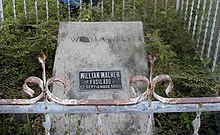
Walker's grave in the Old Trujillo Cemetery, Colón, Honduras
Influence and reputation
William Walker convinced many Southerners of the desirability of creating a slave-holding empire in tropical Latin America. In 1861, when U.S. Senator John J. Crittenden proposed that the 36°30' parallel north be declared as a line of demarcation between free and slave territories, some Republicans denounced such an arrangement, saying that it "would amount to a perpetual covenant of war against every people, tribe, and State owning a foot of land between here and Tierra del Fuego."
Before the end of the American Civil War, Walker's memory enjoyed great popularity in the southern and western United States, where he was known as "General Walker" and as the "grey-eyed man of destiny". Northerners, on the other hand, generally regarded him as a pirate. Despite his intelligence and personal charm, Walker consistently proved to be a limited military and political leader. Unlike men of similar ambition, such as Cecil Rhodes, Walker's grandiose scheming ultimately failed.
In Central American countries, the successful military campaign of 1856–57 against William Walker became a source of national pride and identity, and it was later promoted by local historians and politicians as substitute for the war of independence that Central America had not experienced. April 11 is a Costa Rican national holiday in memory of Walker's defeat at Rivas. Juan Santamaría, who played a key role in that battle, is honored as one of the two Costa Rican national heroes, the other one being Juan Rafael Mora himself.
Cultural references
Walker's campaign has inspired two films, both of which take considerable liberties with his story: Burn! (1969) directed by Gillo Pontecorvo, starring Marlon Brando, and Walker (1987) directed by Alex Cox, starring Ed Harris. Walker's name is used for the main character in Burn!, though the character is not meant to represent the historical William Walker and is portrayed as British. On the other hand, Alex Cox's Walker incorporates many of the signposts of William Walker's life and exploits into a surrealist narrative; from his original excursions into northern Mexico to his trial and acquittal on breaking the neutrality act to the triumph of his assault on Nicaragua and his execution.
In Part Five, Chapter 48, of Gone with the Wind, Margaret Mitchell cites William Walker, "and how he died against a wall in Truxillo", as topic of conversation between Rhett Butler and his filibustering acquaintances, while Rhett and Scarlett are on honeymoon in New Orleans.
In S. M. Stirling's Emberverse Nantucket Books, a young Coast Guard lieutenant, William Walker, steals a ship loaded with modern technology from the timelost Nantucketers. Like the historical William Walker he embarks on a campaign for conquest and carves for himself a personal empire – in this case, in the Bronze Age, first in Britain, then fleeing to Greece. There he eventually overthrows Greek King Agamemnon, who commits suicide rather than be a puppet leader, and then proceeding to carry out his own brutal version of the Trojan War.
A long early poem by the Nicaraguan poet Ernesto Cardenal, Con Walker En Nicaragua, translated as With Walker in Nicaragua, gives a historical treatment of the affair.
Nate DiMeo's historical podcast The Memory Palace featured an episode on William Walker entitled "Presidente Walker".
See also
Knights of the Golden Circle, a secret society interested in annexing territories in Mexico, Central America, and the Caribbean to be added to the United States as slave states
Golden Circle (proposed country)
Nicaragua Canal
Panama Canal
Gaston de Raousset-Boulbon
https://en.wikipedia.org/wiki/William_Walker_%28filibuster%29
&feature=kp
I'm going to do one Bad Boy each weekend, unless or until I run out, or some overwhelming issue preempts it. If you have a candidate, post or PM me....first come, first served. I'm sticking to Corporate/Private Citizen types, at least for now. If there's enough interest, we can go after public servants/political hacks and their hangers-on, supporters and lackeys later.
46 replies
 = new reply since forum marked as read
Highlight:
NoneDon't highlight anything
5 newestHighlight 5 most recent replies
= new reply since forum marked as read
Highlight:
NoneDon't highlight anything
5 newestHighlight 5 most recent replies
= new reply since forum marked as read
Highlight:
NoneDon't highlight anything
5 newestHighlight 5 most recent replies
Putin Slams US $9 Billion Fine Against French BNP As "Blackmail" For Russian Warship Deal
MattSh
Jul 2014
#10
Meanwhile--Some Jokes We Can Be In On (because they aren't crazy, like US foreign policy)
Demeter
Jul 2014
#17
Mysterious firm that sank Spain’s Gowex says it is targeting the financial bad guys
xchrom
Jul 2014
#30
Crucial bankruptcy debt-cutting plan reportedly being approved by Detroit retirees
Demeter
Jul 2014
#43