Welcome to DU!
The truly grassroots left-of-center political community where regular people, not algorithms, drive the discussions and set the standards.
Join the community:
Create a free account
Support DU (and get rid of ads!):
Become a Star Member
Latest Breaking News
Editorials & Other Articles
General Discussion
The DU Lounge
All Forums
Issue Forums
Culture Forums
Alliance Forums
Region Forums
Support Forums
Help & Search
Economy
In reply to the discussion: STOCK MARKET WATCH -- Friday, 31 July 2015 [View all]Demeter
(85,373 posts)5. Lies, Damned Lies, and Greek Statistics (COMPARED TO ICELAND)
http://coppolacomment.blogspot.co.uk/2015/07/lies-damned-lies-and-greek-statistics.html
By Sigrún Davídsdóttir, an Icelandic journalist, broadcaster and writer. Her coverage of Iceland’s financial crisis and subsequent recovery can be found at her Icelog. Together with Professor Þórólfur Matthíasson she has earlier written at A Fistful of Euros on what Icelandic lessons could be used to deal with the Greek banks.
The word “trust” has been mentioned time and again in reports on the tortuous negotiations on Greece. One reason is the persistent deceit in reporting on debt and deficit statistics, including lying about an off market swap with Goldman Sachs: not a one-off deceit but a political interference through concerted action among several public institutions for more then ten years...As late as in the July 12 Euro Summit statement “safeguarding of the full legal independence of ELSTAT” was stated as a required measure. Worryingly, Andreas Georgiou president of ELSTAT from 2010, the man who set the statistics straight, and some of his staff, have been hounded by political forces, including Syriza. Further, a Greek parliamentary investigation aims to show that foreigners are to blame for the “odious” debt. But there is no effort to clarify a decade of falsifying statistics.
In Iceland there were also voices blaming its collapse on foreigners. But the report of the Special Investigation Committee silenced these voices. As long as powerful parts of the Greek political class are unwilling to admit to past failures it might prove difficult to deal with the consequences: the profound lack of trust between Greece and its creditors...In Iceland, this was a common first reaction among some politicians and political forces following the collapse of the three largest Icelandic banks in October 2008. Allegedly, foreign powers were jealous or even scared of the success of the Icelandic banks abroad or aimed at taking over Icelandic energy sources. In April 2010 the publication of a report by the Special Investigation Committee, SIC, effectively silenced these voices. It documented that the causes were domestic: failed policies, lax financial supervision, fawning faith in the fast-growing banking system and thoroughly reckless, and at times criminal, banking.
As the crisis struck, Iceland’s public debt was about 30% of GDP and it had a budget surplus. Though reluctant to seek assistance from the International Monetary Fund (IMF) the Icelandic government did so in the weeks following the collapse. An IMF crisis loan of $2.1bn eased the adjustment from boom to bust. Already by the summer of 2011 Iceland was back to growth and by August 2011 it completed the IMF programme executed by a left government in power from early 2009 until spring 2013. Good implementation and Iceland’s ownership of the programme explains the success. For Ireland it was the same: it entered the crisis with strong public finances and ended a harsh Troika programme late 2013. Ireland’s growth in 2014 was 4.8%.
For Greece it was a different story. From 1995 to 2014 it had an average budget deficit of 7%. Already in 1996, government debt was above 100% of GDP, hovering there until the debt started climbing worryingly in the period 2008 to 2009 – far from the prescribed Maastricht criteria of budget deficit not exceeding 3% and public debt no higher than 60% of GDP. But Greece’s chronically high budget deficit and public debt had one exception: both figures miraculously dived, in the case of the deficit number to below the Maastricht limit, to enable Greece to join the Euro in 2001...Greece had an extra problem not found in Iceland, Ireland or any other crisis-hit EEA countries. In addition to dismal public finances for decades there is the even more horrifying saga of deliberate hiding and falsifying economic realities by misreporting the Excessive Deficit Procedure (EDP) and hiding debt and deficit with off market swaps.* This is not a case of just fiddling the figures once to get into the Euro but a deceit stretching over more than ten years involving not only the National Statistical Service of Greece (NSSG) but the Greek Ministry of Finance (MoF), the Greek Accounting Office (GAO) and other important institutions involved in the compilation of EDP deficit and debt statistics – in short, the whole political power base of Greece’s public economy.
2004: The First Greek Crisis of Unreliable Statistics
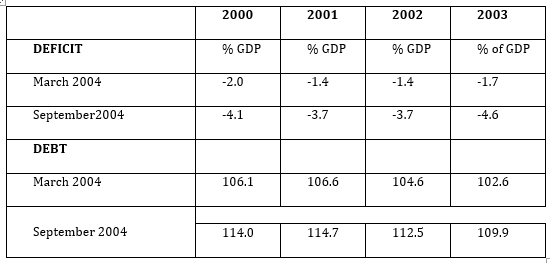
The first Greek crisis did not attract much attention although it was indirectly a crisis of deficit and debt. It was caused by faulty statistics, already unearthed by Eurostat in 2002. Eurostat’s 2004 Report on the revision of the Greek government deficit and debt figures rejected the original figures put forward by the Greek authorities. After revision the numbers for the previous years looked drastically different – the budget deficit, which should have been within 3%, moved shockingly:
The institutions responsible for reporting on the debt and deficit figures were NSSG, the MoF through the GAO as well as MoF’s Single Payment Authority and the Bank of Greece. Specifically, NSSG and the MoF were responsible for the deficit reporting; the MoF was fully responsible for the debt figures. Eurostat drew various lessons from the first Greek crisis. Legislative changes were made to eradicate the earlier problems – not an entirely successful exercise as could be seen when the same problems re-surfaced. But the most important result of the 2004 crisis was a set of statistical principles known as the European Statistics Code of Practice, which was adopted in February 2005 and revised in September 2011 following the next Greek crisis of statistical data. Unfortunately, NSSG drew no such lessons.
2009: The Second Greek Crisis of Unreliable Statistics
Following the 2004 report, Eurostat had NSSG in what can best be described as wholly exceptional and intensive occupational therapy. Of the ten EDP notifications 2005-2009 Eurostat expressed reservations about five of them, more than for any other country. No country other than Greece received “methodological visits” from Eurostat. The Greek notifications which passed did so only because Eurostat had corrected them during the notification period, always increasing the deficit from the numbers originally reported by the Greek authorities. But in spite of Eurostat’s efforts the pupil was unwilling to learn, and in 2009 there was a second crisis of statistics. In January 2010, a 30-page report on Greek Government Deficit and Debt Statistics from the European Commission bluntly stated that things had not improved. In fact what had been going on at Greek authorities had no parallel in any other EU country. This second crisis of Greek statistics in 2009 was set off by the dramatic revisions of the deficit forecast for 2009. As in 2004, this new crisis led to major revisions of earlier forecasts: the April forecast was revised twice in October. What happened between spring and October was that George Papandreou and PASOK ousted New Democracy and prime minister Kostas Karamanlis from power. The new government was now beating drums over a much worse state of affairs than the earlier data and forecast had shown.
After first reporting on October 2nd 2009, NSSG produced another set of figures on October 21st which revised the earlier reported deficit for 2008 from 5% of GDP to 7.7% and the forecasted deficit for 2009 from 3.7% of GDP to 12.5% (as explained in footnote, numbers for current year are a forecast, whereas numbers for earlier years should be actual data). This was not all. In early 2010, Eurostat was still not convinced about the actual EDP data from the years 2005 to 2008. The earlier 2009 deficit forecast of 12.5% had risen to an actual deficit of 13.6% by April 2010. The final figure was confirmed as 15.4% in late 2010.
The European Commission’s report detected common features with events in 2004 and 2009: a change of government. In March 2004, Kostas Karamanlis and New Democracy came to power, ending eleven years of PASOK rule; in October 2009, George Papandreou and PASOK won back power. The EC noted that in both cases:
In other words, the problem was not statistics but politics. As politics is well outside its remit, Eurostat could not get to the core of the problem:
Political interference could be deduced from the fact that reservations expressed by Eurostat between 2005 and 2008 on specific budgetary issues, which had then been clarified and corrected, resurfaced in 2009 when earlier corrections were reverted and the figures were once more wrong.
Good Faith versus Fraud
The EC’s 2010 report identified two different but in some cases linked sets of problems. The first was due to methodological weaknesses and unsatisfactory technical procedures, both at the NSSG and the authorities that provided data to the NSSG, in particular the GAO and the MoF.
The second set of problems stemmed:
Eurostat’s extra scrutiny and unprecedented effort had clearly not been enough:
The EC’s report further pointed out that:
The EC concluded that there was nothing wrong with the quality assurance system in place at Eurostat. The shortcomings were peculiar to Greece:
And the rarity of revisions of such magnitude was underlined:
The EC’s report spells out the interplay between authorities, dictated by political needs. Against these concerted actions by Greek authorities, the efforts of European institutions were bound to be inadequate. “The situation can only be corrected by decisive action of the Greek government,” the report said.
The Goldman Sachs 2001 Swaps – Part of the Greek Statistics Deceit Saga
In early 2010, international media was reporting that Greece had entered into a certain type of swap – off market swaps – with Goldman Sachs in 2001 in order to bring its debt to a certain level so as to be eligible for euro membership...In Council Regulation (EC) No 2223/96 swaps were classified as “financial derivatives,” with a 2001 amendment making it clear that no “payment resulting from any kind of swap arrangement is to be considered as interest and recorded under property.” However, at that time off market swaps were not much noted. By the mid-2000s it became evident that the use of off market swaps could have the effect of reducing the measured debt according to the existing rules. Eurostat took this into account and issued guidelines to record off market swaps differently from regular swaps. Further, Eurostat rules specify that when in doubt national statistical authorities should ask Eurostat.
In 2008, Eurostat asked member states to declare any off market swaps. The prompt Greek answer was: “The State does not engage in options, forwards, futures or FOREX swaps, nor in off market swaps (swaps with non-zero market value at inception).” In its Report on the EDP Methodological Visits to Greece in 2010, Eurostat scrutinised the 2001 currency off-market swap agreements with Goldman Sachs, using an exchange rate different from the spot prevailing one that the Greek Public Debt Agency (PDMA) had made with the bank. It turned out that the 2008 answer was just the opposite of what had happened: the Greek state had indeed engaged in swaps but kept it carefully hidden from the outer world, including Eurostat...After having been found to be lying about the swaps, Greek authorities were decidedly unwilling to inform Eurostat about their details. Not until after the fourth Eurostat visit, at the end of September 2010 – after Andreas Georgiou took over at ELSTAT – did Eurostat feel properly informed on the Goldman Sachs swap.
The GS off market swaps were in total thirteen contracts with maturity from 2002 to 2016, later extended to 2037. As Eurostat remarked, these transactions had several unusual aspects compared to normal practices. The original contracts have been revised, amended and restructured over the years, some of which have resulted in what Eurostat defines as new transactions. The GS swaps hid a debt of $2.8bn in 2001; after later restructuring the understatement of the debt was $5.4bn. The swap transaction, never before reported as part of the public accounts, was part of the revisions in the first ELSTAT reporting after Georgiou took over. This actually increased the deficit by a small amount for every year since 2001, as well as increasing the debt figure. The swap story is a parallel to the Greek data deceit in the sense that it was not a single event but a deceit running for years, involving several Greek authorities. Taken together, both the swap deceit and the faulty reporting of forecasts and statistics by Greek authorities show a determined and concerted political effort to hide facts and figures, which did not change when new governments came to power.
A Thriller of Statistical Data and Mysteriously Acquired Emails
NOW IT GETS UGLY, WONKY, AND WORSE--SEE LINK
********************************
When the European Union created a single currency the Euro countries in effect embarked on a journey all on the same ship. By now, it is evident that the crew – the European authorities – did not have the necessary safety measures to keep discipline among the passengers. Nor have the passengers kept an eye on each other. In the summer of 2011, Mario Monti, sorely tried by his experience as EU Commissary, formulated what had gone wrong:
A successful monetary union demands more than the countries being just fair-weather friends. The crisis countries, most notably Greece, can only learn from the past if they understand what happened. In Greece these failures were, among others, the basic function in a modern state of truthfully reporting statistics.
Truth or Politically Suitable Truth
In December 2008, while Iceland was still in shock after the banking collapse, its parliament set up a Special Investigation Committee, SIC, which operated wholly independently of parliament. The three SIC members were Supreme Court Justice Páll Hreinsson (the chairman), Parliament’s Ombudsman Tryggvi Gunnarsson and lecturer in economics at Yale University Sigríður Benediktsdóttir. Together, they supervised the work of about 40 experts. Their report of 2600 pages was published on April 10th 2010. The report buried politically-motivated explanations of the collapse being caused by foreigners and instead recounted what had actually happened, based on both documents and hearings (private, not public hearings). One benefit of the SIC report is that no political party or anyone else can now tell the collapse saga as suits their interest: the documented saga exists and this effectively ended the political blame game. Importantly, the report points out lessons to learn.
Sadly, nothing similar has been done in Greece. The two committees set up by the Greek parliament do not seem entirely credible, because the allegations of ELSTAT misconduct and manipulation under Georgiou are being recycled. Further, their scope seems myopic, as no effort is made to explain what went on at the institutions that from before 2000 until 2010 were reporting faulty statistics and forecasts and lying about the GS swaps. All of this taken together shows a political class, including within Syriza, not only unwilling to face the past but actively fighting any attempt to clarify things in a battle where even national statistics are a dangerous weapon. The fact that leading Greek political powers are still fighting the wrong fight on statistics is unfortunately symptomatic of political undercurrents in Greece. And this, in part, explains why the Troika and the EU member states find it so hard to trust Greece.
--------------------------------------------------------------------------------
*A note on EU statistics: twice a year, before end of March and August, statistical authorities in the EU countries report forecasts of debt and deficit numbers for the current year, i.e. what the planned deficit and debt is and then statistical data for earlier years, i.e. the real debt and deficit, according to strict Eurostat procedure, in order to produce comparable statistics. This reporting, called Excessive Deficit Procedure (EDP) is published by Eurostat in April and October every year.
By Sigrún Davídsdóttir, an Icelandic journalist, broadcaster and writer. Her coverage of Iceland’s financial crisis and subsequent recovery can be found at her Icelog. Together with Professor Þórólfur Matthíasson she has earlier written at A Fistful of Euros on what Icelandic lessons could be used to deal with the Greek banks.
The word “trust” has been mentioned time and again in reports on the tortuous negotiations on Greece. One reason is the persistent deceit in reporting on debt and deficit statistics, including lying about an off market swap with Goldman Sachs: not a one-off deceit but a political interference through concerted action among several public institutions for more then ten years...As late as in the July 12 Euro Summit statement “safeguarding of the full legal independence of ELSTAT” was stated as a required measure. Worryingly, Andreas Georgiou president of ELSTAT from 2010, the man who set the statistics straight, and some of his staff, have been hounded by political forces, including Syriza. Further, a Greek parliamentary investigation aims to show that foreigners are to blame for the “odious” debt. But there is no effort to clarify a decade of falsifying statistics.
In Iceland there were also voices blaming its collapse on foreigners. But the report of the Special Investigation Committee silenced these voices. As long as powerful parts of the Greek political class are unwilling to admit to past failures it might prove difficult to deal with the consequences: the profound lack of trust between Greece and its creditors...In Iceland, this was a common first reaction among some politicians and political forces following the collapse of the three largest Icelandic banks in October 2008. Allegedly, foreign powers were jealous or even scared of the success of the Icelandic banks abroad or aimed at taking over Icelandic energy sources. In April 2010 the publication of a report by the Special Investigation Committee, SIC, effectively silenced these voices. It documented that the causes were domestic: failed policies, lax financial supervision, fawning faith in the fast-growing banking system and thoroughly reckless, and at times criminal, banking.
As the crisis struck, Iceland’s public debt was about 30% of GDP and it had a budget surplus. Though reluctant to seek assistance from the International Monetary Fund (IMF) the Icelandic government did so in the weeks following the collapse. An IMF crisis loan of $2.1bn eased the adjustment from boom to bust. Already by the summer of 2011 Iceland was back to growth and by August 2011 it completed the IMF programme executed by a left government in power from early 2009 until spring 2013. Good implementation and Iceland’s ownership of the programme explains the success. For Ireland it was the same: it entered the crisis with strong public finances and ended a harsh Troika programme late 2013. Ireland’s growth in 2014 was 4.8%.
For Greece it was a different story. From 1995 to 2014 it had an average budget deficit of 7%. Already in 1996, government debt was above 100% of GDP, hovering there until the debt started climbing worryingly in the period 2008 to 2009 – far from the prescribed Maastricht criteria of budget deficit not exceeding 3% and public debt no higher than 60% of GDP. But Greece’s chronically high budget deficit and public debt had one exception: both figures miraculously dived, in the case of the deficit number to below the Maastricht limit, to enable Greece to join the Euro in 2001...Greece had an extra problem not found in Iceland, Ireland or any other crisis-hit EEA countries. In addition to dismal public finances for decades there is the even more horrifying saga of deliberate hiding and falsifying economic realities by misreporting the Excessive Deficit Procedure (EDP) and hiding debt and deficit with off market swaps.* This is not a case of just fiddling the figures once to get into the Euro but a deceit stretching over more than ten years involving not only the National Statistical Service of Greece (NSSG) but the Greek Ministry of Finance (MoF), the Greek Accounting Office (GAO) and other important institutions involved in the compilation of EDP deficit and debt statistics – in short, the whole political power base of Greece’s public economy.
2004: The First Greek Crisis of Unreliable Statistics
The first Greek crisis did not attract much attention although it was indirectly a crisis of deficit and debt. It was caused by faulty statistics, already unearthed by Eurostat in 2002. Eurostat’s 2004 Report on the revision of the Greek government deficit and debt figures rejected the original figures put forward by the Greek authorities. After revision the numbers for the previous years looked drastically different – the budget deficit, which should have been within 3%, moved shockingly:
The institutions responsible for reporting on the debt and deficit figures were NSSG, the MoF through the GAO as well as MoF’s Single Payment Authority and the Bank of Greece. Specifically, NSSG and the MoF were responsible for the deficit reporting; the MoF was fully responsible for the debt figures. Eurostat drew various lessons from the first Greek crisis. Legislative changes were made to eradicate the earlier problems – not an entirely successful exercise as could be seen when the same problems re-surfaced. But the most important result of the 2004 crisis was a set of statistical principles known as the European Statistics Code of Practice, which was adopted in February 2005 and revised in September 2011 following the next Greek crisis of statistical data. Unfortunately, NSSG drew no such lessons.
2009: The Second Greek Crisis of Unreliable Statistics
Following the 2004 report, Eurostat had NSSG in what can best be described as wholly exceptional and intensive occupational therapy. Of the ten EDP notifications 2005-2009 Eurostat expressed reservations about five of them, more than for any other country. No country other than Greece received “methodological visits” from Eurostat. The Greek notifications which passed did so only because Eurostat had corrected them during the notification period, always increasing the deficit from the numbers originally reported by the Greek authorities. But in spite of Eurostat’s efforts the pupil was unwilling to learn, and in 2009 there was a second crisis of statistics. In January 2010, a 30-page report on Greek Government Deficit and Debt Statistics from the European Commission bluntly stated that things had not improved. In fact what had been going on at Greek authorities had no parallel in any other EU country. This second crisis of Greek statistics in 2009 was set off by the dramatic revisions of the deficit forecast for 2009. As in 2004, this new crisis led to major revisions of earlier forecasts: the April forecast was revised twice in October. What happened between spring and October was that George Papandreou and PASOK ousted New Democracy and prime minister Kostas Karamanlis from power. The new government was now beating drums over a much worse state of affairs than the earlier data and forecast had shown.
After first reporting on October 2nd 2009, NSSG produced another set of figures on October 21st which revised the earlier reported deficit for 2008 from 5% of GDP to 7.7% and the forecasted deficit for 2009 from 3.7% of GDP to 12.5% (as explained in footnote, numbers for current year are a forecast, whereas numbers for earlier years should be actual data). This was not all. In early 2010, Eurostat was still not convinced about the actual EDP data from the years 2005 to 2008. The earlier 2009 deficit forecast of 12.5% had risen to an actual deficit of 13.6% by April 2010. The final figure was confirmed as 15.4% in late 2010.
The European Commission’s report detected common features with events in 2004 and 2009: a change of government. In March 2004, Kostas Karamanlis and New Democracy came to power, ending eleven years of PASOK rule; in October 2009, George Papandreou and PASOK won back power. The EC noted that in both cases:
substantial revisions took place revealing a practice of widespread misreporting, in an environment in which checks and balances appear absent, information opaque and distorted, and institutions weak and poorly coordinated. The frequent missions conducted by Eurostat in the interval between these episodes, the high number of methodological visits, the numerous reservations to the notifications of the Greek authorities, on top of the non-compliance with Eurostat recommendations despite assurances to the contrary, provide additional evidence that the problems are only partly of a methodological nature and would largely lie beyond the statistical sphere.
In other words, the problem was not statistics but politics. As politics is well outside its remit, Eurostat could not get to the core of the problem:
Though eventually an overall level of completion was achieved, given that Eurostat is restricted to statistical matters in its work the measures foreseen in the action plan were mainly of a methodological nature, and did not address the issues of institutional settings, accountability, responsibility and political interference.
Political interference could be deduced from the fact that reservations expressed by Eurostat between 2005 and 2008 on specific budgetary issues, which had then been clarified and corrected, resurfaced in 2009 when earlier corrections were reverted and the figures were once more wrong.
Good Faith versus Fraud
The EC’s 2010 report identified two different but in some cases linked sets of problems. The first was due to methodological weaknesses and unsatisfactory technical procedures, both at the NSSG and the authorities that provided data to the NSSG, in particular the GAO and the MoF.
The second set of problems stemmed:
from inappropriate governance, with poor cooperation and lack of clear responsibilities between several Greek institutions and services responsible for the EDP notifications, diffuse personal responsibilities, ambiguous empowerment of officials, absence of written instruction and documentation, which leave the quality of fiscal statistics subject to political pressures and electoral cycles
Eurostat’s extra scrutiny and unprecedented effort had clearly not been enough:
even this activity was unable to detect the level of (hidden) interference in the Greek EDP data. In particular, after the closure of the infringement procedure at the end of 2007, Eurostat issued a reservation on the quality of the Greek data in the April 2008 notification and validated the notifications of October 2008 and April 2009 only after it intervened before and during the notification period to correct mistakes or inappropriate recording, with the result of increasing the notified deficit in both instances. As an example, Eurostat’s methodological missions in 2008 resulted in an increase of the 2007 deficit figure notified by the Greek authorities, from 2.8% to 3.5% of GDP.
The EC’s report further pointed out that:
on top of the serious problems observed in the functioning of other areas involved in the management of Greek public revenues and expenditures, that are not the object of this report, the current set-up does not guarantee the independence, integrity and accountability of the national statistical authorities. In particular the professional independence of the NSSG from the Ministry of Finance is not assured, which has allowed the reporting of EDP data to be influenced by factors other than the regulatory and legally binding principles for the production of high quality European statistics.
The EC concluded that there was nothing wrong with the quality assurance system in place at Eurostat. The shortcomings were peculiar to Greece:
The partners in the ESS (European Statistical System) are supposed to cooperate in good faith. Deliberate misreporting or fraud is not foreseen in the regulation.
And the rarity of revisions of such magnitude was underlined:
Revisions of this magnitude in the estimated past government deficit ratios have een extremely rare in other EU Member States, but have taken place for Greece on several occasions.
The EC’s report spells out the interplay between authorities, dictated by political needs. Against these concerted actions by Greek authorities, the efforts of European institutions were bound to be inadequate. “The situation can only be corrected by decisive action of the Greek government,” the report said.
The Goldman Sachs 2001 Swaps – Part of the Greek Statistics Deceit Saga
In early 2010, international media was reporting that Greece had entered into a certain type of swap – off market swaps – with Goldman Sachs in 2001 in order to bring its debt to a certain level so as to be eligible for euro membership...In Council Regulation (EC) No 2223/96 swaps were classified as “financial derivatives,” with a 2001 amendment making it clear that no “payment resulting from any kind of swap arrangement is to be considered as interest and recorded under property.” However, at that time off market swaps were not much noted. By the mid-2000s it became evident that the use of off market swaps could have the effect of reducing the measured debt according to the existing rules. Eurostat took this into account and issued guidelines to record off market swaps differently from regular swaps. Further, Eurostat rules specify that when in doubt national statistical authorities should ask Eurostat.
In 2008, Eurostat asked member states to declare any off market swaps. The prompt Greek answer was: “The State does not engage in options, forwards, futures or FOREX swaps, nor in off market swaps (swaps with non-zero market value at inception).” In its Report on the EDP Methodological Visits to Greece in 2010, Eurostat scrutinised the 2001 currency off-market swap agreements with Goldman Sachs, using an exchange rate different from the spot prevailing one that the Greek Public Debt Agency (PDMA) had made with the bank. It turned out that the 2008 answer was just the opposite of what had happened: the Greek state had indeed engaged in swaps but kept it carefully hidden from the outer world, including Eurostat...After having been found to be lying about the swaps, Greek authorities were decidedly unwilling to inform Eurostat about their details. Not until after the fourth Eurostat visit, at the end of September 2010 – after Andreas Georgiou took over at ELSTAT – did Eurostat feel properly informed on the Goldman Sachs swap.
The GS off market swaps were in total thirteen contracts with maturity from 2002 to 2016, later extended to 2037. As Eurostat remarked, these transactions had several unusual aspects compared to normal practices. The original contracts have been revised, amended and restructured over the years, some of which have resulted in what Eurostat defines as new transactions. The GS swaps hid a debt of $2.8bn in 2001; after later restructuring the understatement of the debt was $5.4bn. The swap transaction, never before reported as part of the public accounts, was part of the revisions in the first ELSTAT reporting after Georgiou took over. This actually increased the deficit by a small amount for every year since 2001, as well as increasing the debt figure. The swap story is a parallel to the Greek data deceit in the sense that it was not a single event but a deceit running for years, involving several Greek authorities. Taken together, both the swap deceit and the faulty reporting of forecasts and statistics by Greek authorities show a determined and concerted political effort to hide facts and figures, which did not change when new governments came to power.
A Thriller of Statistical Data and Mysteriously Acquired Emails
NOW IT GETS UGLY, WONKY, AND WORSE--SEE LINK
********************************
When the European Union created a single currency the Euro countries in effect embarked on a journey all on the same ship. By now, it is evident that the crew – the European authorities – did not have the necessary safety measures to keep discipline among the passengers. Nor have the passengers kept an eye on each other. In the summer of 2011, Mario Monti, sorely tried by his experience as EU Commissary, formulated what had gone wrong:
At the root of the eurozone crisis lies of course the past indiscipline of specific member states, Greece in the first place. But such indiscipline could simply not have occurred without two widespread failings by governments as they sit at the table of the European Council: an unhealthy politeness towards each other, and excessive deference to large member states.
A successful monetary union demands more than the countries being just fair-weather friends. The crisis countries, most notably Greece, can only learn from the past if they understand what happened. In Greece these failures were, among others, the basic function in a modern state of truthfully reporting statistics.
Truth or Politically Suitable Truth
In December 2008, while Iceland was still in shock after the banking collapse, its parliament set up a Special Investigation Committee, SIC, which operated wholly independently of parliament. The three SIC members were Supreme Court Justice Páll Hreinsson (the chairman), Parliament’s Ombudsman Tryggvi Gunnarsson and lecturer in economics at Yale University Sigríður Benediktsdóttir. Together, they supervised the work of about 40 experts. Their report of 2600 pages was published on April 10th 2010. The report buried politically-motivated explanations of the collapse being caused by foreigners and instead recounted what had actually happened, based on both documents and hearings (private, not public hearings). One benefit of the SIC report is that no political party or anyone else can now tell the collapse saga as suits their interest: the documented saga exists and this effectively ended the political blame game. Importantly, the report points out lessons to learn.
Sadly, nothing similar has been done in Greece. The two committees set up by the Greek parliament do not seem entirely credible, because the allegations of ELSTAT misconduct and manipulation under Georgiou are being recycled. Further, their scope seems myopic, as no effort is made to explain what went on at the institutions that from before 2000 until 2010 were reporting faulty statistics and forecasts and lying about the GS swaps. All of this taken together shows a political class, including within Syriza, not only unwilling to face the past but actively fighting any attempt to clarify things in a battle where even national statistics are a dangerous weapon. The fact that leading Greek political powers are still fighting the wrong fight on statistics is unfortunately symptomatic of political undercurrents in Greece. And this, in part, explains why the Troika and the EU member states find it so hard to trust Greece.
--------------------------------------------------------------------------------
*A note on EU statistics: twice a year, before end of March and August, statistical authorities in the EU countries report forecasts of debt and deficit numbers for the current year, i.e. what the planned deficit and debt is and then statistical data for earlier years, i.e. the real debt and deficit, according to strict Eurostat procedure, in order to produce comparable statistics. This reporting, called Excessive Deficit Procedure (EDP) is published by Eurostat in April and October every year.
Edit history
Please sign in to view edit histories.
Recommendations
0 members have recommended this reply (displayed in chronological order):
21 replies
 = new reply since forum marked as read
Highlight:
NoneDon't highlight anything
5 newestHighlight 5 most recent replies
RecommendedHighlight replies with 5 or more recommendations
= new reply since forum marked as read
Highlight:
NoneDon't highlight anything
5 newestHighlight 5 most recent replies
RecommendedHighlight replies with 5 or more recommendations
= new reply since forum marked as read
Highlight:
NoneDon't highlight anything
5 newestHighlight 5 most recent replies
RecommendedHighlight replies with 5 or more recommendations