Economy
In reply to the discussion: The Weekend Economists travel the Yellow Brick Road, November 14-15. [View all]Demeter
(85,373 posts)STRANGER THAN USUAL, THEY MEAN?
http://www.bloomberg.com/news/articles/2015-11-12/five-strange-things-that-have-been-happening-in-financial-markets
...Interesting things have certainly been happening in the underpinnings of global markets—things that either run counter to long-standing financial logic, or represent an unusual dislocation in the "normal" state of market affairs, or were once rare occurrences but have been happening with increasing frequency.
Here's a rundown:
1. Negative swap spreads
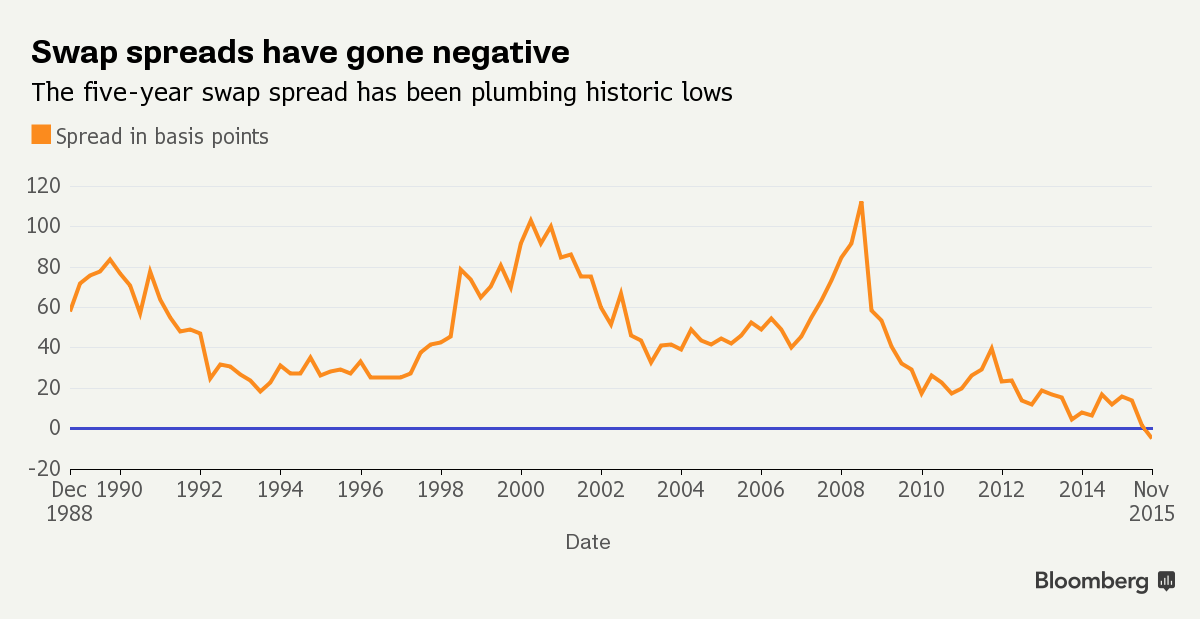
...At issue is the fact that swap rates—or rates charged for interest rate swaps—have dipped below yields on equivalent U.S. Treasuries, indicating that investors are charging less to deal with banks and corporations than with the U.S. government. Such a thing should never happen, as U.S. Treasuries theoretically represent the "risk-free" rate while swap rates are imbued with significant counterparty risk that should demand a premium.
That may have changed, however, as new financial market rules require interest rate swaps to be run through central clearing houses, effectively stripping them of counterparty risk and leaving just a minimal funding component. At the same time, funding costs for U.S. Treasuries are said to have gone up due to a host of post-financial crisis rules that crimp bank balance sheets (more on this later) causing costs to go up...
2. Fractured repo rates
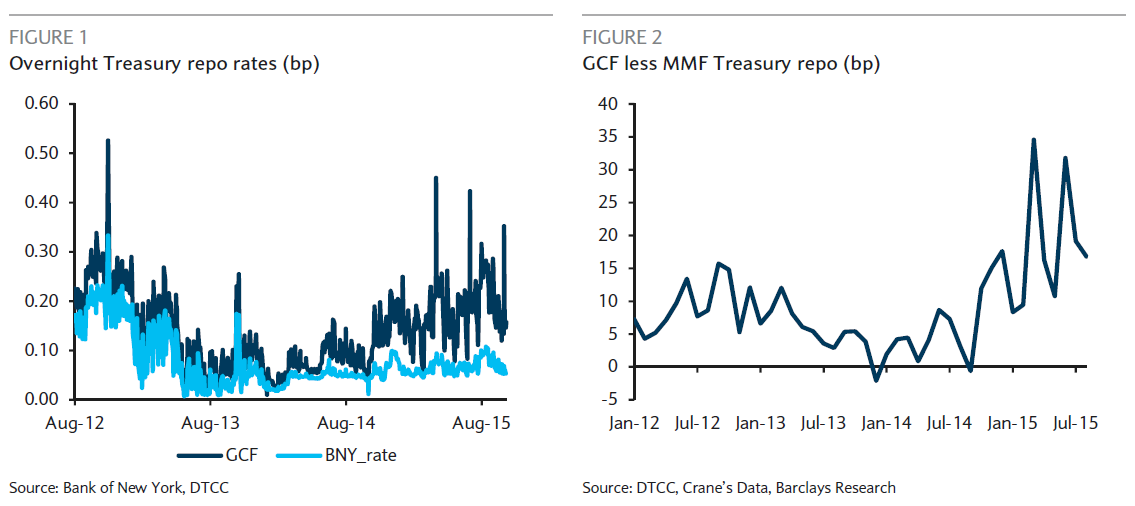
The difference between different repo rates has been widening.
Source: Barclays
The repo market is the lubricant for the global financial system, allowing banks and investors to pawn their assets—typically U.S. Treasuries and other high-quality paper—in exchange for short-term financing.
While there used to be little distinction between the rates at which counterparties raised money against their U.S. Treasury collateral, there is now an increasing divergence. "You no longer have a single repo rate," Joseph Abate, Barclays analyst, said in an interview last week. "The market itself is fracturing."
...The repo market is the lubricant for the global financial system, allowing banks and investors to pawn their assets—typically U.S. Treasuries and other high-quality paper—in exchange for short-term financing.
While there used to be little distinction between the rates at which counterparties raised money against their U.S. Treasury collateral, there is now an increasing divergence. "You no longer have a single repo rate," Joseph Abate, Barclays analyst, said in an interview last week. "The market itself is fracturing."
3. Corporate bond inventories below zero

Analysts at Goldman Sachs made waves this week when they highlighted the fact that inventories of some corporate bonds held by big dealer-banks had gone negative for the first time since the Federal Reserve began collecting such data. That means big banks are now net short corporate bonds with a maturity greater than 12 months equivalent to $1.4 billion, bucking the longer-term trend of net positive positions.
The record-breaking event revived a flurry of concerns about so-called liquidity, or ease of trading, in the $8.1 trillion corporate bond market. Similar to the repo market, a confluence of new rules is said to have made it more difficult for banks to hold corporate bonds on their balance sheets. At the same time, years of low interest rates have encouraged investors to herd into corporate bonds and hold onto them tightly.
That has worried some people who fear a lack of liquidity could worsen turmoil in the market, especially if interest rates rise...
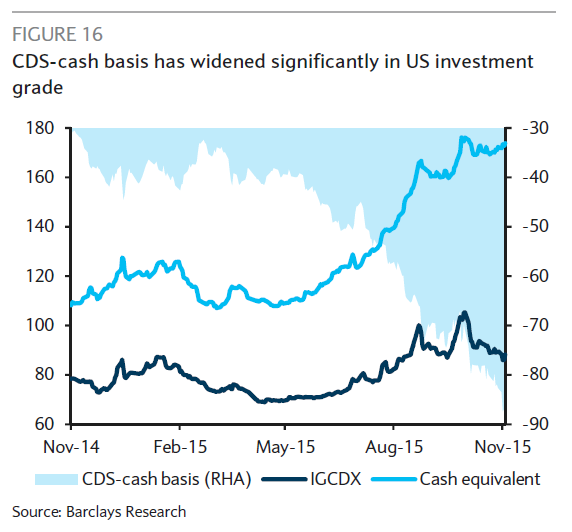
4. Synthetic credit is trading tighter than cash credit
Investors struggling to trade bonds amid an apparent dearth of liquidity have turned to a bevy of alternative products to gain or reduce exposure to corporate debt.
Such instruments include derivatives like credit default swap (CDS) indexes, total return swaps (TRS) and credit index swaptions. The rush for derivatives that are supposed to be more liquid than the cash market they track has produced another odd dislocation in markets.
Above is the so-called basis between the CDX IG, an index that includes CDS tied to U.S. investment-grade companies, and the underlying cash bonds. The basis has been persistently wide and negative in recent years, as spreads on the CDX index trade at tighter levels than cash.
"In exchange for the substantial liquidity of derivative indices, investors are often giving up spread right now, as most indices trade at a negative basis versus the comparable cash market," Barclays' Bradley Rogoff wrote in research published today. "The negative basis right now is near the largest we have witnessed at a time when there was not a funding crisis."
Investors may be ogling such synthetic tools not just because of their purported liquidity benefits but also because of funding benefits, a similar dynamic to the one currently pushing swap spreads into negative territory.
"These dynamics are part of a broader pattern whereby cash bonds that require balance sheet financing underperform their synthetic counterparts (e.g. ... CDX vs. corporate bonds)," Goldman Sachs's Francesco Garzarelli and Rohan Khanna said today in reference to sub-zero swap spreads.
5. Market moves that aren't supposed to happen keep happening
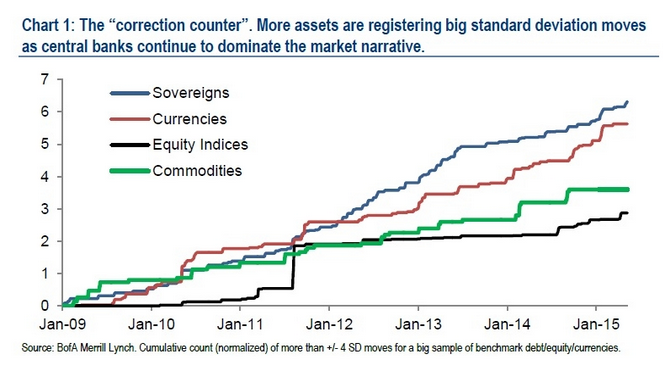
Much of Wall Street runs on mathematical models that abhor statistical anomalies. Unfortunately for the Street, such statistical anomalies have been happening more frequently, with short-term moves in many assets exceeding historical norms.
Barnaby Martin, a credit strategist at Bank of America Merrill Lynch, made this point earlier this year. The number of assets registering large moves—four or more standard deviations away from their normal trading range—has been increasing. Such moves would normally be expected to happen once every 62 years.
While Martin blamed much of the confusion on unexpected decisions by central banks—such as the Swiss National Bank's surprise decision to scrap its long-standing currency cap—there have been sharp market moves with seemingly little reasons behind them. Perhaps the best-known example is Oct. 15, 2014, when the yield on the 10-year U.S. Treasury briefly plunged 33 basis points—a seven standard-deviation move that should happen once every 1.6 billion years, based on a normal distribution of probabilities.
Some market participants have also blamed lower market liquidity for the wild moves. At TD Securities, analysts Priya Misra and Gennadiy Goldberg argued that similar liquidity issues to the ones related to corporate bonds could also be extending into the $12.8 trillion U.S. Treasury market...
6. Volatility is itself more volatile
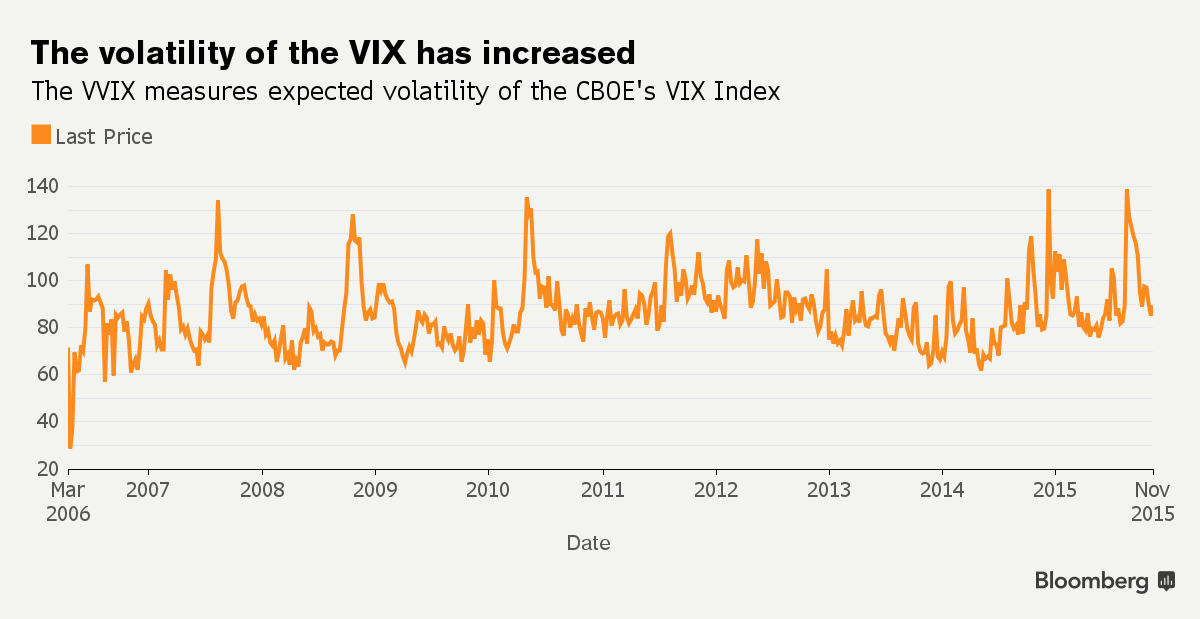
In October 2008, Lehman Brothers had just collapsed, interbank lending had ground to a halt, the repo market seized up, and the future of the entire financial system was in question. At that time, a measure of expected volatility in the Chicago Board Options Exchange Volatility Index, or the VIX, hit 134.87.
In August, 2015 the stock market fell 5.3 percent and the same measure of implied volatility in the VIX closed at 168.75, after reaching an all-time intraday record.
Whatever one's opinions of the stock market selloff, you'd be hard-pressed to argue that global markets were more stressed in August than they were during the depths of the financial crisis. Instead, the vacillations in the VIX underscore a post-financial-crisis trend that has seen volatility explode into its own asset class.
A host of exchange-traded funds, futures, and derivatives products are now enjoyed by both big, professional fund managers and mom and pop retail investors. Meanwhile, some large investors have been pumping up their returns by selling volatility, with Pimco under Bill Gross perhaps the best-known example.
"The volatility market that exists today is much more complex than it used to be; ETFs, indices, futures, and options traded on all of the above have complex relationships that haven't been fully tested," George Pearkes, analyst at Bespoke Investment Group, said in an interview.
He added: "Eventually, as we saw in the wake of last August, equilibrium is found when dislocations occur. But getting there can be complicated. Volatility, in my view, hasn't changed. What's changed is how it's warehoused and shifted."
THOSE LAST TWO ARE MORE GLOBAL, LESS WONKY, AND A SIGN OF GROWING INSTABILITY IN THE GLOBAL ECONOMY...ANOTHER GOOD REASON TO LATCH ONTO ISLAMIC FINANCE! PULL THEM DOWN WITH US.
Edit history
Recommendations
0 members have recommended this reply (displayed in chronological order): = new reply since forum marked as read
Highlight:
NoneDon't highlight anything
5 newestHighlight 5 most recent replies
RecommendedHighlight replies with 5 or more recommendations
= new reply since forum marked as read
Highlight:
NoneDon't highlight anything
5 newestHighlight 5 most recent replies
RecommendedHighlight replies with 5 or more recommendations