Welcome to DU!
The truly grassroots left-of-center political community where regular people, not algorithms, drive the discussions and set the standards.
Join the community:
Create a free account
Support DU (and get rid of ads!):
Become a Star Member
Latest Breaking News
Editorials & Other Articles
General Discussion
The DU Lounge
All Forums
Issue Forums
Culture Forums
Alliance Forums
Region Forums
Support Forums
Help & Search
Economy
In reply to the discussion: The Weekend Economists travel the Yellow Brick Road, November 14-15. [View all]Demeter
(85,373 posts)33. Greece and Creditors at Loggerheads Again; Troika Wants More Foreclosures YVES SMITH
http://www.nakedcapitalism.com/2015/11/greece-and-creditors-at-loggerheads-again-troika-wants-more-foreclosures.html?utm_source=feedburner&utm_medium=email&utm_campaign=Feed%3A+NakedCapitalism+%28naked+capitalism%29
European creditors want to extract more blood from a stone, in this case Greece.
Greece and its lenders are again at odds over the latest “bailout” funds, which is €2 billion that was scheduled to be approved for release by the famed Eurobgroup (remember them? That’s all the Eurozone finance ministers) on Monday. But a precondition for getting more dough was that Greece show enough “progress,” as in either have implemented or have committed to a sufficiently large number of “reforms”. “Reform” is Eurocrat-speak for austerian blood-letting. The creditors see Greece as coming up short. As we’ve pointed out repeatedly in our coverage of Greece, the lenders are hell-bent on seeing Greece remake its economy in ways that are guaranteed to make their loans fail, or perhaps more accurately, produce even greater losses than if they allowed for more investment and spending, rather than insist on punitively high budget surpluses and other destructive measures.
Why this fixation on implementing failed policies? The reasons vary by actor, but they include: delusion (as in they believe austerity “works” as in makes economies better), political necessity/survival (governments that implemented austerity programs at high costs to their citizens can’t be seen to be letting the greatest profligate, Greece, get off easy), a fixation with morality (Greece must suffer pour decourager les autres). But irrespective of the proximate causes of what looks like an exercise in sadism dressed up as economic orthodoxy, the creditors appear united, or at least united enough, to cram yet another set of punitive reforms on the already prostrated Greeks. Here are the big issues where the two sides remain far apart:
As anyone who remembers the US foreclosure crisis will attest, almost without exception foreclosing on homes leads to higher losses than keeping the homeowner in place. There’s no reason to think the results will be any different in Greece. First, foreclosed properties cost money to secure and maintain and often deteriorate rapidly. In Greece, unlike the US, you have much greater risk of civil disobedience with foreclosures, in the form of squatting or vandalism (and we had plenty here that was purely economic, such as stripping homes of copper and appliances). Second, who will buy these properties? Foreigners are at risk of being threatened physically. And the idea of buying properties and turning them into rentals for the displaced homeowners hasn’t worked out for investors in the US, where we’ve had a so-so economic recovery and a strong bounce in house prices in the weakest markets. The outcomes would clearly be worse in Greece. And that’s before you get to the offset of higher social costs from more homelessness.
Similarly, it might have occurred to the creditors that the threat of a bank holiday, which then took place, led many citizens to pull as much as possible out of their bank accounts. So Greece, which already had a large black market economy, has if anything more cash in circulation to facilitate even more domestic tax evasion. One can argue that the taxable economy is in a death spiral. The more the creditors insist on higher VAT, the greater the incentive to deal in cash to avoid the VAT, which means lower VAT receipts than projected, which leads the creditors to call for higher tax rates. Greece already has a huge problem with tax avoidance; the current program for dealing with it reads like a prescription to make matters worse. Even tourists are wising up. A contact recently vacationed in Greece and took tons of cash, and got substantial price breaks and much happier vendors/service providers as a result.
Needless to say, Greeks are not putting their cash back in banks. From the Telegraph:
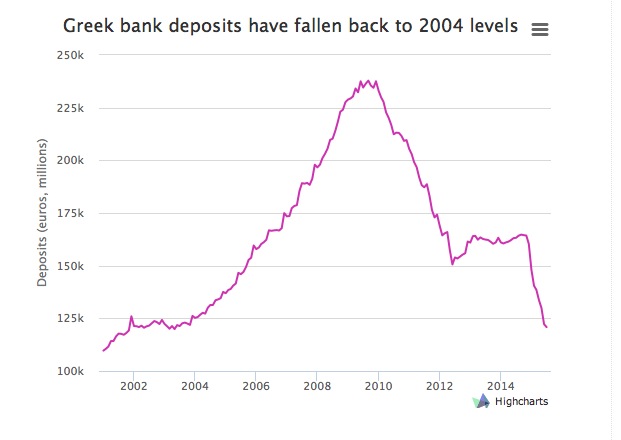
Tsipras is again trying to resolve the impasse at the “political” level, meaning going to Merkel Hollande, and Juncker. This has a Groundhog day feel...So Greece is caught between a Scylla and a Charybdis. But unlike the myth, there’s no evidence that a path exists to navigate between them.
MORE BAD NEWS AT LINK
European creditors want to extract more blood from a stone, in this case Greece.
Greece and its lenders are again at odds over the latest “bailout” funds, which is €2 billion that was scheduled to be approved for release by the famed Eurobgroup (remember them? That’s all the Eurozone finance ministers) on Monday. But a precondition for getting more dough was that Greece show enough “progress,” as in either have implemented or have committed to a sufficiently large number of “reforms”. “Reform” is Eurocrat-speak for austerian blood-letting. The creditors see Greece as coming up short. As we’ve pointed out repeatedly in our coverage of Greece, the lenders are hell-bent on seeing Greece remake its economy in ways that are guaranteed to make their loans fail, or perhaps more accurately, produce even greater losses than if they allowed for more investment and spending, rather than insist on punitively high budget surpluses and other destructive measures.
Why this fixation on implementing failed policies? The reasons vary by actor, but they include: delusion (as in they believe austerity “works” as in makes economies better), political necessity/survival (governments that implemented austerity programs at high costs to their citizens can’t be seen to be letting the greatest profligate, Greece, get off easy), a fixation with morality (Greece must suffer pour decourager les autres). But irrespective of the proximate causes of what looks like an exercise in sadism dressed up as economic orthodoxy, the creditors appear united, or at least united enough, to cram yet another set of punitive reforms on the already prostrated Greeks. Here are the big issues where the two sides remain far apart:
- Foreclosures. As part of the banking system bailout, the Troika wants more writeoffs of bad loans. They insist on a related measure, of lowering the value of homes that are subject to foreclosure from €200,000 to €120,000
- Increasing tax collections
- Increasing the VAT on private schools to 23%. I’m a bit mystified by Syriza fighting this measure if “private schools” are academies for the wealthy. But if the Greek Orthodox Church operates primary and secondary schools, as the Catholic Church does in the US, it could affect a much larger number of students at much lower levels of family income. Input from informed readers appreciated. Mind you, Syriza is proposing to find the funds to cover up this income loss elsewhere, but apparently have yet to satisfy the lenders on this point.
As anyone who remembers the US foreclosure crisis will attest, almost without exception foreclosing on homes leads to higher losses than keeping the homeowner in place. There’s no reason to think the results will be any different in Greece. First, foreclosed properties cost money to secure and maintain and often deteriorate rapidly. In Greece, unlike the US, you have much greater risk of civil disobedience with foreclosures, in the form of squatting or vandalism (and we had plenty here that was purely economic, such as stripping homes of copper and appliances). Second, who will buy these properties? Foreigners are at risk of being threatened physically. And the idea of buying properties and turning them into rentals for the displaced homeowners hasn’t worked out for investors in the US, where we’ve had a so-so economic recovery and a strong bounce in house prices in the weakest markets. The outcomes would clearly be worse in Greece. And that’s before you get to the offset of higher social costs from more homelessness.
Similarly, it might have occurred to the creditors that the threat of a bank holiday, which then took place, led many citizens to pull as much as possible out of their bank accounts. So Greece, which already had a large black market economy, has if anything more cash in circulation to facilitate even more domestic tax evasion. One can argue that the taxable economy is in a death spiral. The more the creditors insist on higher VAT, the greater the incentive to deal in cash to avoid the VAT, which means lower VAT receipts than projected, which leads the creditors to call for higher tax rates. Greece already has a huge problem with tax avoidance; the current program for dealing with it reads like a prescription to make matters worse. Even tourists are wising up. A contact recently vacationed in Greece and took tons of cash, and got substantial price breaks and much happier vendors/service providers as a result.
Needless to say, Greeks are not putting their cash back in banks. From the Telegraph:
Tsipras is again trying to resolve the impasse at the “political” level, meaning going to Merkel Hollande, and Juncker. This has a Groundhog day feel...So Greece is caught between a Scylla and a Charybdis. But unlike the myth, there’s no evidence that a path exists to navigate between them.
MORE BAD NEWS AT LINK
Edit history
Please sign in to view edit histories.
Recommendations
0 members have recommended this reply (displayed in chronological order):
60 replies
 = new reply since forum marked as read
Highlight:
NoneDon't highlight anything
5 newestHighlight 5 most recent replies
RecommendedHighlight replies with 5 or more recommendations
= new reply since forum marked as read
Highlight:
NoneDon't highlight anything
5 newestHighlight 5 most recent replies
RecommendedHighlight replies with 5 or more recommendations
= new reply since forum marked as read
Highlight:
NoneDon't highlight anything
5 newestHighlight 5 most recent replies
RecommendedHighlight replies with 5 or more recommendations
Well, Matt, if this is what you do extemporaneously, I'll give more notice next time!
Demeter
Nov 2015
#3
probably none of it...they will focus on the Paris attacks and foreign policy. nt
antigop
Nov 2015
#39
Greece and Creditors at Loggerheads Again; Troika Wants More Foreclosures YVES SMITH
Demeter
Nov 2015
#33
The Illusions of the Leaders of Large Health Organizations, as Illustrated by Medtronic’s Founder
Demeter
Nov 2015
#28