“Flower Power”: Photovoltaic Cells Replicate Rose Petals [View all]
http://www.kit.edu/kit/english/pi_2016_097_flower-power-photovoltaic-cells-replicate-rose-petals.php[font face=Serif]Press Release 097/2016
[font size=5]“Flower Power”: Photovoltaic Cells Replicate Rose Petals[/font]
[font size=4]KIT scientists increase the efficiency of solar cells by replicating the structure of petals – publication in Advanced Optical Materials[/font]
[center]
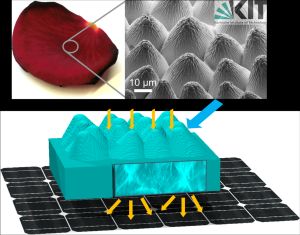
[font size=1]Biomimetics: The epidermis of a rose petal is replicated in a transparent layer which is then integrated into the front of a solar cell. (Illustration: Guillaume Gomard, KIT)[/font][/center]
[font size=4]With a surface resembling that of plants, solar cells improve light-harvesting and thus generate more power. Scientists of KIT (Karlsruhe Institute of Technology) reproduced the epidermal cells of rose petals that have particularly good antireflection properties and integrated the transparent replicas into an organic solar cell. This resulted in a relative efficiency gain of twelve percent. An article on this subject has been published recently in the Advanced Optical Materials journal (DOI:
10.1002/adom.201600046).[/font]
[font size=3]Photovoltaics works in a similar way as the photosynthesis of plants. Light energy is absorbed and converted into a different form of energy. In this process, it is important to use a possibly large portion of the sun's light spectrum and to trap the light from various incidence angles as the angle changes with the sun’s position. Plants have this capability as a result of a long evolution process – reason enough for photovoltaics researchers to look closely at nature when developing solar cells with a broad absorption spectrum and a high incidence angle tolerance.
Scientists at the KIT and the ZSW (Center for Solar Energy and Hydrogen Research Baden-Württemberg) now suggest in their article published in the Advanced Optical Materials journal to replicate the outermost tissue of the petals of higher plants, the so-called epidermis, in a transparent layer and integrate that layer into the front of solar cells in order to increase their efficiency.
First, the researchers at the Light Technology Institute (LTI), the Institute of Microstructure Technology (IMT), the Institute of Applied Physics (APH), and the Zoological Institute (ZOO) of KIT as well as their colleagues from the ZSW investigated the optical properties, and above all, the antireflection effect of the epidermal cells of different plant species. These properties are particularly pronounced in rose petals where they provide stronger color contrasts and thus increase the chance of pollination. As the scientists found out under the electron microscope, the epidermis of rose petals consists of a disorganized arrangement of densely packed microstructures, with additional ribs formed by randomly positioned nanostructures.
…[/font][/font]

 = new reply since forum marked as read