The Pacific Ocean has a plastic problem. Here's the bold plan to fix it. [View all]
Environmental group will use floating nets to snag plastic debris.
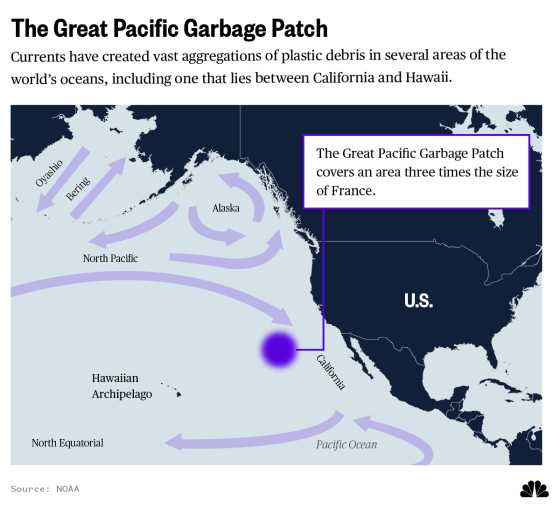
In the Pacific Ocean halfway between California and Hawaii lies what’s become known as the Great Pacific Garbage Patch, a huge jumble of fishing nets, bottles, bags, and other plastic items as well as tiny bits of plastic debris. “It’s a vast plastic soup,” says Kahi Pacarro, executive director of Honolulu-based Sustainable Coastlines Hawaii.
We’ve known about the existence of the patch since the mid-1980s but weren't quite sure about its size until a study published last March showed that it holds at least 79,000 tons of plastic and covers an area three times the size of France.
And the aggregation of trash is growing, says Richard Thompson, a marine biologist at Plymouth University in the U.K. who has studied plastic waste and wasn’t involved in the paper. “It’s a big cause for concern,” he says.
The patch presents more than an aesthetic problem. The debris entangles and kills all sorts of sea animals, including turtles, dolphins, and whales, and breaks down into microscopic particles that are consumed by fish and filter feeders like mussels and oysters. When we eat these animals, we may, in turn, consume those particles — with unknown effects on our health.
And the Great Pacific Garbage Patch isn't the only one out there. It's technically known as the eastern Pacific Garbage Patch because there is another collection of trash in the western Pacific. Similar aggregations can be found in the oceans' four other circular currents, or gyres, with one patch each in the South Pacific and Indian Ocean and two in the Atlantic. Some researchers object to the term "patch," as it connotes a heap of visible plastic, when in reality most of the trash floats invisibly in small pieces below the surface.
Much more:
https://www.nbcnews.com/mach/science/pacific-ocean-has-plastic-problem-here-s-bold-plan-fix-ncna867456

 = new reply since forum marked as read