Welcome to DU!
The truly grassroots left-of-center political community where regular people, not algorithms, drive the discussions and set the standards.
Join the community:
Create a free account
Support DU (and get rid of ads!):
Become a Star Member
Latest Breaking News
Editorials & Other Articles
General Discussion
The DU Lounge
All Forums
Issue Forums
Culture Forums
Alliance Forums
Region Forums
Support Forums
Help & Search
Environment & Energy
In reply to the discussion: America's 2 New Nukes Are on the Brink of Death [View all]
kristopher
(29,798 posts)41. Nuclear industry dreams dashed by current economic reality
Nuclear industry dreams dashed by current economic reality
It was the financing model and rates of return that prompted German nuclear giants RWC and E.ON to pull out of UK energy plans
Martin Cohen
guardian.co.uk, Monday 2 April 2012 05.58 EDT
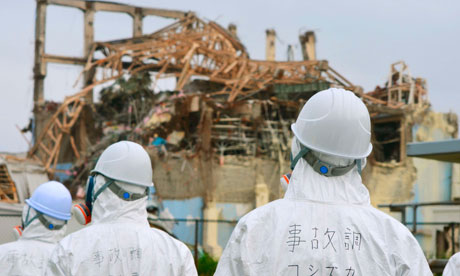
Japan's Fukushima nuclear plant was built just above sea-level, with cliffs bulldozed – a risky plan forced by economic necessity. Photograph: Kyodo/Reuters
http://www.guardian.co.uk/business/economics-blog/2012/apr/02/nuclear-dreams-economic-reality-blog
It was the financing model and rates of return that prompted German nuclear giants RWC and E.ON to pull out of UK energy plans
Martin Cohen
guardian.co.uk, Monday 2 April 2012 05.58 EDT
Japan's Fukushima nuclear plant was built just above sea-level, with cliffs bulldozed – a risky plan forced by economic necessity. Photograph: Kyodo/Reuters
The news that nuclear giants RWE and E.ON are dropping plans to build any new UK reactors has sent a toxic cloud not only over Wales, but over the nuclear industry itself.
Of course, everyone knows nowadays, post-Chernobyl, post-Fukushima, that nuclear power plants are not really safe. Even if there are a few noisy die-hards, arguing that the resulting radiation is harmless, and that "hardly anyone" dies as a direct consequence of atomic meltdown, that old canard just won't wash any more.
Other nuclear myths, though, have lingered on. Atomic energy, unveiled by Her Majesty with grand aplomb at Calder Hall half a century ago, still has a hi-tech glamour, an aura of somehow being "the future". The reality that atomic plants are basically steam engines staffed by thousands of casual workers who would otherwise be picking strawberries or digging up roads somehow never impinges. Perhaps one of the most shocking images post-Fukushima, was of unskilled workers hosing sea water on to the smouldering wreckage. Not here the calm, fatherly figures in their white lab-coats in front of consoles worthy of the Starship Enterprise.
But there are solid, practical reasons why nuclear power relies on casual staff using dustpans and brushes to sweep up radioactive dust, or hoses to cool down spent fuel. Best of which is that it's cheaper. An enlightening fact about Fukushima, where the tsunami swept over the safety wall, was that at this point on the coast, the land is well above the level of any waves, tsunami or otherwise. It required considerable ingenuity to bulldoze the cliffs down to sea-level to construct a plant that was then potentially at risk. However, the plant operators knew that nuclear electricity is not actually "too cheap to meter", whatever Eisenhower may have said, and the additional cost of pumping seawater up to the top of the cliffs would have eaten into their bottom line. Hence, the small, if ever so slightly risky, strategy of situating the complex at sea-level.
So the torpedo that has just been launched at the majestic British nuclear ship ...
Of course, everyone knows nowadays, post-Chernobyl, post-Fukushima, that nuclear power plants are not really safe. Even if there are a few noisy die-hards, arguing that the resulting radiation is harmless, and that "hardly anyone" dies as a direct consequence of atomic meltdown, that old canard just won't wash any more.
Other nuclear myths, though, have lingered on. Atomic energy, unveiled by Her Majesty with grand aplomb at Calder Hall half a century ago, still has a hi-tech glamour, an aura of somehow being "the future". The reality that atomic plants are basically steam engines staffed by thousands of casual workers who would otherwise be picking strawberries or digging up roads somehow never impinges. Perhaps one of the most shocking images post-Fukushima, was of unskilled workers hosing sea water on to the smouldering wreckage. Not here the calm, fatherly figures in their white lab-coats in front of consoles worthy of the Starship Enterprise.
But there are solid, practical reasons why nuclear power relies on casual staff using dustpans and brushes to sweep up radioactive dust, or hoses to cool down spent fuel. Best of which is that it's cheaper. An enlightening fact about Fukushima, where the tsunami swept over the safety wall, was that at this point on the coast, the land is well above the level of any waves, tsunami or otherwise. It required considerable ingenuity to bulldoze the cliffs down to sea-level to construct a plant that was then potentially at risk. However, the plant operators knew that nuclear electricity is not actually "too cheap to meter", whatever Eisenhower may have said, and the additional cost of pumping seawater up to the top of the cliffs would have eaten into their bottom line. Hence, the small, if ever so slightly risky, strategy of situating the complex at sea-level.
So the torpedo that has just been launched at the majestic British nuclear ship ...
http://www.guardian.co.uk/business/economics-blog/2012/apr/02/nuclear-dreams-economic-reality-blog
Edit history
Please sign in to view edit histories.
Recommendations
0 members have recommended this reply (displayed in chronological order):
46 replies
 = new reply since forum marked as read
Highlight:
NoneDon't highlight anything
5 newestHighlight 5 most recent replies
RecommendedHighlight replies with 5 or more recommendations
= new reply since forum marked as read
Highlight:
NoneDon't highlight anything
5 newestHighlight 5 most recent replies
RecommendedHighlight replies with 5 or more recommendations
= new reply since forum marked as read
Highlight:
NoneDon't highlight anything
5 newestHighlight 5 most recent replies
RecommendedHighlight replies with 5 or more recommendations
If taxpayers aren't forced to cover the risk, then a new nuke is nowhere near feasible.
qb
Apr 2012
#2
Good now that the most expensive form of energy is off the table, can we get on with real green
Vincardog
Apr 2012
#4
Vogtle Nuclear Construction Faces “Additional Delay” Based on Miscalculations in Foundation Concrete
kristopher
Apr 2012
#28
Exelon CEO: (nuclear) "is on the backs of the ratepayers, not the backs of the shareholders"
kristopher
Apr 2012
#29
The spreading global economic crisis is going to put a major crimp in nuclear plans in many places.
GliderGuider
Apr 2012
#45