Climate of North American cities will shift hundreds of miles in one generation [View all]
https://www.umces.edu/content/climate-north-american-cities-will-shift-hundreds-miles-one-generationClimate of North American cities will shift hundreds of miles in one generation
February 12, 2019
Appalachian Laboratory
New web application helps visualize climate changes in 540 North American cities
FROSTBURG, MD (February 12, 2019)—In one generation, the climate experienced in many North American cities is projected to change to that of locations hundreds of miles away—or to a new climate unlike any found in North America today. A new study and
interactive web application aim to help the public understand how climate change will impact the lives of people who live in urban areas of the United States and Canada. These new climate analyses match the expected future climate in each city with the current climate of another location, providing a relatable picture of what is likely in store.
“Within the lifetime of children living today, the climate of many regions is projected to change from the familiar to conditions unlike those experienced in the same place by their parents, grandparents, or perhaps any generation in millennia,” said study author
Matt Fitzpatrick of the
University of Maryland Center for Environmental Science. “Many cities could experience climates with no modern equivalent in North America.”
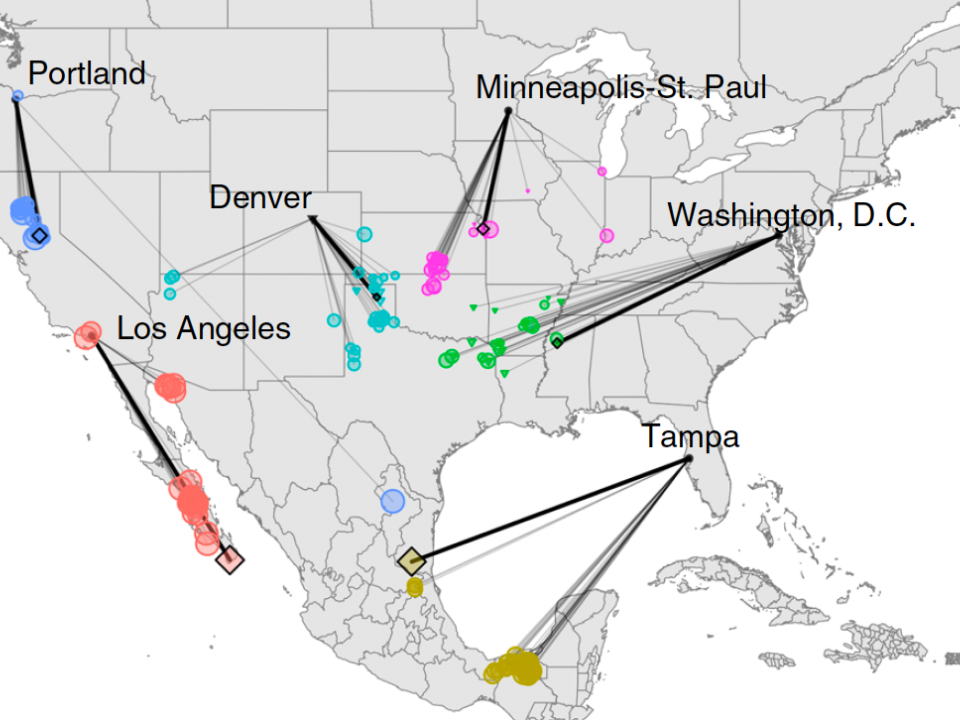
Under current high emissions the average urban dweller is going to have to drive more than 500 miles to the south to find a climate similar to their home city by 2080. (Matthew Fitzpatrick/University of Maryland Center for Environmental Science)
Scientists analyzed 540 urban areas that encompassed approximately 250 million inhabitants in the United States and Canada. For each urban area, they mapped the similarity between that city’s future climate expected by the 2080s and contemporary climate in the western hemisphere north of the equator using 12 measures of climate, including minimum and maximum temperature and precipitation during the four seasons.
The study also mapped climate differences under two emission trajectories: unmitigated emissions (RCP8.5), the scenario most in line with what might be expected given current policies and the speed of global action, and mitigated emissions (RCP4.5), which assumes policies are put in place to limit emissions, such as the Paris Agreement.
…
https://dx.doi.org/10.1038/s41467-019-08540-3

 = new reply since forum marked as read