https://www.vims.edu/newsandevents/topstories/2019/oil_spill_grass.php
Study shows continuing impacts of Deepwater Horizon oil spill
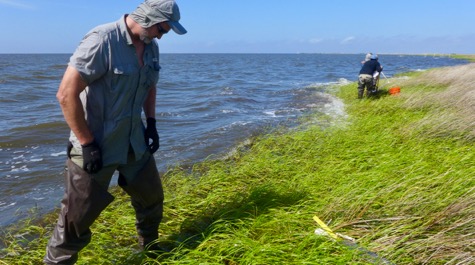
Salt Marsh Sampling Dr. Sean Graham of Nicholls State (L) prepares to sample the marsh soil within a Louisiana salt marsh as his students work in the background. © D. Johnson/VIMS.
by David Malmquist | April 18, 2019
Findings reveal that restoration of marsh vegetation is key to overall recovery
Nine years ago tomorrow—April 20, 2010—crude oil began leaking from the Deepwater Horizon drilling rig into the Gulf of Mexico in what turned out to be the
largest marine oil spill in history. A long-term study suggests the oil is still affecting the salt marshes of the Gulf Coast, and reveals the key role that marsh grasses play in the overall recovery of these important coastal wetlands.
Conducting the study was a multi-institutional research team funded in part by the
Gulf of Mexico Research Initiative, a 10-year independent program established through a $500 million financial commitment from BP. The team began sampling soon after the spill was finally contained, and continue their work today.
Their most-recent article—in Estuaries and Coasts—reports on the first six and a half years of sampling post-spill.
Lead author on the study is John Fleeger, an emeritus professor at LSU. Co-authors are Rita Riggio, Irving Mendelssohn, Qianxin Lin, and Aixin Hou of LSU; David Johnson of William & Mary’s Virginia Institute of Marine Science; Donald Deis of Atkins North America; Kevin Carman of the University of Nevada-Reno; Sean Graham of Nicholls State University; and Scott Zengel of Research Planning, Inc.
Johnson, an assistant professor at VIMS and expert in salt-marsh invertebrates, says “Our study highlights the crucial role that plants play in the recovery of important links in the Gulf of Mexico’s coastal food web.” Those links ultimately connect to the fish and shellfish that support the region’s economy and culture.
…
https://dx.doi.org/10.1007/s12237-018-0443-2

 = new reply since forum marked as read