Welcome to DU!
The truly grassroots left-of-center political community where regular people, not algorithms, drive the discussions and set the standards.
Join the community:
Create a free account
Support DU (and get rid of ads!):
Become a Star Member
Latest Breaking News
Editorials & Other Articles
General Discussion
The DU Lounge
All Forums
Issue Forums
Culture Forums
Alliance Forums
Region Forums
Support Forums
Help & Search
Environment & Energy
In reply to the discussion: Collapse Of Antarctic Ice Sheet Would Likely Put Washington, D.C. Largely Underwater [View all]
OKIsItJustMe
(22,100 posts)13. Here's a helpful graph
http://climate.nasa.gov/news/index.cfm?FuseAction=ShowNews&NewsID=242
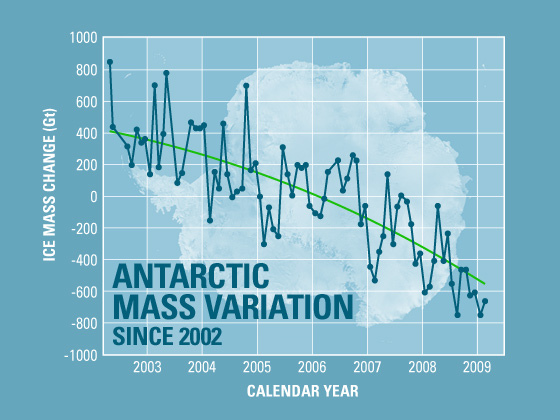
And here’s a better source for the recent news (Please note, NASA publication, copyright concerns are nil):
http://www.nasa.gov/topics/earth/features/currents-ice-loss.html
And here’s a better source for the recent news (Please note, NASA publication, copyright concerns are nil):
http://www.nasa.gov/topics/earth/features/currents-ice-loss.html
[font face=Times, Times New Roman, Serif][font size=5]Warm Ocean Currents Cause Majority of Ice Loss from Antarctica[/font]
04.25.12
[font size=3]WASHINGTON -- Warm ocean currents attacking the underside of ice shelves are the dominant cause of recent ice loss from Antarctica, a new study using measurements from NASA's Ice, Cloud, and land Elevation Satellite (ICESat) revealed.
An international team of scientists used a combination of satellite measurements and models to differentiate between the two known causes of melting ice shelves: warm ocean currents thawing the underbelly of the floating extensions of ice sheets and warm air melting them from above. The finding, published today in the journal Nature, brings scientists a step closer to providing reliable projections of future sea level rise.
The researchers concluded that 20 of the 54 ice shelves studied are being melted by warm ocean currents. Most of these are in West Antarctica, where inland glaciers flowing down to the coast and feeding into these thinning ice shelves have accelerated, draining more ice into the sea and contributing to sea-level rise. This ocean-driven thinning is responsible for the most widespread and rapid ice losses in West Antarctica, and for the majority of Antarctic ice sheet loss during the study period.
"We can lose an awful lot of ice to the sea without ever having summers warm enough to make the snow on top of the glaciers melt," said the study's lead author Hamish Pritchard of the British Antarctic Survey in Cambridge, United Kingdom. "The oceans can do all the work from below."
…
The new research also links the observed increase in melting that occurs on the underside of a glacier or ice shelf, called basal melt, and glacier acceleration with changes in wind patterns.
"Studies have shown Antarctic winds have changed because of changes in climate," Pritchard said. "This has affected the strength and direction of ocean currents. As a result warm water is funnelled beneath the floating ice. These studies and our new results suggest Antarctica's glaciers are responding rapidly to a changing climate."
A different picture is seen on the Antarctic Peninsula, the long stretch of land pointing towards South America. The study found thinning of the largest ice shelf on the peninsula can be explained by warm summer winds directly melting the snow on the ice shelf surfaces. The patterns of widespread ocean-driven melting and summer melting on the Antarctic Peninsula can be attributed to changing wind patterns.
…[/font][/font]
04.25.12
[font size=3]WASHINGTON -- Warm ocean currents attacking the underside of ice shelves are the dominant cause of recent ice loss from Antarctica, a new study using measurements from NASA's Ice, Cloud, and land Elevation Satellite (ICESat) revealed.
An international team of scientists used a combination of satellite measurements and models to differentiate between the two known causes of melting ice shelves: warm ocean currents thawing the underbelly of the floating extensions of ice sheets and warm air melting them from above. The finding, published today in the journal Nature, brings scientists a step closer to providing reliable projections of future sea level rise.
The researchers concluded that 20 of the 54 ice shelves studied are being melted by warm ocean currents. Most of these are in West Antarctica, where inland glaciers flowing down to the coast and feeding into these thinning ice shelves have accelerated, draining more ice into the sea and contributing to sea-level rise. This ocean-driven thinning is responsible for the most widespread and rapid ice losses in West Antarctica, and for the majority of Antarctic ice sheet loss during the study period.
"We can lose an awful lot of ice to the sea without ever having summers warm enough to make the snow on top of the glaciers melt," said the study's lead author Hamish Pritchard of the British Antarctic Survey in Cambridge, United Kingdom. "The oceans can do all the work from below."
…
The new research also links the observed increase in melting that occurs on the underside of a glacier or ice shelf, called basal melt, and glacier acceleration with changes in wind patterns.
"Studies have shown Antarctic winds have changed because of changes in climate," Pritchard said. "This has affected the strength and direction of ocean currents. As a result warm water is funnelled beneath the floating ice. These studies and our new results suggest Antarctica's glaciers are responding rapidly to a changing climate."
A different picture is seen on the Antarctic Peninsula, the long stretch of land pointing towards South America. The study found thinning of the largest ice shelf on the peninsula can be explained by warm summer winds directly melting the snow on the ice shelf surfaces. The patterns of widespread ocean-driven melting and summer melting on the Antarctic Peninsula can be attributed to changing wind patterns.
…[/font][/font]
Edit history
Please sign in to view edit histories.
Recommendations
0 members have recommended this reply (displayed in chronological order):
34 replies
 = new reply since forum marked as read
Highlight:
NoneDon't highlight anything
5 newestHighlight 5 most recent replies
RecommendedHighlight replies with 5 or more recommendations
= new reply since forum marked as read
Highlight:
NoneDon't highlight anything
5 newestHighlight 5 most recent replies
RecommendedHighlight replies with 5 or more recommendations
= new reply since forum marked as read
Highlight:
NoneDon't highlight anything
5 newestHighlight 5 most recent replies
RecommendedHighlight replies with 5 or more recommendations
Collapse Of Antarctic Ice Sheet Would Likely Put Washington, D.C. Largely Underwater [View all]
MindMover
Apr 2012
OP
For all the snarking, remember the actual RESIDENTS of DC would be absolutely screwed...
Scuba
Apr 2012
#6
Not just residents of DC, residents of almost all coastal areas. 300k people a year.
joshcryer
Apr 2012
#16
Okay, D.C. is toast. I mean, swamp. Wasn't it built on one to being with, LOL.
freshwest
Apr 2012
#8
The judge in the British lawsuit against "An Inconvenient Truth" also said thousands of years
bananas
Apr 2012
#32
The vast majority of ice loss in the 500 billion ton number comes from the Antarctic.
joshcryer
Apr 2012
#30