Environment & Energy
Showing Original Post only (View all)
Disease-Bearing Ticks & Insects Thrive As Climate Chg. Heats Up: Blood-Sucking Bugs Beyond NE [View all]
'Disease-bearing ticks thrive as climate change heats up US.' Blood-sucking ticks & other insects, mosquitos, fleas, flies, lice can spread Lyme disease and are extending beyond their traditional north-eastern range. The Guardian, Aug. 11, 2020.
Growing up in north-eastern Ohio, Kimberly Byce spent much of her childhood running around in the woods, with the greatest threat being mosquito bites or sunburn. She can’t remember her parents ever uttering the word “tick”. And yet, in adulthood, disease-laden ticks now blight her family’s life. Byce’s husband Trent Beers has been struck down by Lyme disease twice in the past year, initially misdiagnosed after suffering back pain so bad he couldn’t emerge from bed, drenched from night sweats and his mind a fog of confusion. Their sons Arbor, four, and Abbott, seven, were struck down by raging fevers initially thought to be related to coronavirus, but subsequently confirmed to also be from Lyme disease.
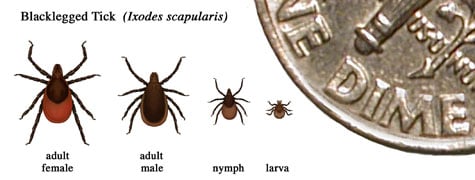
- Image, CDC, Centers for Disease Control
The family has been ravaged by the tiny black-legged, or deer, ticks, a creature the size of a pinhead that can carry Lyme disease and other maladies. Byce picked two of the ticks off her body last week, part of a regime that has become a constant worry in the family’s semi-rural household, located about 30 miles north-east of Columbus, Ohio’s capital. “It’s really wearing on the kids, when they are in the back yard I’m spraying them like a maniac which is kind of putting a lot of fear into them,” Byce said. “I feel like some of their carefree childhood is being taken away but there’s the threat of a lot of damage. What’s scary is that I am the most diligent person with spraying, keeping to trails, being careful, checking for ticks. If I can get them on me, anyone can.”
That Byce could, in her lifetime, go from never even hearing about the warmth-loving ticks to fretting about them from as early as February each year is a possible symptom of a warming climate that, scientists say, is helping push ticks northward and westward from their traditional ranges in the US north-east. Cases of Lyme disease, a potentially debilitating condition primarily transmitted by black-legged ticks, have doubled over the past two decades to about 30,000 cases a year in the US. These ticks have spread into the upper reaches of New England and the midwest, while other tick species normally found in warmer southern states, such as the longhorned tick and lone star tick, are now popping up in New York and New Jersey.
Infections may now spread further, ironically, due to restrictions imposed to curb the spread of Covid-19. National parks and hiking groups have reported huge booms in the number of people seeking to break the monotony of lockdown by heading to walking trails, risking contact with ticks that latch on to people as they brush through vegetation.
“We know tons of people checking out new trails and parks because they have no other options,” said Byce. “If you don’t know what to look for in tick areas, it becomes problematic.”...
Read More, https://www.theguardian.com/us-news/2020/aug/11/ticks-lyme-disease-climate-change-us
__________________________
- CDC, Centers for Disease Control, Lyme Transmission:
In general, adult ticks are approximately the size of a sesame seed and nymphal ticks are approximately the size of a poppy seed. The Lyme disease bacterium, Borrelia burgdorferi, is spread through the bite of infected ticks.
The blacklegged tick (or deer tick, Ixodes scapularis) spreads the disease in the northeastern, mid-Atlantic, and north-central United States. The western blacklegged tick (Ixodes pacificus) spreads the disease on the Pacific Coast.
Ticks can attach to any part of the human body but are often found in hard-to-see areas such as the groin, armpits, and scalp. In most cases, the tick must be attached for 36 to 48 hours or more before the Lyme disease bacterium can be transmitted.
Most humans are infected through the bites of immature ticks called nymphs. Nymphs are tiny (less than 2 mm) and difficult to see; they feed during the spring and summer months. Adult ticks can also transmit Lyme disease bacteria, but they are much larger and are more likely to be discovered and removed before they have had time to transmit the bacteria. Adult Ixodes ticks are most active during the cooler months of the year... https://www.cdc.gov/lyme/transmission/index.html#:~:text=The%20Lyme%20disease%20bacterium%2C%20Borrelia,and%20north%2Dcentral%20United%20States.
 = new reply since forum marked as read
Highlight:
NoneDon't highlight anything
5 newestHighlight 5 most recent replies
= new reply since forum marked as read
Highlight:
NoneDon't highlight anything
5 newestHighlight 5 most recent replies