Welcome to DU!
The truly grassroots left-of-center political community where regular people, not algorithms, drive the discussions and set the standards.
Join the community:
Create a free account
Support DU (and get rid of ads!):
Become a Star Member
Latest Breaking News
Editorials & Other Articles
General Discussion
The DU Lounge
All Forums
Issue Forums
Culture Forums
Alliance Forums
Region Forums
Support Forums
Help & Search
Environment & Energy
In reply to the discussion: (TED Talk) Amory Lovins: A 50-year plan for energy [View all]
OKIsItJustMe
(22,066 posts)36. Energy Efficiency is for Real, Energy Rebound a Distraction
http://blogs.berkeley.edu/2012/01/24/rebound-redux/
[font face=Serif][font size=5]Energy Efficiency is for Real, Energy Rebound a Distraction[/font]
Written by: Shakeb Afsah and Kendyl Salcito and Chris Wielga* • Jan 11, 2012
[font size=4]Summary[/font][font size=3]
Energy efficiency is an over-rated policy tool when it comes to cutting energy use and CO2 emissions—that’s the basic message promoted by the US think tank the Breakthrough Institute (BTI), and amplified in major news outlets like the New Yorker and the New York Times. Their logic is that every action to conserve energy through efficient use leads to an opposite reaction to consume more energy—a “rebound” mechanism, which, according to the BTI, can negate as much as 60-100% of saved energy, and in some cases can backfire to increase net energy consumption.
In this research note we refute this policy message and show that the BTI, as well as its champions in the media, have overplayed their hand, supporting their case with anecdotes and analysis that don’t measure up against theory and data. Our fact-checking revealed that empirical estimates of energy rebound cited by the BTI are over-estimated or wrong, and they contradict the technological reality of energy efficiency gains observed in many industrial sectors.
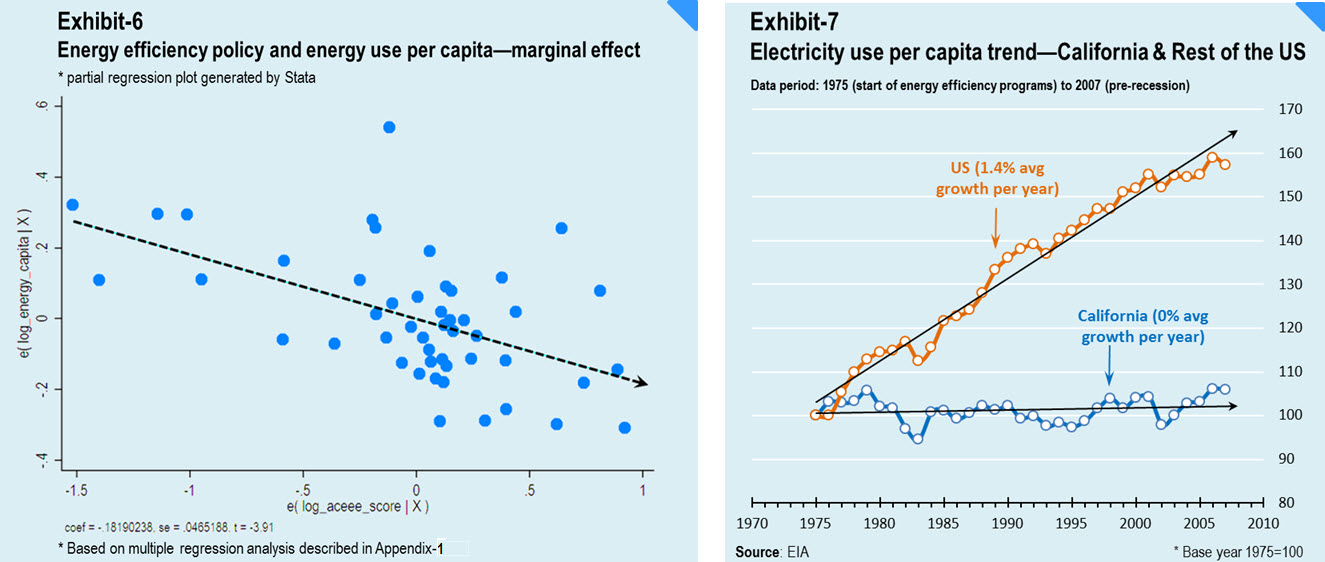
We provide new statistical evidence to show that energy efficiency policies and programs can reliably cut energy use—a finding that is consistent with the policy stance of leading experts and organizations like the US Energy Information Agency (EIA) and the World Bank. Additionally, we take our policy message one step further—by using new insights from the emerging multi-disciplinary literature on “energy efficiency gap”, we recommend that the world needs more energy efficiency policies and programs to cut greenhouse gases—not less as implied by the BTI and its cohorts in the media.
Corresponding author: Kendyl.Salcito@CO2Scorecard.org
…
…[/font][/font]
Written by: Shakeb Afsah and Kendyl Salcito and Chris Wielga* • Jan 11, 2012
[font size=4]Summary[/font][font size=3]
Energy efficiency is an over-rated policy tool when it comes to cutting energy use and CO2 emissions—that’s the basic message promoted by the US think tank the Breakthrough Institute (BTI), and amplified in major news outlets like the New Yorker and the New York Times. Their logic is that every action to conserve energy through efficient use leads to an opposite reaction to consume more energy—a “rebound” mechanism, which, according to the BTI, can negate as much as 60-100% of saved energy, and in some cases can backfire to increase net energy consumption.
In this research note we refute this policy message and show that the BTI, as well as its champions in the media, have overplayed their hand, supporting their case with anecdotes and analysis that don’t measure up against theory and data. Our fact-checking revealed that empirical estimates of energy rebound cited by the BTI are over-estimated or wrong, and they contradict the technological reality of energy efficiency gains observed in many industrial sectors.
We provide new statistical evidence to show that energy efficiency policies and programs can reliably cut energy use—a finding that is consistent with the policy stance of leading experts and organizations like the US Energy Information Agency (EIA) and the World Bank. Additionally, we take our policy message one step further—by using new insights from the emerging multi-disciplinary literature on “energy efficiency gap”, we recommend that the world needs more energy efficiency policies and programs to cut greenhouse gases—not less as implied by the BTI and its cohorts in the media.
Corresponding author: Kendyl.Salcito@CO2Scorecard.org
…
…[/font][/font]
Edit history
Please sign in to view edit histories.
Recommendations
0 members have recommended this reply (displayed in chronological order):
75 replies
 = new reply since forum marked as read
Highlight:
NoneDon't highlight anything
5 newestHighlight 5 most recent replies
RecommendedHighlight replies with 5 or more recommendations
= new reply since forum marked as read
Highlight:
NoneDon't highlight anything
5 newestHighlight 5 most recent replies
RecommendedHighlight replies with 5 or more recommendations
= new reply since forum marked as read
Highlight:
NoneDon't highlight anything
5 newestHighlight 5 most recent replies
RecommendedHighlight replies with 5 or more recommendations
In other words you are going strictly by your own evaluation of the evidence
kristopher
May 2012
#55
Every communication is semantically loaded - at least this one was obvious.
GliderGuider
May 2012
#18
Or, perhaps, you dismiss evidence out-of-hand which does not confirm your beliefs
OKIsItJustMe
May 2012
#27
Your "rebuttal" of Lovins etal leaves the realm of energy efficiency and rebound ...
kristopher
May 2012
#44
That doesn’t follow—(i.e. It's all in where you draw the system boundaries.)
OKIsItJustMe
May 2012
#34
The question is, do “whole lot of little bits add up to” more than the initial savings?
OKIsItJustMe
May 2012
#37
I guess my difficulty is that I don't see further economic productivity as "good".
GliderGuider
May 2012
#57
Having fuel efficient cars in Europe has done nothing to decrease global oil use
GliderGuider
May 2012
#43
I call it a logical deduction. You may call it a hunch if it makes you feel better.
GliderGuider
May 2012
#53