Welcome to DU!
The truly grassroots left-of-center political community where regular people, not algorithms, drive the discussions and set the standards.
Join the community:
Create a free account
Support DU (and get rid of ads!):
Become a Star Member
Latest Breaking News
Editorials & Other Articles
General Discussion
The DU Lounge
All Forums
Issue Forums
Culture Forums
Alliance Forums
Region Forums
Support Forums
Help & Search
Environment & Energy
Showing Original Post only (View all)Some thoughts about Carrying Capacity [View all]
Note to mods: my own work, copyright does not apply.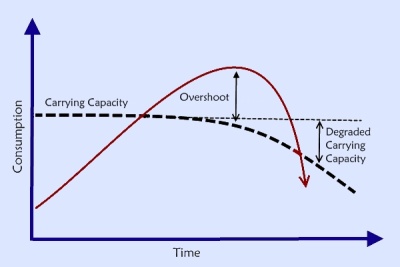
Carrying Capacity is a term that has an obvious intuitive meaning, but one that becomes more nebulous the closer you look at it – especially when we start talking about the planetary carrying capacity for humans
I think the confusion arises because we intuitively conflate two very different understandings of the phrase. I call them the “outside” view and the “inside” view.
The “outside” view of carrying capacity (I call it CCo) is the view of an observer who adopts a position outside the species in question. It’s the typical analytic/synthetic view of an ecologist looking at the reindeer on St. Matthew’s Island, or at the impact of humanity on other species and its own resource base. CCo is the view that is usually assumed by ecologists when they use the naked phrase “carrying capacity”, and it is an assessment that can only be arrived at through deductive reasoning. From this point of view humanity passed CCo a while ago. It probably happened between 1850 to 1950, depending on what factors you draw into your assessment, but certainly before 1975.
The “inside” view of carrying capacity (I call it CCi) comes from adopting the position of a participant within the species in question. Rather than arising from an analytical assessment of the overall situation, it is an instinctual, experiential judgement limited strictly to the population of one's own species. All that matters in this view is how many of my own species will be able to survive to reproduce. If that number is still rising, we have not yet passed CCi. All species, including humans, have this orientation. From this point of view humanity has not yet hit CCi, since our population is still growing.
In the case of humans it’s possible through education to move from the CCi to the CCo view, but for most people who are simply living their daily lives, the CCi view dominates their understanding. It’s the instinctual view, after all, and is therefore a primary driver of our behaviour that can be only weakly modified by reason.
When a species surpasses CCi the inside and outside views converge, as population decline begins. Humanity is now in the uncomfortable region between CCo and CCi where outside observers (we Martian ecologists) have detected overshoot, but the species population as a whole has not identified it yet. As we approach CCi more and more ordinary people are recognizing the problem as the symptoms become more obvious to casual observers. The problem is, of course, the fact that we've been in overshoot with respect to CCo for quite a while already.
When I say that humans have “expanded our carrying capacity” through technological innovation, I am using my "inside" voice. From the experiential, subjective, species point of view, we have indeed made it possible for the environment to support ever more people. This is the only view that matters at the biological, evolutionary level. In humans it is this perspective that encourages constant innovation in the face of scarcity.
The combination of our immense intellectual capacity for innovation and our biological inability to step outside our chauvinistic, anthropocentric perspective has made it impossible for us to avoid landing ourselves in our current insoluble global ecological predicament.
20 replies
 = new reply since forum marked as read
Highlight:
NoneDon't highlight anything
5 newestHighlight 5 most recent replies
= new reply since forum marked as read
Highlight:
NoneDon't highlight anything
5 newestHighlight 5 most recent replies
= new reply since forum marked as read
Highlight:
NoneDon't highlight anything
5 newestHighlight 5 most recent replies
Nope. I expect people to think about what I say if the topic interests them
GliderGuider
May 2012
#12
You're welcome. It helps me to step back and look at the big picture from time to time.
GliderGuider
May 2012
#20