It is generally accepted that the most important inflection point in the past 200K years occurred about 10K years ago with the development of agriculture and settlements. Have you considered that you are placing too heavy an emphasis on fossil fuels and that you are missing the fact that what you are seeing as flat on your chart is actually part of the curves tail covering a period of early geometric growth into the available space with increasingly efficient agricultural techniques?
While energy is very important and fossil fuels have unquestionably played a major role, how would you explain the relationship of these two charts to your thesis. The first is distribution of population by political boundary and the second is GDP, which can serve for the moment as a proxy for fossil fuel consumption:
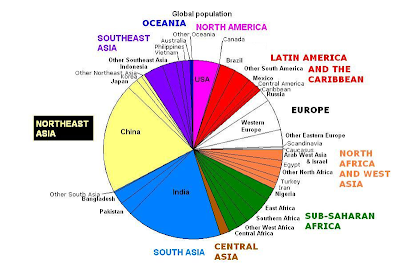
http://3.bp.blogspot.com/_pCDyiFUv9XU/ShMtRtF3zWI/AAAAAAAAEFM/ljupL-7ydQM/s1600-h/GDP+PIE.jpg
The link for the second chart is good, but it isn't displaying for some reason. What it shows is that population growth correlates very poorly with energy consumption.
Let's add one more piece of evidence to the discussion:
Conclusion
We submit that the models provided here present a compelling case that the road to a sustainable future lies in concerted efforts to move from fossil fuels to renewable wind and solar energy sources. This transition can occur in two or three decades and requires very little fossil fuel (on the order of one half of a year’s present global consumption) and no revolutionary technological innovations. Since our model uses conservative estimates, the true renewable potential that is available to our society may be even more optimistic than we show. The primary anticipated obstacles to implementing this transition are non-technical, including lack of political will and economic prioritization. Nevertheless, this transition in the time scale of a few decades is imperative for global climate security.
A Solar Transition is Possible
Peter D. Schwartzman & David W. Schwartzman
March 2011
David Schwartzman is Professor in the Department of Biology at Howard University. He is the author of Life, Temperature and the Earth: The Self-Or- ganizing Biosphere (Columbia University Press). He obtained a PhD in Geo- chemistry from Brown University in 1971.
Peter Schwartzman is Associate Professor and Chair of Environmental Stud- ies at Knox College. He obtained his PhD in Environmental Sciences from the University of Virginia in 1997.

 = new reply since forum marked as read