As of this writing, Germany's carbon dioxide intensity is 298 g CO2/kwh. Wind is providing 35.8 GW of instantaneous power 55.86% capacity utilization.
Electricity Map Germany (3:39 AM 1/29/2022, 9:39 AM Saturday 1/29/2022 Berlin Time)
Coal is providing 19.6 GW of electricity, the first time I've seen it fall below 20 GW of electricity in the last week during random check-ins
It appears from other sources that currently the form of coal that Germany is burning is, in fact, lignite, although it is importing some bituminous coal.
We have from this source, an account of deaths per GWh for major contributors to electrical generation:
Anil Markandya, Paul Wilkinson, Electricity generation and health, The Lancet, Volume 370, Issue 9591, 2007, Pages 979-990.
Here's table 2: 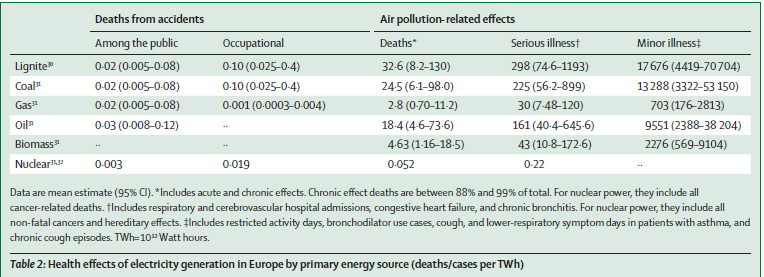
For coal (presumably bituminous and anthracite), 19.6 GWh (24 hour period), the estimated death toll for German electricity will average11.5 deaths/day, which would annualize to around 4200 deaths per year.
For lignin, the corresponding figure for 19.6 GWh (24 hour period) the estimated death toll for German electricity will average 15.3 deaths/day, which would annualize to around 5600 deaths per year.
Heavily nuclearized France, the next door country to Germany, has a carbon intensity of 75 g CO2/kwh. France is producing 47.8 GW as of this writing using nuclear energy.
Using the Lancet figures above, French nuclear electricity works out to an average of 0.06 deaths per day, annualized to 22 deaths/year.
Germany has been telling the rest of Europe, which apparently couldn't care less, that nuclear energy is "too dangerous."
In the best case, if the wind blew constantly and Germany "only" used 19.6 GW of coal electricity continuously, producing "only" 5600 deaths per year, the excess deaths from the German declaration that nuclear power is "too dangerous" would be 5580 deaths per year, rounding the French death toll to 20 deaths/year to respect that the Lancet figures are estimations.
However, 19.6 GW is the lowest figure for coal based electricity I've seen in random checks.
Numbers don't lie, but apparently the people deciding official German energy policy do.

 = new reply since forum marked as read