Welcome to DU!
The truly grassroots left-of-center political community where regular people, not algorithms, drive the discussions and set the standards.
Join the community:
Create a free account
Support DU (and get rid of ads!):
Become a Star Member
Latest Breaking News
Editorials & Other Articles
General Discussion
The DU Lounge
All Forums
Issue Forums
Culture Forums
Alliance Forums
Region Forums
Support Forums
Help & Search
Environment & Energy
In reply to the discussion: In Switzerland today, a pumped hydro facility started operation [View all]
NNadir
(37,890 posts)2. Wow! We're saved! Great! Stupendous! Well, at least until...
...the glaciers in Switzerland disappear because we bet the planetary atmosphere on replacing nuclear energy with stupid fantasies about storing trivial amounts of expensive and useless wind and solar while burning coal.
Egli, P. E., Belotti, B., Ouvry, B., Irving, J., & Lane, S. N. (2021). Subglacial channels, climate warming, and increasing frequency of Alpine glacier snout collapse. Geophysical Research Letters, 48, e2021GL096031.
Excerpts:
Alpine glaciers have been retreating rapidly since the 1980s because of rapid climate warming (Diolaiuti et al., 2011; Fischer et al., 2015; Haeberli et al., 2007; Paul et al., 2004; Sommer et al., 2020). The retreat is forecast to accelerate in the coming decades (Zekollari et al., 2019). The primary mechanism of mass loss for Alpine glaciers is surface melt (Arnold, 2005; Oerlemans & Knap, 1998; Vincent et al., 2004). Negative glacier mass balance can also be driven by reduced snow accumulation. Less considered is basal or internal ablation. This can involve the collapse of subglacial channels in the snout marginal zone, driven by thinning ice combined with slow creep closure. After the collapse, ice is removed via the channel to the glacier outlet.
This mechanism of glacier retreat was first described some time ago as “subglacial stoping” or “block caving” (Loewe, 1957; Paige, 1956). There are very few documented or quantified examples of this process (Bartholomaus et al., 2011; Dewald et al., 2021; Kellerer-Pirklbauer & Kulmer, 2019; Konrad, 1998; Lindström, 1993; Stocker-Waldhuber et al., 2017). As a result, little is known about where and when collapse features form and whether or not their formation frequency is changing due to climate warming...
...The frequency of collapse features in Alpine glaciers has increased markedly since 2000. Such collapse is associated with glaciers that tend to have lower rates of longitudinal ice flux and so reduced compression and longitudinal closure. Low longitudinal flux is a consequence of glacier thinning related to a tendency for Alpine glaciers to have a negative mass balance due to climate warming. Glacier thinning leads to a longterm reduction of flux of accumulated ice into the ablation zone. Thus, the frequency of collapse at Alpine glacier margins is likely to increase as climate warming continues.
This mechanism of glacier retreat was first described some time ago as “subglacial stoping” or “block caving” (Loewe, 1957; Paige, 1956). There are very few documented or quantified examples of this process (Bartholomaus et al., 2011; Dewald et al., 2021; Kellerer-Pirklbauer & Kulmer, 2019; Konrad, 1998; Lindström, 1993; Stocker-Waldhuber et al., 2017). As a result, little is known about where and when collapse features form and whether or not their formation frequency is changing due to climate warming...
...The frequency of collapse features in Alpine glaciers has increased markedly since 2000. Such collapse is associated with glaciers that tend to have lower rates of longitudinal ice flux and so reduced compression and longitudinal closure. Low longitudinal flux is a consequence of glacier thinning related to a tendency for Alpine glaciers to have a negative mass balance due to climate warming. Glacier thinning leads to a longterm reduction of flux of accumulated ice into the ablation zone. Thus, the frequency of collapse at Alpine glacier margins is likely to increase as climate warming continues.
Since 2000...2000...um...2000...why does that year stick in my brain? Oh, I know. That was the year that in 1976 the anti-nuke shithead Amory Lovins implied strongly that we "could" have 16 "quads" (EJ, roughly) of solar energy in the United States. We don't have that on the entire planet, but it's the thought that counts.
It's nice to see "I'm not an anti-nuke" antinukes using units of energy, albeit the derived unit GWh. 20 GWh works out to be 72 trillion joules, slightly less energy than that contained in a single kg of plutonium, 80.3 trillion Joules.
It's a stupendous - and let's be careful to use "percent talk" - 0.000012% of the roughly 600 EJ that humanity consumes each year.
At peak capacity - which in theory can only be utilized 50% of the time at maximum, but will actually will be available for much smaller fractions of a day, it's the equivalent of an 833 MW power plant.
Earth shattering, quite literally.
What's the theory? As of this writing German coal based power output is 19.3 GW, compared to it's wind output of 16.7 MW.
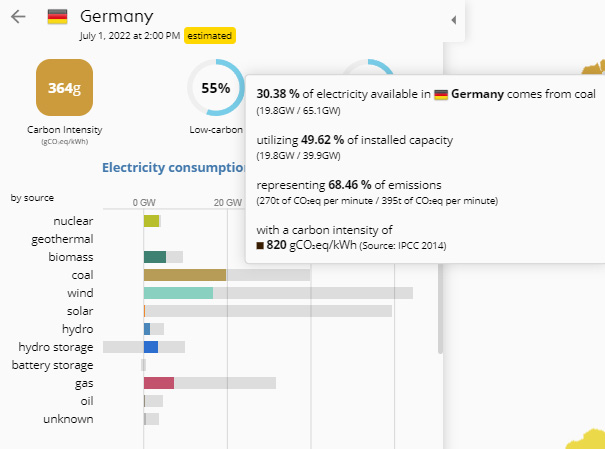
Electricity Map Germany 2200hBerlin220701
Which form of German energy is this water "battery" going to store at 80% efficiency? Or are the Swiss just going to wait until the wind is blowing real, real, real, real, real hard in Germany to fill this daydream up or are they going to waste the power generated by coal?
Have a very pleasant 4th of July weekend.
Edit history
Please sign in to view edit histories.
Recommendations
0 members have recommended this reply (displayed in chronological order):
13 replies
 = new reply since forum marked as read
Highlight:
NoneDon't highlight anything
5 newestHighlight 5 most recent replies
RecommendedHighlight replies with 5 or more recommendations
= new reply since forum marked as read
Highlight:
NoneDon't highlight anything
5 newestHighlight 5 most recent replies
RecommendedHighlight replies with 5 or more recommendations
= new reply since forum marked as read
Highlight:
NoneDon't highlight anything
5 newestHighlight 5 most recent replies
RecommendedHighlight replies with 5 or more recommendations
You are welcome, of course, to find any point on the Electricity Map for that coal hell Germany...
NNadir
Jul 2022
#5
Let's not play pretend: The article in the OP refers to doing away with NUCLEAR energy.
NNadir
Jul 2022
#7