Environment & Energy
Showing Original Post only (View all)
A Commentary on Failure, Delusion and Faith: Danish Data on Big Wind Turbines and Their Lifetimes. [View all]
Last edited Sun Jul 17, 2022, 02:57 PM - Edit history (4)
The consequences of the decades long malign effort to destroy nuclear infrastructure, by diverting vast material, financial and land resources to so called "renewable energy" are now tragically being observed all over the planet, extreme temperatures, vast stretches of wilderness aflame, dying oceanic ecosystems, critical water supplies threatened, desertification on a continental scale, energy poverty emerging in first world countries and so on.
The destroyed nuclear infrastructure is not just that of forty or fifty year old functional and still viable and operable nuclear plants that are being shut by appeals to fear and ignorance; the infrastructure of intellectual engineering, education, manufacturing, training and trained highly skilled and highly paid construction labor, the financial infrastructure, the maintenance infrastructure have all been decimated. The regulatory infrastructure is, frankly, no better. This is true not only in the United States, but in Europe as well. Only in parts of Asia do these tools still exist.
As I never tire of saying, in this century we have spent trillions of dollars on solar and wind energy and the results are those listed in the first paragraph here. Despite the clear evidence of the uselessness, we are still on a path of spending trillions more.
What is worse, these resources were diverted with mere lip service to addressing the most serious matter before humanity, the breakdown of the planetary climate, but rather with the hope of destroying the only viable tool that might have avoided this outcome, nuclear energy.
This experiment in a reactionary approach to energy and the environment - depending on the weather for all of needs, this precisely at the time the weather is seriously destabilized, a feedback loop tied to the failure of the experiment - has produced experimental data. The experiment was reactionary in the sense that for most of human history humanity survived via the vicissitudes of the weather, but the discovery of energy dense materials - dangerous fossil fuels - led to a Faustian postponement of a Malthusian apocalypse, with the result that the human population is roughly 8 times larger than it was when the abandonment of dependence on the weather for all human needs began.
There are quantitative results measuring all of these things. It's called "data."
I am trained to value data as a tool to evaluate the value of theory: When I was a young man, I was an anti-nuke myself; the data from the worst case - Chernobyl - caused me to change my mind, to rethink my position. When the event occurred, knowing almost nothing about nuclear energy other than the pabulum of my fellow anti-nukes, I expected millions of deaths. That didn't happen. There's data on the outcome, and it's still being collected, albeit under conditions threatened by Putin's war, financed by the sale of dangerous fossil fuels to "Green" Europe.
When I joined DU in 2002, I believed that solar and wind were important tools for addressing climate change. I was supportive of money spent on the infrastructure and research devoted to this theory. Of course, when I joined DU in November of 2002, the concentration of the dangerous fossil fuel waste carbon dioxide in the planetary atmosphere was 372.68 ppm. For the last week for which Mauna Loa data has been posted as of this writing, the week beginning July 3, 2022, that measurement was 419.73. I trust - hopefully not naively - that people can add and subtract. The first derivative, the rate of change of CO2 concentrations as measured by 12 month running averages of weekly Mauna Loa CO2 Observatory data, in November 2002 in the week I joined DU, was 1.66 ppm/year. Given the last data point as of this writing, it has reached 2.45 ppm/year.
Let's do something very, very, very crude, just as an illustration with the understanding that it is unsophisticated but may be illustrative:
As of this writing, I have been a member of DU for 19 years and 240 days, which works out in decimal years to 19.658 years. This means the second derivative, the rate of change of the rate of change is 0.04 ppm/yr^2 for my tenure here. (A disturbing fact is that the second derivative for seven years of similar data running from April of 1993 to April of 2000 showed a second derivative of 0.03 ppm/yr^2; the third derivative is also positive, but I'll ignore that for now.) If these trends continue, this suggests that “by 2050,” 28 years from now, using the language that bourgeois assholes in organizations like Greenpeace use to suggest the outbreak of a “renewable energy” nirvana, the rate of change, the first derivative, will be on the order of 3.6 ppm/year. Using very simple calculus, integrating the observed second derivative twice, using the boundary conditions – the current data - to determine the integration constants, one obtains a quadratic equation (0.04)t^2+(2.45)t+ 419.71 = c where t is the number of years after 2022 and c is the concentration at the year in question.
If one looks at the data collected at the Mauna Loa displayed graphically, one can see that the curve is not exactly linear, but has a quadratic aspect somewhat hidden by the small coefficient (0.04) of the squared term:
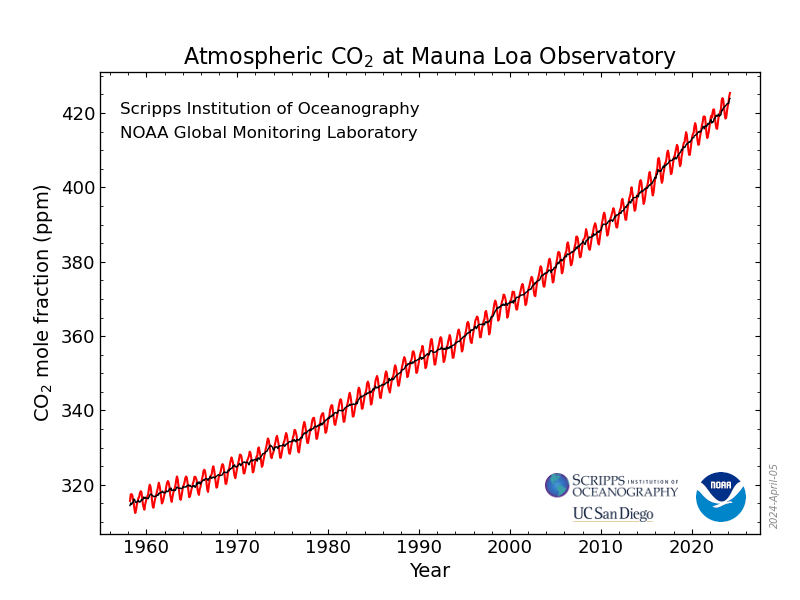
This admittedly crude "model" roughly suggests that the concentration of dangerous fossil fuel waste, carbon dioxide concentrations, given the trend, will be around 520 ppm “by 2050,” in 28 years, passing, by solving the resultant quadratic equation, somewhere around 500 ppm around 2046, just 24 years from now.
I’ll be dead then, but while I’m living the realization of what we are doing to future humanity fills me with existential horror.
Maybe we should rethink our faith in the reactionary impulse to depend on weather for energy.
Maybe we should rethink our assumptions.
Now I’d like to talk about, exactly that, assumptions, in particular very glib assumptions that are as disconnected with reality as the notion that climate change is part of a Chinese plot against America, or that Covid isn't real, or that if it is real, it can be cured by horse de-wormers.
Several times in the past several years I've analyzed the comprehensive database provided the Danish Energy Agency describing the performance every wind turbine they have built in that country going back to the 1970s. This database is the comprehensive Master Register of Wind Turbines. Ironically, or perhaps unironically, the link to the spreadsheet on the same page where, tellingly, if one believes, as I do, that the so called "renewable energy" industry has no problem with the dangerous fossil fuels strangling the planet, one can also download information about Danish oil and gas drilling and rigs in the North Sea.
Several times in this space I have remarked on analyses of the data obtained there, by downloading the Master Register of Wind Turbines, importing it into Excel, and doing some calculations with data, particularly but not exclusively, the Excel date functions. Most recently posted about this analysis here: The Growth Rate of the Danish Wind Industry As Compared to the New Finnish EPR Nuclear Reactor.
Some relevant excerpted text from that post:
The first, reporting a limitation on the accuracy of the energy output of these exercises in environmentally destructive wishful thinking is this:
Second, the analysis of the data on the lifetime of Danish wind turbines:
To understand the average lifetime of wind turbines, it is almost certainly better to look at those that have been decommissioned, those listed in the the afmeldte, "decommissioned" tab. Denmark has built 9,740 turbines and decommissioned 3,444 of them, roughly 35% in "percent talk." The average age of decommissioned wind turbines is 17 years and 317 days, slightly longer than the 2018 figure I calculated back then, which was 17 years and 283 days, an improvement of a whopping 34 days.
An aside:
For a long time on this website, I liberally used the magnificent "ignore button" to deal with rote "renewable energy will save us" anti-nukes who write here. Having been an energy illiterate anti-nuke in my youth, and having changed my mind, I assert that doing so, changing one's mind, requires consideration (of data in this case) and is impossible without consideration. In my (therefore) considered opinion these people are leading the entire planet to irretrievable destruction. Most individuals can arm themselves against the ignorance of the anti-vaxxers; we can get the shot. On the contrary, no one on this planet can arm themselves against climate change and the associated pollution. The human death toll of anti-nukism is already enormous based on the death toll of air pollution and, now, more recently, extreme weather including but limited to extreme heat. The broader implications are listed in the first paragraph of this post.
Someone wants to carry on, 43 years after the fact, about Three Mile Island in this context? Really? Can such a person actually believe that they should be taken seriously? I, mean, really?
Nevertheless, at the end of my life, I should learn to control my anger at what stupidity is if not at what it does. I will never manage what the Japanese call shirankao (知らん顔 ) but I have the personal luxury of knowing that at least in one of my sons, the tools are present to carry on the fight. History abound with those who not live to see their hopes vindicated.
I have no choice but to accept that I will be exiting life, I fear, in an age where ignorance is proudly and loudly celebrated. We of course, see this on the far right; there is no "near right" or "moderate right" anymore. However, we need to recognize that the celebration of ignorance is only weakly, very weakly, associated with one's politics. After nearly 20 years here I know this, but to satisfy myself of the case, and having attained a certain bemusement - although bemusement is hardly appropriate when considering a tragedy - I removed some of the more absurd cases here from my "ignore" list. It does not matter which anti-nukes I've removed from the "ignore list." They're a pretty generic bunch, all chanting the same things over and over and over, in the face of dire reality, the reality described in the first paragraph of this post. I fail to see any difference between the stuff anyone of them says and Catholics reciting the "Hail Mary" without a shred of consciousness in a Sunday service.
End of the aside.
In response to an evocation of the Danish Energy Agency's Master Register of Wind Turbines in which I (generously) asserted that they last "less than 20 years," the short lifetime that this useless junk possesses is less than 18 years, I was "informed" thusly by a former "ignoree" thusly:
...RE: your Danish spreadsheet. As I have noted in the past, you are misrepresenting the data. Yes most of the early windmills were taken out of service but not because they broke and weren't worth fixing. It's a simple concept - doubling the diameter of the blades increases output by a factor of over 3. In addition, each generation of windmills improves on the previous - in operational efficiency and durability. It's what happens when engineers get to do their work.
I have added to bold to this benighted comment. I note that the person claiming that I was misrepresenting data offered no to support this frankly insipid comment. My "representation" consisted merely of opening the Master Register of Wind Turbines and using Excel functions to calculate directly from the data.
Numbers don't lie.
As for something being "simple," it's clear that the author of this comment knows next to nothing about the wind power he or she endorses so vociferously, which is hardly surprising for a know nothing who chants loudly and proudly. I have in my files an electronic copy of the following book:
Computational Fluid Dynamics for Engineers and Scientists
It is very clear that a person who claims to know something about what occurs when "engineers get to do their work" is so completely unfamiliar with the subject of engineering fluid dynamics - wind is by definition a fluid in a dynamic state - as to declare something that compels an educated and knowledgeable professor to write an entire monograph on computation of the system, is in no position to declare whether something is simple.
It is in fact, only known how wind turbines perform after they are built, since every wind turbine is in a unique place: Huge tracts of land must be industrialized. It is also true that wind turbines actually affect one another, as noted in this paper:
Lundquist, J.K., DuVivier, K.K., Kaffine, D. et al. Costs and consequences of wind turbine wake effects arising from uncoordinated wind energy development. Nat Energy 4, 26–34 (2019) The paper refers to data from wind turbines in Texas and contains this interesting graphic, figure 1b, showing the actual capacity utilization of Texas wind turbines over a period of seven years:
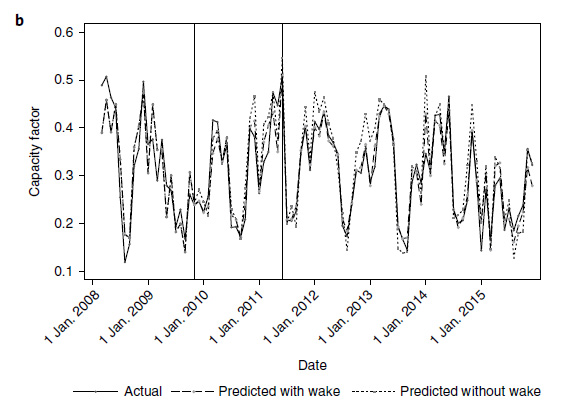
As any idiot can see - although it's clear that there are idiots who will refuse to see - wind turbines only very rarely produce even 50% of their rated capacity. It appears that in summer they have low capacity utilization in general, which in Texas has real consquences since the trillions of dollars squandered on wind energy have had no effect on climate change, with the result that Texas is a "hot spot" for extreme temperatures, pun intended.
The point is that only a person who knows next to nothing would declare any facet of these complex, but useless (in addressing climate change) systems "simple."
This is further obviated by a recent review article in Science which says, in a year that concentrations of the dangerous fossil fuel waste carbon dioxide exceeded 421 for the first time, that there are a lot of unanswered questions about this junk approach to energy: Paul Veers, Katherine Dykes, Eric Lantz, Stephan Barth, Carlo L. Bottasso, Ola Carlson, Andrew Clifton, Johney Green, Peter Green, Hannele Holttinen, Daniel Laird, Ville Lehtomäki, Julie K. Lundquist, James Manwell, Melinda Marquis, Charles Meneveau, Patrick Moriarty, Xabier Munduate, Michael Muskulus, Jonathan Naughton, Lucy Pao, Joshua Paquette, Joachim Peinke, Amy Robertson, Javier Sanz Rodrigo, Anna Maria Sempreviva, J. Charles Smith, Aidan Tuohy, Ryan Wiser, Grand challenges in the science of wind energy, Science, 366, 6464, eaau2027, 2019.
From my perspective there's nothing "Grand" about it: It doesn't work, if working focuses on addressing climate change. It does work if the goal is to defund the only tool we have to address climate change, nuclear energy, to drain its coffers, destroy its infrastructure and thus support the fossil fuel industry's ability to destroy this planet.
In any case, with respect to the idiot claiming I'm "misrepresenting" data, there can be no "misrepresentation" of data when the data is properly subject to simple algebraic operations. In fact, the results are still, under these circumstances, simply data themselves.
I note that the fool in question apparently didn't look at the data provided by the Master Register of Wind Turbines at all when engaging in delusional handwaving, because it has data on large wind turbines, turbines constructed recently and turbines constructed a long time ago. The rated peak power - the figure most often used to lie baldly about wind capacity since these devices never actually produce their rated power - of every turbine in Denmark is listed for each entry.
There are 1,230 commissioned wind turbines in Denmark that are larger than 2000 kW (2MW). There are 40 decommissioned wind turbines in Denmark that are larger than 2000 kW (2MW).
There are commissioned two wind turbines in this class that have operated for more than 20 years, both have a power rating of 2300 kW, 2.3 MW. One, the oldest in the set, is a prototype, a turbine located at Ikast-Brande. It's not performing well. If one takes the average of its two highest years of energy production, and compares it to the most recent complete year of data, that of 2021, one can calculate that in 2021 it produced just 36.01% (in "percent talk"
 of the average of its two best years.
Another commissioned large wind turbine, an 8600 kW (8.5 MW) wind turbine listed as commissioned on October 5, 2018, the turbine at Thistead, produced 23,031,560 kWh of electricity in 2019, 24,986,470 kWh of electricity in 2020, and 6,161,830 kWh in 2021, having apparently failed in the latter year. It's produced zero energy in all of 2022 thus far. The capacity utilization of this turbine was thus 30.55% in 2019, 33.14% in 2020, 8.17% in 2021 and 0.00% as of this writing in 2022. Over it's lifetime, through March 30, 2022 - the date this version of the Master Register ends - the capacity utilization of this broke down "commissioned" turbine operated, its overall capacity utilization was 20.6%. If it has not been repaired as of July 17, 2022 - if it ever will be - it's capacity utilization will have fallen to 19.0%.
The largest commissioned wind turbine listed is the 14000 kW unit also at Thistead. It was commissioned on December 9, 2021, but still has not produced a single Watt of energy.
Of the 1,230 commissioned wind turbines larger than 2MW, only 471 have operated for more than 10 years. So there is no data to support that they will last more than 20 years other than the two 2300 kW (2.3MW) turbines, which may or may not prove to be outliers, to support a handwaving assertion that agrees with the statement of the antinuke that because of the putative "simple concept" that...
...to agree with the implication that bigger turbines are more "durable." The antinuke is simply engaged in wishful thinking based on the data which he or she claims I've "misrepresented" with the obvious inattention to the fact that all I have done is simply to present data itself.
There is weak support from the data which the anti-nuke clearly didn't bother to review, for the claim that large turbines are somewhat more efficient. The average capacity utilization of all the wind turbines in Denmark that are larger than 2000 kW peak power, is 32.50%, which is still not all that impressive to anyone serious about climate change, a subject clearly of no importance to antinukes. Over 22 years since the first "larger than 2MW" wind turbine came on line, all 1,280 of them produced a total of 1.00 Exajoule of energy on a planet that is now consuming about 600 Exajoules of energy every single year.
The data for the 40 decommissioned wind turbines in no way supports a claim of increased durability for large wind turbines, any more than the data for the 10,000 kW (10 MW) and 14,000 (MW) commissioned turbines does. The largest wind turbine ever decommissioned in Denmark, the 9,500 kW (9.5 MW) turbine at Esbjerg operated for just 113 days before turning into landfill. The vanes on the turbine had a diameter of 152 meters, roughly the length of 1.5 US football fields. Only two of them lasted more than 10 years. The 2500 kw (2.5 MW) turbine at Lemvig operated for 10 years and 175 days before becoming landfill. The 2300 kw (2.3 MW) wind turbine at Samsø lasted 14 years and 319 days before becoming landfill. Overall, 13 of the 40 decommissioned wind turbines lasted less than 2 years.
The numbers above - numbers don't lie - are all data. I have not "interpreted" or "represented" the data in any particular fashion. I am spectacularly disinterested in statements from people who clearly know nothing about engineering who while away their days producing more of the same horseshit we've been hearing about so called "renewable energy" - most of it directed at attacking the last best hope of humanity, nuclear energy.
Let me now "interpret" and "represent" the data above: The wind industry, built at a cost of trillions of dollars, is useless if being "useful" is defined at addressing climate change. We don't need anti-nuke airheads pontificating on engineering - a subject about which they clearly know zero - to know that, and we don't even need to open the Danish Master Register of Wind Turbines to know that. We only need to look at the concentration of the dangerous fossil fuel waste carbon dioxide measured at the Mauna Loa CO2 observatory to understand this:
Week beginning on July 10, 2022: 419.08 ppm
Weekly value from 1 year ago: 417.25 ppm
Weekly value from 10 years ago: 394.59 ppm
Last updated: July 17, 2022
Weekly average CO2 at Mauna Loa
I have no respect at all for ignorant chanting, nor the "confidence" that anti-nukes show that someday so called "renewable energy" will provide meaningful energy. It has not; it is not; and it won't.
An anecdote: I went to my dermatologist to look at a suspicious growth on my arm wearing one of the t-shirts the AAAS sends every year when one pays one's membership dues. It read, "Facts are facts." My dermatologist said, "I like your shirt," to which I replied, "It shouldn't be controversial, but somehow it is."
Facts matter.
It shouldn't be controversial to state that half a century of bullshit about how wind energy would replace nuclear has done nothing to address climate change, which in any case has never been the interest of anti-nukes. They have worked tirelessly and clearly somewhat effectively to vandalize an important piece of clean energy infrastructure by carrying on with selective, and frankly exceedingly stupid and dangerous, attention.
Because we have allowed this, because we have allowed fear and ignorance to triumph, history will not forgive us, nor should it.
Enjoy the rest of this Sunday.
 = new reply since forum marked as read
Highlight:
NoneDon't highlight anything
5 newestHighlight 5 most recent replies
= new reply since forum marked as read
Highlight:
NoneDon't highlight anything
5 newestHighlight 5 most recent replies