Environment & Energy
In reply to the discussion: Three DOE National Labs (ORNL, ANL, INL) Report on the Conversion of Coal Plants to Nuclear Plants. [View all]
NNadir
(38,433 posts)The report gives the criteria by which they selected them. Traditionally, before the invention of the combined cycle gas plant, the first process intensification type power plants, coal plants ran as base load power.
I think once the process is demonstrated on low hanging fruit, plants with suitable equipment, up to and including steam generators, it may be useful to move as quickly as is possible to newer operating coal plants as opposed to suitable retired plants. In all cases, coal has go first, and since coal's reliability is second only to nuclear, this will have an immediate effect on the release of carbon dioxide, PAHs, mercury, lead, cadmium, etc..
Combined cycle gas plants run at high efficiency only when they run continuously. When their shut down because some assholes trashed wilderness for wind industrial parks and the wind is blowing, their thermodynamic efficiency falls, rising back only with sufficient run times. These, I think should be next in line. The gas turbine would need to driven by superheated air, rather than by combustion gas; this process will offer the opportunity to remove greenhouse gases and certain very serious pollutants; neither aerosol microplastics, methane, and indeed some HFC's would not survive this process, thus the process would clean the air as opposed to dirtying it. (A caveat is that nitrogen chemistry would need to be monitored carefully, but some fission products in used nuclear fuel might be useful in minimizing this issue.) I have also been studying this process for direct air capture in Brayton/Rankine hybrids, which is what a combined cycle plant is, although I'm still in favor of seawater based carbon capture for a number reasons.
Any Rankine Steam gas plant should be converted to nuclear, because it's essentially equivalent to a coal plant, but slightly less dirty.
I would leave standalone gas turbines in place. Reaching thermal efficiencies (in which exergy is included) of 70-80% using nuclear heat, and thus reducing the heat rejected to the atmosphere, vastly lowering or eliminating the need for cooling water, since our "renewables will save us" rhetoric has destroyed the world's rivers, will necessarily involve the synthesis of fluid fuels, the best one being DME with a carbon source of captured CO2, or CO2 obtained from the pyrolysis of waste biomass, municipal waste and perhaps the clean up of ground water destroyed by fracking.
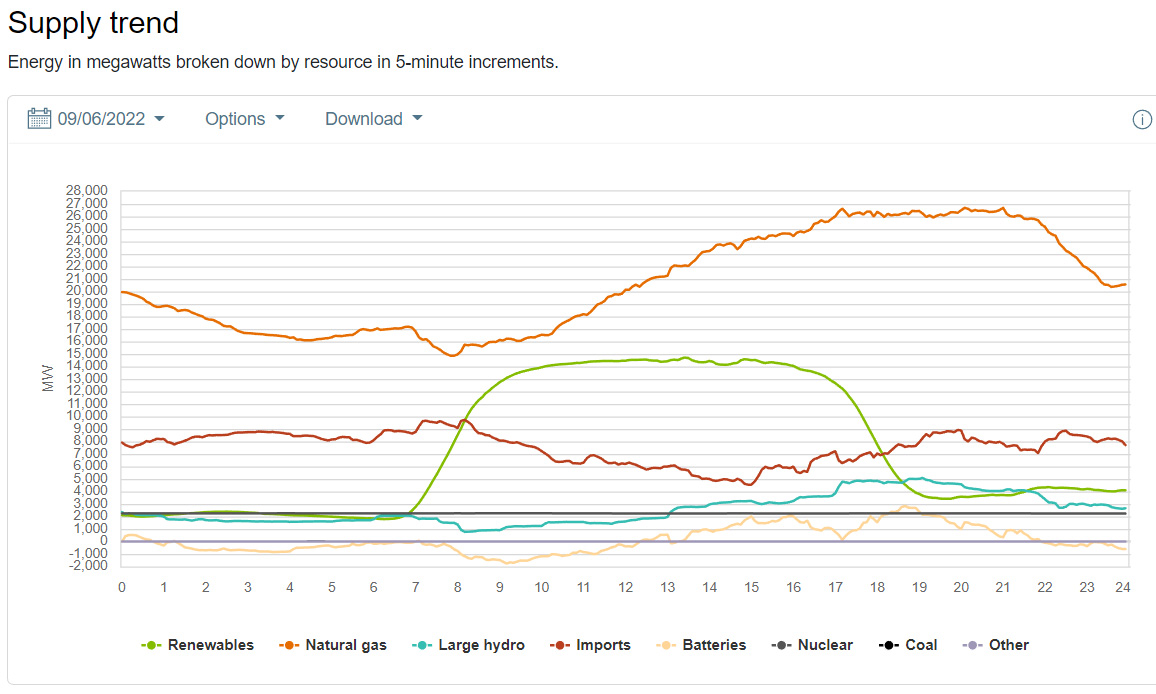
Here is the demand profile for the CAISO system on September 6, 2022, during the episode of extreme heat the state experienced during which record demand on that grid was recorded.

CAISO Demand (Click on Date in upper left)
The peak power, which may have been a record for Demand in the State, with restrictions in place, was 51,145 MW at 7:05 PM in the afternoon.
Here is how California was generating energy that day:
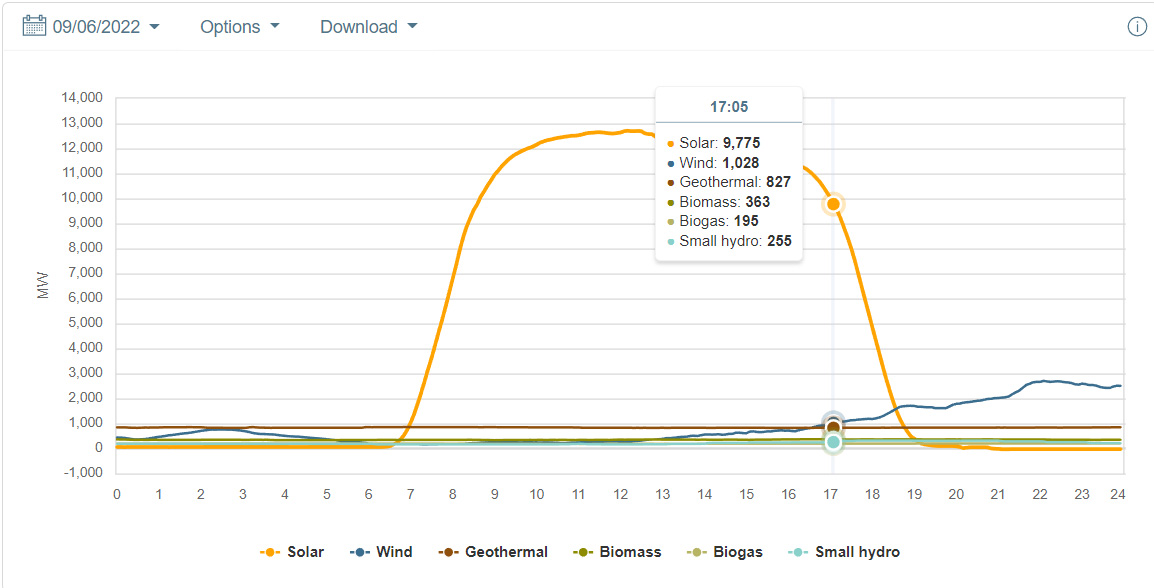
(The so called "renewable" energy shows the power generation numerically in a pop up at 7:05 PM)
The output of dangerous natural gas based power generation, for which the waste CO2 was dumped directly into the atmosphere, remained above 25,000 MW from 4:30 in the afternoon until 10:00 in the evening. The wind, which was producing next to nothing for most of the daylight hours, kicked up a little, but the wind was still a trivial component of demand throughout the entire emergency.
In the morning hours, until noon, the grid was destroying the exergy available in dangerous natural gas to charge batteries - knowing a crisis was coming - at a thermodynamic penalty for which future generations will have to pay.
How might this awful case have been addressed carbon free, without wondering if the wind will blow or if they'll be cloud cover, or (as happened here) extreme heat persists after sundown?
Now consider a case where to capture exergy by converting what would have been waste heat in a nuclear plant to DME. I think that nuclear plants should run flat out, producing more electricity (more or less as a waste product) than the grid demands, utilizing the electricity for industrial processes such as metal refining, desalination, the reduction of carbon dioxide to carbon for materials use, etc., delivering the excess to the grid only during grid emergencies, shutting the industrial plants down temporarily and selling the electricity at a price where doing so is profitable. At this point people might fire up gas turbines with carbon neutral DME (as it will have been made from atmospheric or oceanic carbon dioxide or carbonate).
Given that climate change has made a situation in which a lack of air conditioning can lead to mass fatalities, it might be well advised to lead some cheap peaker plants in place. DME is a drop in fuel for dangerous methane, and as it would be manufactured as a closed cycle, is easily liquified for storage, more easily than propane or LPG, it would represent a stable reserve of fuel.
Thanks for your comment.
Edit history
Recommendations
0 members have recommended this reply (displayed in chronological order): = new reply since forum marked as read
Highlight:
NoneDon't highlight anything
5 newestHighlight 5 most recent replies
RecommendedHighlight replies with 5 or more recommendations
= new reply since forum marked as read
Highlight:
NoneDon't highlight anything
5 newestHighlight 5 most recent replies
RecommendedHighlight replies with 5 or more recommendations