Environment & Energy
In reply to the discussion: Steel recycling firm considers the use of small nuclear reactors to power its arc furnaces. [View all]
progree
(13,076 posts)Last edited Sun Jun 4, 2023, 10:56 PM - Edit history (3)
The most recent release by the International Energy Agency shows solar and wind produced just 12 Exajoules on a planet consuming 624 Exajoules per year.
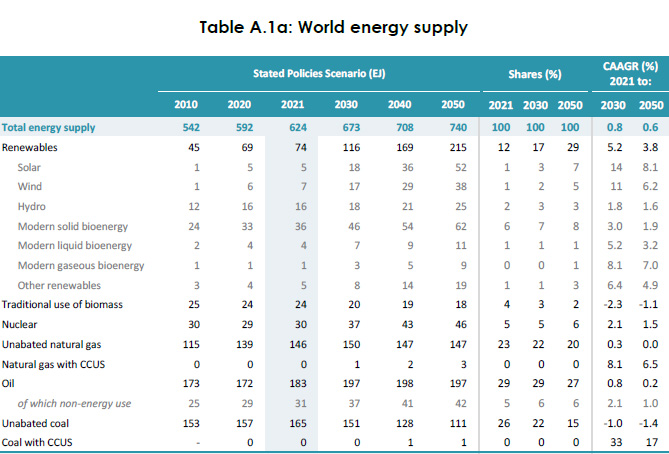
Taken from: https://www.democraticunderground.com/10143033959#post14 (scroll to bottom half of post)
I did a little math exercise to see how much the WEO's "stated policies" scenario (shown in the above table) would reduce fossil fuel use by 2050, the last year in the table.
Fossil fuel supply from IEA WEO 2022. 2021 and 2050 under stated policies scenario, ExaJoules (EJ).
Subtracting "abated with CCUS" and subtracting non-energy use oil (since the table is titled World ENERGY Supply):
2021: 146 - 0 + 183 - 31 + 165 - 0 = 463 EJ . Total energy supply: 624 EJ. % of total energy that is fossil: 74.1%
2050: 147 - 3 + 197 - 42 + 111 - 1 = 409 EJ . Total energy supply: 740 EJ. % of total energy that is fossil: 55.3%
Total fossil supply for energy, % change in EJ from 2021 to 2050: -11.7%, or -12% rounded
So unless the world goes beyond what they project in the above table (a 7.5 fold increase in wind and solar exajoules), we'll reduce fossil fuel consumption by only 12% in 29 years (counting from 2021).
I think we're going to hit some serious resource limits before we get to 7.5-fold increase in solar and wind, and even if that is achieved (see #19 above in the resource intensity ), it only makes a small dent (12%) in the fossil fuel problem as explained just above.
See also a hint at the amount of storage required and its resource intensity to break away from fossil fuel back up. And that doesn't include the amount needed for electric vehicles.
Edited to add 1030p ET: another example is the humble metal nickel:
EV Makers Confront the 'Nickel Pickle' 6/4/23
https://www.democraticunderground.com/1016353383
Large amounts of the mineral are needed for electric car batteries ((and presumably batteries for any large-scale storage purpose such as grid storage -Progree)), but getting it out of the ground and refining it often requires clearing rainforests and generating large amounts of carbon.
In the electric-vehicle business, the quandary is known as the nickel pickle.
To make batteries for EVs, companies need to mine and refine large amounts of nickel. The process of getting the mineral out of the ground and turning it into battery-ready substances, though, is particularly environmentally unfriendly. Reaching the nickel means cutting down swaths of rainforest. Refining it is a carbon-intensive process that involves extreme heat and high pressure, producing waste slurry that’s hard to dispose of.
... The challenge is playing out across Indonesia’s mineral-rich islands, by far the world’s largest source of nickel. These deposits aren’t deep underground but lie close to the surface, under stretches of overlapping forests. Getting to the nickel is easy and inexpensive, but only after the forests are cleared.
And then there's the water requirement of lithium mining, often in arid areas...
But I guess only a "snowflake" worries their pretty little heads off about such matters.
Edit history
Recommendations
0 members have recommended this reply (displayed in chronological order): = new reply since forum marked as read
Highlight:
NoneDon't highlight anything
5 newestHighlight 5 most recent replies
RecommendedHighlight replies with 5 or more recommendations
= new reply since forum marked as read
Highlight:
NoneDon't highlight anything
5 newestHighlight 5 most recent replies
RecommendedHighlight replies with 5 or more recommendations