Welcome to DU!
The truly grassroots left-of-center political community where regular people, not algorithms, drive the discussions and set the standards.
Join the community:
Create a free account
Support DU (and get rid of ads!):
Become a Star Member
Latest Breaking News
Editorials & Other Articles
General Discussion
The DU Lounge
All Forums
Issue Forums
Culture Forums
Alliance Forums
Region Forums
Support Forums
Help & Search
Environment & Energy
Showing Original Post only (View all)
Elevated Radium Activity in a Hydrocarbon-Contaminated Aquifer [View all]
The paper I'll discuss in this post is this one: Elevated Radium Activity in a Hydrocarbon-Contaminated Aquifer, Amy K. Wiersma, Glen Hook, Madeleine Mathews, Sean R. Scott, Jessica R. Meyer, Beth L. Parker, and Matthew Ginder-Vogel Environmental Science & Technology 2023 57 (24), 8983-8993.
Before breaking in commentary, allow me to produce the synopsis of the paper:
Synopsis
This study reports geochemical conditions resulting in elevated naturally occurring radium in groundwater near the source zone of an organic chemical mixture, with implications for human and ecosystem health if extensively mobilized downgradient to aquatic systems and drinking water sources.
This study reports geochemical conditions resulting in elevated naturally occurring radium in groundwater near the source zone of an organic chemical mixture, with implications for human and ecosystem health if extensively mobilized downgradient to aquatic systems and drinking water sources.
The word "synopsis" is in bold and larger type in the original; in the copied text here I have added the bold for "naturally occurring radium."
The hydrocarbon contamination described in the text is anthropogenic as the text I will cite will show, and in this case comes from releases from a chemical plant. However the largest instances, to be sure, of aquifers contaminated with hydrocarbons are those involved with fracking. The Marcellus shale, now part of a huge fracking exercise and not all that far from where I live, is notable for the large amount of "produced water" dumped on the surface. As this shale is both a geological formation of dangerous natural gas, and a uranium formation, the produced water is radioactive because the radium in the natural decay series of uranium, is extracted along with the gas into the water, brought to the surface and dumped.
There are areas where the lakes of produced water are far more radioactive than the seas around Fukushima, Fukushima being the big bogeyman that raises enthusiasm for dangerous natural gas, coal and oil, the difference between the release of radioactivity at Fukushima and the wastes of dangerous natural gas, coal and oil kill people and Fukushima on a scale of millions of people per year, and it not clear if radiation releases at Fukushima has killed anyone, although it is thought that the fear of radiation killed people.
Recently we've had hydrogen salespeople here who nonetheless carried on - stupidly in my opinion - about Fukushima, while advocating for the increased use of fossil fuels, although their industry advertising for the hydrogen industry doesn't represent what it is as such. Nevertheless, 48% of the world's hydrogen is produced by the steam reforming of dangerous natural gas, 30% by the steam reforming of petroleum, and 18% by the steam reforming of coal, the latter mostly in China, the largest consumer of coal in the world. The remaining 4% of the world's hydrogen is produced by electrolysis, mostly as a side product of the chlorine industry, which until recently, represented a major source of mercury release owing to the use of mercury anodes. (Mercury anodes have been largely displaced in the industry, but are still used in some facilities.)
Source: Progress on Catalyst Development for the Steam Reforming of Biomass and Waste Plastics Pyrolysis Volatiles: A Review Laura Santamaria, Gartzen Lopez, Enara Fernandez, Maria Cortazar, Aitor Arregi, Martin Olazar, and Javier Bilbao, Energy & Fuels 2021 35 (21), 17051-17084].
The salespeople in the ads run here would like you to believe that the hydrogen produced by electrolysis is "green hydrogen" produced by using electricity from the generally useless solar and wind industry, and they are always running ads featuring "green hydrogen" facilities that they say run on solar and wind. However, it is very clear that it is highly unlikely that these trivial Potemkin plants shut down whenever the wind isn't blowing and the sun isn't shining, because hysteresis, a lag time during which a current must be applied to an electrolysis device before hydrogen is produced, further degrading the already degraded economics and environmental impact of electrolysis of water. No one will audit the "green hydrogen" plants to see if the electricity really stops being applied to the electrolysis units on dark windless nights, and if they do, be sure you will see cheap accounting tricks like "offsets" that are used to greenwash the use of dangerous fossil fuels. Overall, almost all of hydrogen produced for electrolysis on this planet, the 4% in "percent talk" results from the use of dangerous fossil fuels, at a larger thermodynamic loss than reforming except, perhaps, in places like that off shore oil and gas drilling hellhole Norway.
Steam reforming of dangerous fossil fuels is not only cheaper than electrolysis, it is probably cleaner, where the bold "er" refers to the fact that "cleaner" is hardly ever the same as "clean."
So the hydrogen sales people are really in a "bait and switch" advertising campaign for dangerous fossil fuels, and are only concerned about "radioactivity" when it is present in technologies for the elimination of dangerous fossil fuels. They couldn't care less about radioactivity from the stuff they actually promote in their shell game, dangerous fossil fuels. Let's be clear, anyone promoting hydrogen is promoting dangerous fossil fuels. Soothsaying about some magical wind and solar nirvana that did not come, is not here, and will not come is not the same as actually relying on a product that requires fossil fuels in reality, and even worse, one that wastes energy for the purpose of energy storage. Hydrogen is generally not produced by electrolysis, and when it is, it is very unlikely that the electricity comes from the trivial solar and wind industries.
So then, lets turn the extraction of radium, including both chemical and biological mobilization and transport from the presence of hydrocarbons, in this case from spills and deliberate discharges.
From the paper's introduction:
Thousands of oil, gas, and chemical spills occur annually in the U.S. that pose threats to surface water and groundwater quality. (1) Reducing organic mixtures that reach the subsurface can modify the redox environment of a pristine aquifer, affecting both organic and inorganic groundwater chemistry. Important processes include dissolution/precipitation of minerals, complexation, ion exchange, sorption, and organic matter biodegradation. (2) Strongly reducing conditions typically develop close to the source, and the plume develops a redox gradient, or biogeochemical zones, along and transverse to the dominant groundwater flow direction. (3) The introduced organic matter has a great capacity to donate electrons and is oxidized with corresponding reduction reactions including that of oxygen to water, nitrate to elementary nitrogen (N2), manganese (III/IV) to manganese(II), iron(III) to iron(II), sulfate to sulfide, and carbon dioxide to methane. (3) Microbial communities play a key role in these redox reactions, including those related to organic contaminant biodegradation and inorganic elemental cycling within the developed biogeochemical zones. (4,5) The resulting redox changes associated with organic contaminant spills can result in metal (hydr)oxide reduction and subsequent release of naturally occurring contaminants to groundwater, particularly those with a strong sorption affinity to iron (Fe(III)) and manganese (Mn(IV)) (hydr)oxides. For example, elevated concentrations of arsenic (As), cobalt (Co), chromium (Cr), and nickel (Ni) have been observed in groundwater at crude oil-contaminated sites, (6−12) and elevated concentrations of As and Ni can occur in groundwater at sites contaminated with chlorinated solvents. (13,14) Radium (Ra) is another geogenic contaminant with a strong sorption affinity for Fe(III) and Mn(IV) (hydr)oxides, (15,16) but its occurrence in relation to redox zonation and geochemical conditions in a hydrocarbon-contaminated aquifer has not yet been examined. Recent studies have emphasized the critical need for a holistic view of hydrocarbon-contaminated sites that considers both primary contamination and potential secondary water quality impacts, including the persistence of hydrocarbon partial transformation products (e.g., oxyhydrocarbons) (17−20) and the release of geogenic contaminants from aquifer sediments. (8) This holistic view can improve the assessment of the potential ecological and health effects associated with hydrocarbon-contaminated sites. (21) For example, the mobilization of Ra to aquatic systems and drinking water sources located downgradient creates potential exposure risks to biota and humans. (22)
Consumption of Ra over extended periods is linked to an elevated risk of bone cancer (23,24) and is therefore regulated in drinking water by the U.S. Environmental Protection Agency (EPA) at a maximum contaminant level (MCL) of 185 millibecquerel per liter (mBq/L), or five picocuries per liter (pCi/L), for the combined total of 226Ra and 228Ra. An alkaline earth metal, Ra primarily exists as a divalent cation (Ra2+) under environmentally relevant conditions. (25) Ra is produced within the uranium-238 (238U) and thorium-232 (232Th) decay series, with 226Ra produced along the 238U decay chain and 228Ra produced directly from the alpha decay of 232Th. Therefore, the distribution of parent nuclides 238U and 232Th are important considerations for Ra occurrence in groundwater. Ultimately, Ra activity (concentration) in groundwater is controlled by sorption to Fe and Mn (hydr)oxide and clay minerals, and co-precipitation with sulfate and carbonate minerals. (26−29)
Geochemical conditions that limit sorption, including elevated total dissolved solids (TDS), low pH, and reducing conditions, can result in elevated Ra in groundwater. (30) While these conditions can occur naturally, anthropogenic activities can also alter aquifer geochemical conditions and subsequently influence Ra occurrence in groundwater. For example, increased TDS due to road salt application results in competition for sorption sites and the prevalence of mobile Ra-chloride complexes, increasing Ra activities in groundwater over decadal timescales. (31−33) Seawater intrusion can also increase aquifer TDS, subsequently mobilizing Ra. (34,35) The infiltration of brines from oil production into groundwater can alter salinity, pH, and redox conditions, releasing Ra from aquifer sediments to groundwater. (36,37)
The spill of organic chemicals that reaches the subsurface is another example of anthropogenic influence on aquifer geochemical conditions that could potentially impact Ra occurrence in groundwater. This study evaluates Ra (226Ra + 228Ra) and parent nuclide (e.g., 238U) occurrence in a sandstone aquifer contaminated with a mixture of chlorinated solvents, ketones, and aromatics occurring as a dense non-aqueous phase liquid (DNAPL) in the source zone. The objectives of this study are to (1) compare Ra occurrence within the influence of contamination relative to a background reference location, (2) identify geochemical conditions associated with elevated Ra activity within the influence of contamination, and (3) evaluate potential Ra attenuation mechanisms within the dissolved phase contaminant plume. A network of high-resolution multi-level monitoring systems is used to compare Ra activities in groundwater at three locations: (1) directly downgradient, but not in the DNAPL source zone, (2) near the middle of the dissolved phase hydrocarbon plume, and (3) a background location outside the influence of hydrocarbon contamination. (38) Measured aqueous parameters used to assess 226Ra activities in relation to geochemical conditions induced by organic contaminant occurrence and biodegradation include redox parameters (e.g., nitrate, sulfate, Fe, Mn), TDS, and pH. Geochemical modeling is applied to evaluate Ra sequestration mechanisms within the dissolved phase plume (e.g., co-precipitation, sorption). Overall, this study assesses the potential for the release of naturally occurring Ra from aquifer sediments at hydrocarbon-impacted sites and highlights the importance of characterizing trace elements to achieve a holistic assessment of the potential health and environmental impacts at such sites...
Consumption of Ra over extended periods is linked to an elevated risk of bone cancer (23,24) and is therefore regulated in drinking water by the U.S. Environmental Protection Agency (EPA) at a maximum contaminant level (MCL) of 185 millibecquerel per liter (mBq/L), or five picocuries per liter (pCi/L), for the combined total of 226Ra and 228Ra. An alkaline earth metal, Ra primarily exists as a divalent cation (Ra2+) under environmentally relevant conditions. (25) Ra is produced within the uranium-238 (238U) and thorium-232 (232Th) decay series, with 226Ra produced along the 238U decay chain and 228Ra produced directly from the alpha decay of 232Th. Therefore, the distribution of parent nuclides 238U and 232Th are important considerations for Ra occurrence in groundwater. Ultimately, Ra activity (concentration) in groundwater is controlled by sorption to Fe and Mn (hydr)oxide and clay minerals, and co-precipitation with sulfate and carbonate minerals. (26−29)
Geochemical conditions that limit sorption, including elevated total dissolved solids (TDS), low pH, and reducing conditions, can result in elevated Ra in groundwater. (30) While these conditions can occur naturally, anthropogenic activities can also alter aquifer geochemical conditions and subsequently influence Ra occurrence in groundwater. For example, increased TDS due to road salt application results in competition for sorption sites and the prevalence of mobile Ra-chloride complexes, increasing Ra activities in groundwater over decadal timescales. (31−33) Seawater intrusion can also increase aquifer TDS, subsequently mobilizing Ra. (34,35) The infiltration of brines from oil production into groundwater can alter salinity, pH, and redox conditions, releasing Ra from aquifer sediments to groundwater. (36,37)
The spill of organic chemicals that reaches the subsurface is another example of anthropogenic influence on aquifer geochemical conditions that could potentially impact Ra occurrence in groundwater. This study evaluates Ra (226Ra + 228Ra) and parent nuclide (e.g., 238U) occurrence in a sandstone aquifer contaminated with a mixture of chlorinated solvents, ketones, and aromatics occurring as a dense non-aqueous phase liquid (DNAPL) in the source zone. The objectives of this study are to (1) compare Ra occurrence within the influence of contamination relative to a background reference location, (2) identify geochemical conditions associated with elevated Ra activity within the influence of contamination, and (3) evaluate potential Ra attenuation mechanisms within the dissolved phase contaminant plume. A network of high-resolution multi-level monitoring systems is used to compare Ra activities in groundwater at three locations: (1) directly downgradient, but not in the DNAPL source zone, (2) near the middle of the dissolved phase hydrocarbon plume, and (3) a background location outside the influence of hydrocarbon contamination. (38) Measured aqueous parameters used to assess 226Ra activities in relation to geochemical conditions induced by organic contaminant occurrence and biodegradation include redox parameters (e.g., nitrate, sulfate, Fe, Mn), TDS, and pH. Geochemical modeling is applied to evaluate Ra sequestration mechanisms within the dissolved phase plume (e.g., co-precipitation, sorption). Overall, this study assesses the potential for the release of naturally occurring Ra from aquifer sediments at hydrocarbon-impacted sites and highlights the importance of characterizing trace elements to achieve a holistic assessment of the potential health and environmental impacts at such sites...
Some graphics from the text:
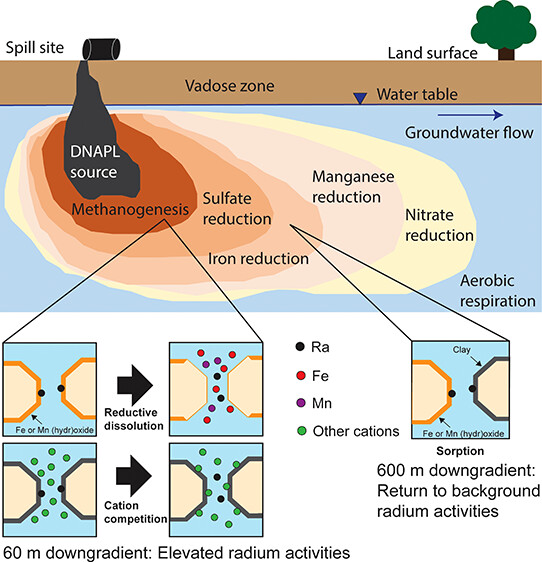
The cartoon for the abstract:
The geographical location:
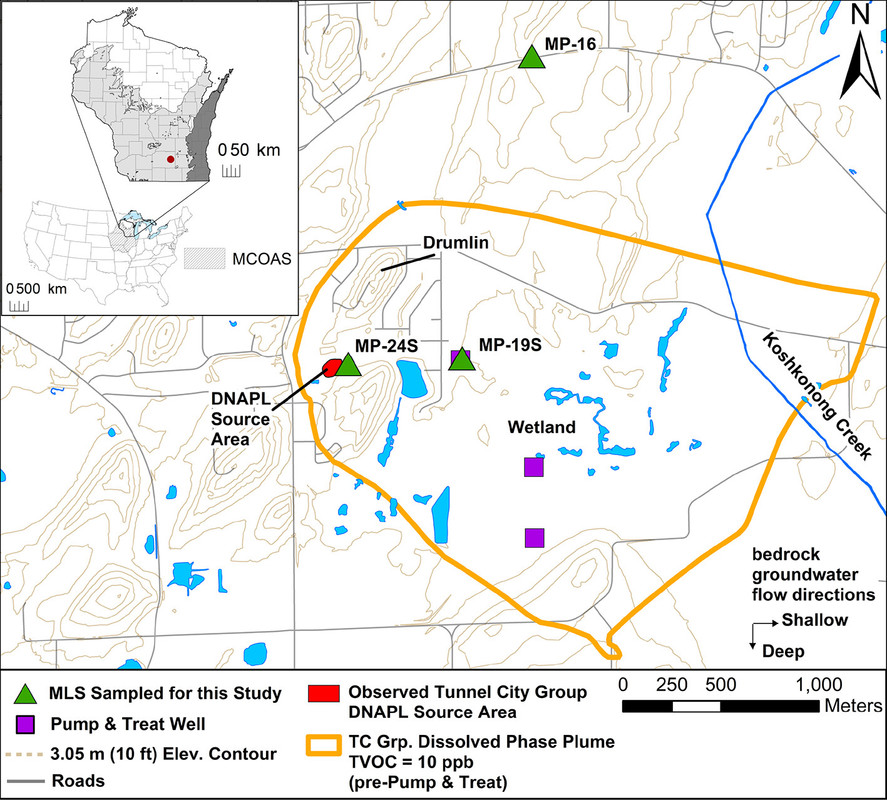
The caption:
Figure 1. Site map showing the Tunnel City Group DNAPL source zone, dissolved phase plume extent, pump and treat wells, and the multi-level systems (MLS) sampled for groundwater in this study. The inset map in the top left shows the study site location within the Midwestern Cambrian-Ordovician aquifer system (MCOAS), with the dark gray area denoting regional confinement of the MCOAS by the Maquoketa Formation. MLS MP-16 is used to represent background aquifer conditions and was sampled by Mathews et al. (38) TVOC = total volatile organic compounds.
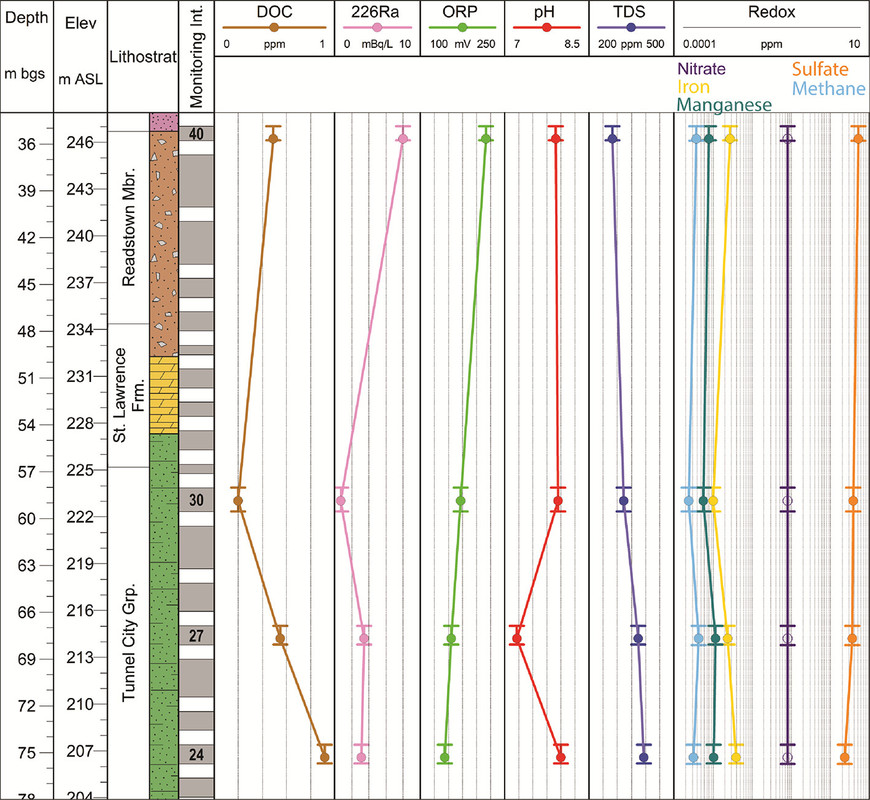
The caption:
Figure 2. 226Ra activities and geochemical conditions in the Tunnel City Group and Readstown Member at multi-level system (MLS) MP-16, located outside the influence of hydrocarbon contamination. (38) The bars above and below each data point indicate the length of each sampling interval. Open data points indicate the measurement is below the limit of detection (LOD) and is plotted as 0.5 × LOD. Bgs = below ground surface, ALS = above sea level, DOC = dissolved organic carbon, ORP = oxidation–reduction potential, TDS = total dissolved solids. A complete stratigraphic column of the study site is shown in Figure S1.
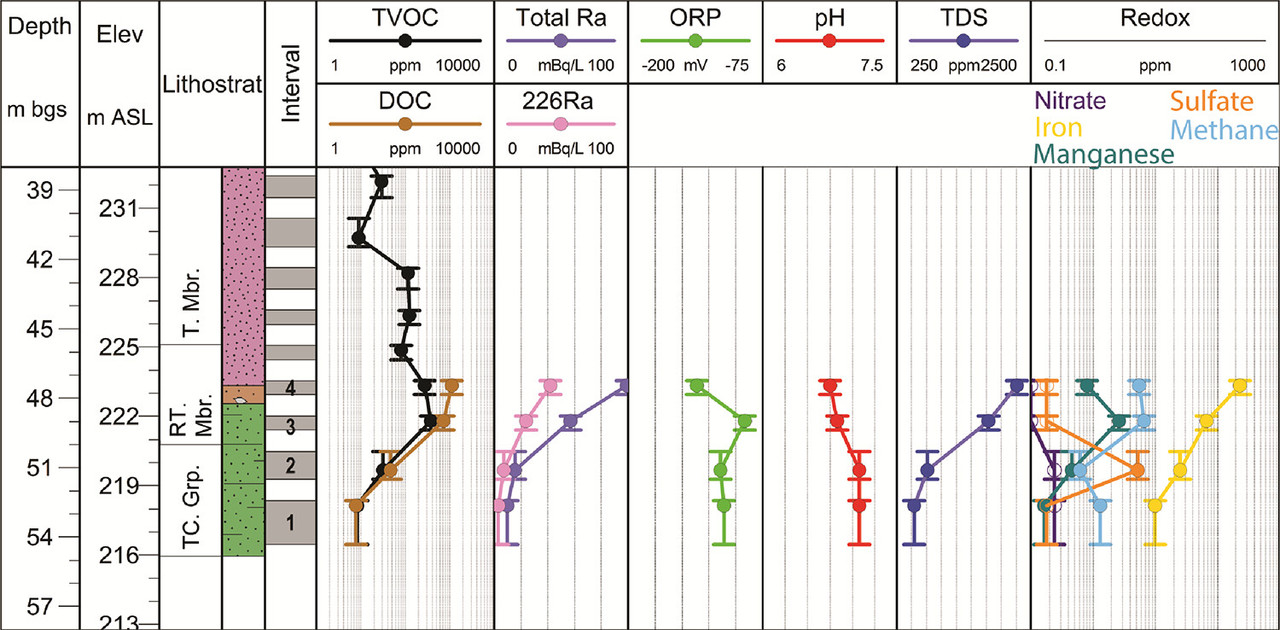
The caption:
Figure 3. Ra activities and geochemical conditions within the Tunnel City Group and Readstown Member at multi-level system (MLS) MP-24S, located 60 m southeast of the DNAPL source zone and within the dissolved phase plume. The vertical distribution of the dissolved phase plume is denoted by total organic compound (TVOC) concentration. The bars above and below each data point indicate the length of each sampling interval. Open data points indicate that the measurement is below the limit of detection (LOD) and is plotted as 0.5 × LOD. Bgs = below ground surface, ALS = above sea level, TC = Tunnel City, RT = Readstown, T = Tonti, DOC = dissolved organic carbon, ORP = oxidation–reduction potential, TDS = total dissolved solids. A complete stratigraphic column of the study site is shown in Figure S1.
The caption:
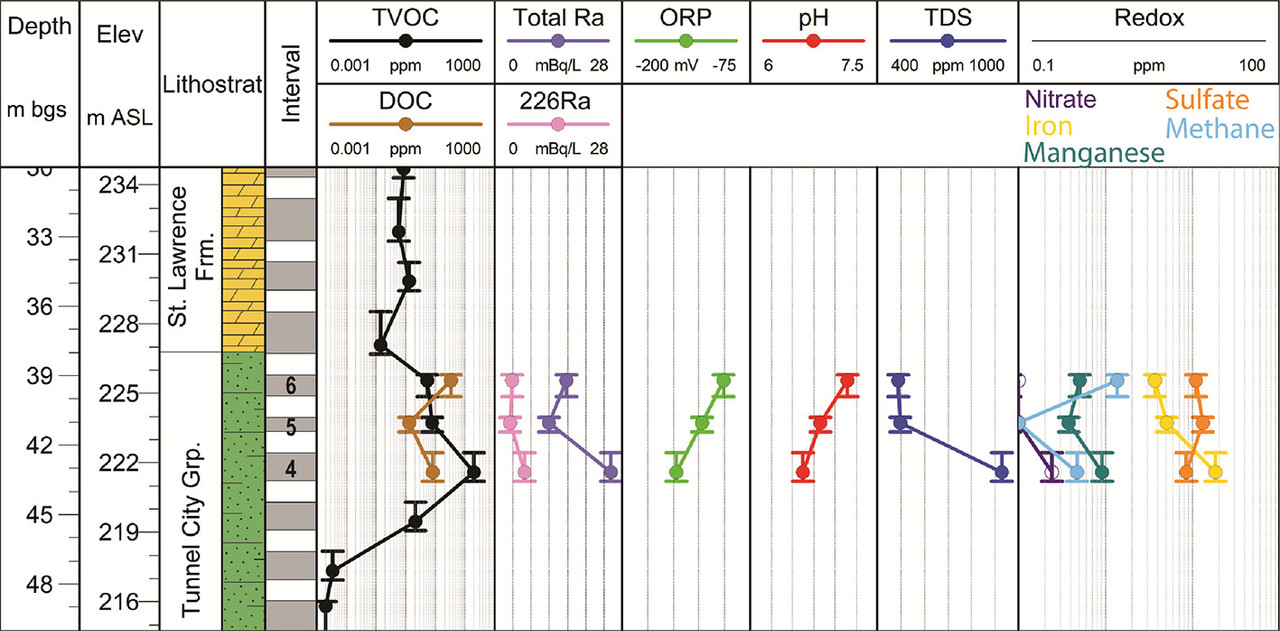
Figure 4. Ra activities and geochemical conditions within the Tunnel City Group at multi-level system (MLS) MP-19S, located 600 m downgradient from the DNAPL source zone and within the dissolved phase plume. The vertical distribution of the dissolved phase plume is denoted by total organic compound (TVOC) concentration. The bars above and below each data point indicate the length of each sampling interval. Open data points indicate the measurement is below the limit of detection (LOD) and is plotted as 0.5 × LOD. Bgs = below ground surface, ALS = above sea level, DOC = dissolved organic carbon, ORP = oxidation–reduction potential, TDS = total dissolved solids. A complete stratigraphic column of the study site is shown in Figure S1.
The caption:
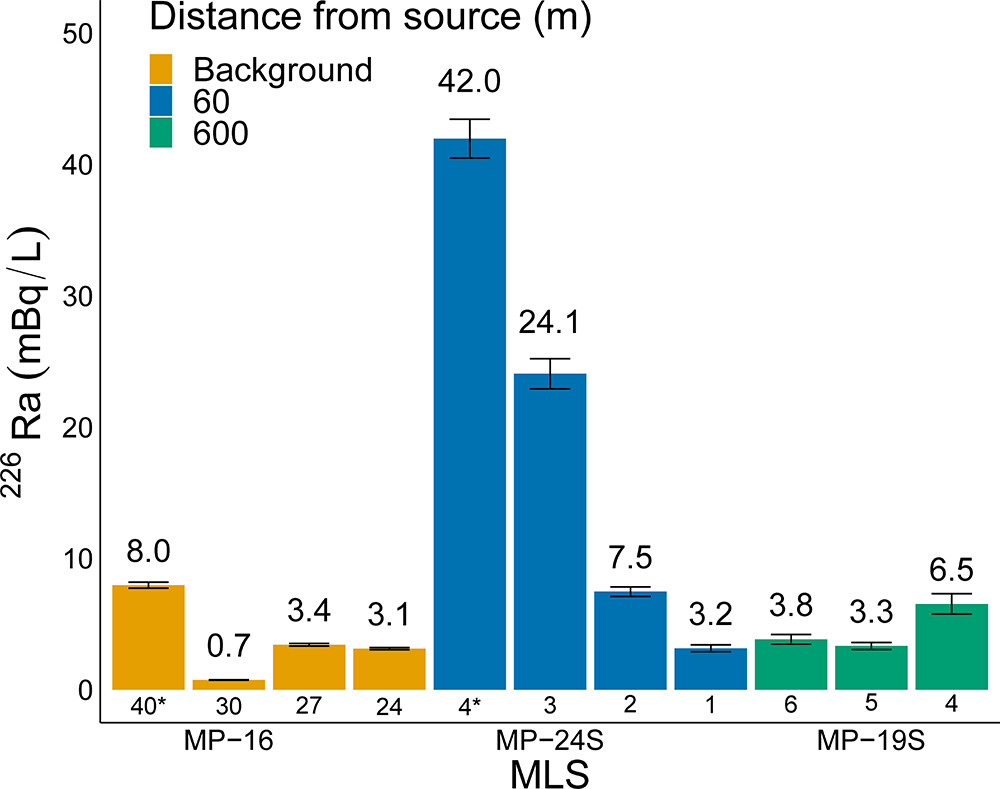
Figure 5. 226Ra activities at sampled multi-level systems (MLS) relative to the distance downgradient from the DNAPL source zone. MLS MP-16 was sampled by Mathews et al. (38) Numbers below the bars indicate the port intervals. *Port 4 at MP-24S and 40 at MP-16 are located in the Readstown Member, while all other samples are located in the Tunnel City Group.
The caption:
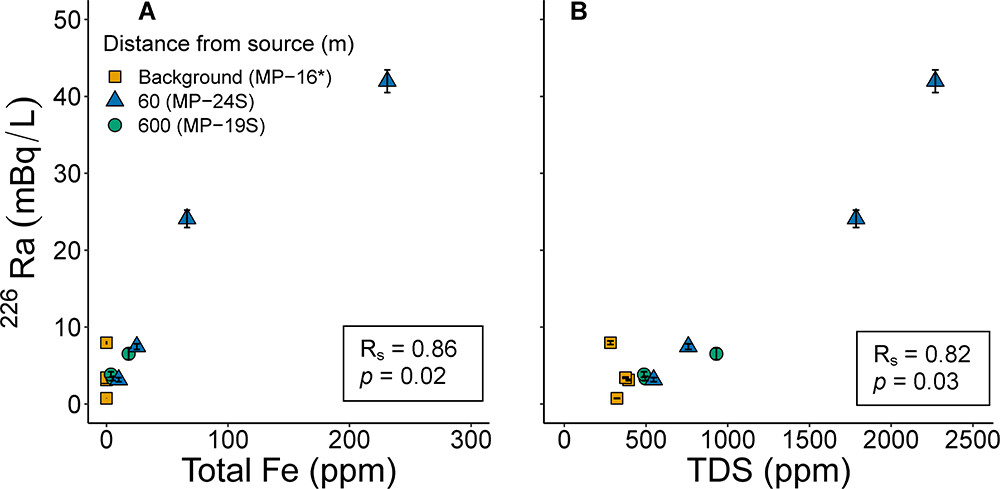
Figure 6. 226Ra activity vs (A) total Fe concentration and (B) total dissolved solids (TDS) concentration. Data for MP-16 are plotted for comparison but not included in the calculation of the correlation coefficient. Rs is the Spearman rank correlation coefficient, and p is the significance level. *Multi-level system MP-16 was sampled by Mathews et al. (38)
From the paper's conclusion:
...This study combines high-resolution multi-level system sampling and MC-ICPMS analysis of ultra-trace Ra activities to report the first investigation of Ra activities relative to biogeochemical zones in a hydrocarbon-contaminated aquifer. Our proposed conceptual model for Ra cycling at the site includes the enhanced release of Ra to groundwater 60 m downgradient from the source zone, likely due to geochemical conditions (e.g., methanogenic conditions, high TDS concentrations) resulting in the reductive dissolution of Fe and Mn (hydr)oxides and cation competition for sorption sites. 600 m downgradient from the source zone and near the middle of the dissolved phase plume, conditions are predominantly Fe(III)/SO42–-reducing and Ra activity in groundwater is similar to background activities in the aquifer. Upon release from aquifer sediments near the source zone, Ra resorbs downgradient where it is expected to encounter available sorption sites on negatively-charged secondary mineral phases (e.g., clays) within the dissolved phase plume, and Fe and Mn (hydr)oxides as geochemical conditions return to background further downgradient near the leading edge of the plume (e.g., higher pH, more oxic). The elevated Ra activities in groundwater downgradient from the DNAPL source zone demonstrate the potential secondary impacts of industrial waste released to the environment...
The authors go on to discuss some sites in Cape Cod and in New Jersey that might be investigated for similar effects.
What is to be done about radium? Actually not much can be done other than to prevent its mobilization by anthropogenic activities. Uranium, the parent of radium, is a natural product, of course, widely distributed in Earth's crust. Radium, which has a half-life of around 1610 years is in secular equilibrium with its parent compound, decaying as rapidly as it is formed, with the ratio at this equilibrium, when undisturbed, existing in the ratio of its activity constants, these being themselves determined by dividing the natural logarithm of 2 by the half life in equivalent time units. For example, Ra-226, the radioactive daughter in the decay series of Uranium-238 with a half life of 4.5 billion years is at equilibrium (ln(2)/4,500,000,000)/ln(2)/1610) = 1610/4,500,000,000 = 3.58 X 10^(-7). Economically recoverable terrestrial ores of uranium at current prices are thought to be around 6,000,000 tons, suggesting that there are about 2 tons of radium in them at secular equilibrium. However economically recoverable ores are only a small fraction of the uranium found in the geochemical uranium cycle which involves the uplift of mantle rocks, where the decay of uranium accounts for much of the internal heat of the Earth, cycling through the crust on geological time scales, weathering of crustal rocks by rivers, glaciers and the like, followed by flow ultimately into the oceans where uranium is present on the scale of 4.5 billion tons.
(cf. S. Krishnaswami and J. Kirk Cochrane, eds. U-Th Nuclides in Aquatic Systems. Vol 13 of the Radioactivity in the Environment Series, U and Th-Series Nuclides as Tracers of Particle Dynamics, Scavenging and Biogeochemical cycles, Elsevier, 2008.)
Recoverable uranium ores represent only a trivial portion of the uranium in the continental crust. The mass of the continental crust is taken to be around 2.2 X 10^(24) kg, or 2.2 X 10^21 tons.
Source: Seema Kumari, Debajyoti Paul, Andreas Stracke, Constraints on Archean crust formation from open system models of Earth evolution, Chemical Geology, Volume 530, 2019, 119307
Uranium is thought to represent about 2.75 ppm of this mass, roughly as common in Earth's crust as tin.
Source: Herring, Uranium and Thorium Resources Encyclopedia of Sustainability Science and Technology (2012)
It follows that crustal rock contains over 6 trillion tons of uranium, suggesting that a secular equilibrium if unextracted by chemical means, that it also contains about 22 million tons of radium.
There is obviously a considerable amount of radium that in theory could be extracted by chemical means, including from chemical and dangerous fossil fuel extraction procedures, now endorsed, albeit with disingenuous "bait and switch" tactics using the useless solar and wind industry as a marketing tool to say that what is happening isn't happening - literally gaslighting, since hydrogen is mostly made from dangerous natural gas, by the "hydrogen will save us" industry, pure thermodynamic nonsense.
Most of this radium will not be extracted of course, but we mess with Earth's crust at our peril. Extracting even a small fraction of 22 million tons is problematic. All this said, uranium itself is extracted by water weathering of crustal rock and it does end up in the oceans, as mentioned above, and a great deal of work has been done to show the economics and feasibility of extracting uranium from seawater, although at this time, terrestrial ores are much cheaper, if less environmentally benign.
I discussed this at length some years back on another website, maintained by Professor Barry Brook, an Australian Academic, to strongly suggest that uranium is inexhaustible: Is Uranium Exhaustible?.
One thing that might be done, and this may be feasible at the Marcellus shale after the gas is gone, assuming the planet survives the use of dangerous fossil fuels while we all wait stupidly and increasingly breathlessly for the grand so called "renewable energy" nirvana that has not come, is not here and won't come, would be extract and destroy the uranium parent, recovering vast amounts of clean energy in the process. A new process for uranium mining, related to fracking but less noxious, relies on extraction procedures of this type, and as the Marcellus shale is already destroyed for the rest of the history of humanity, these techniques could be switched, perhaps using supercritical carbon dioxide, to both chemically clean the crustal industrial mess while recovering uranium for use.
About four or five years ago a new type of antinuke began showing up at DU to add to the traditional antinukes who have always argued that nuclear energy is "too expensive," "too dangerous," "too this," "too that," blah, blah, blah which, by extension, as a practical matter, is the same as arguing that "climate change is not too dangerous," "fossil fuels are not too dangerous," "ocean acidification is not too dangerous" and so on. This is the "I'm not an antinuke" antinuke, a breed that shows up with increasing frequency, a set of poorly educated and poor thinking individuals who concede that while nuclear energy is effective against climate change, it's, um, well, "too expensive," "too dangerous," "too this," "too that," blah, blah, blah, advancing every moronic specious argument against nuclear energy, including the extremely disingenuous "problem" of so called "nuclear waste," despite the spectacular record of used nuclear fuel in not killing anyone.
This goes on while the world burns and people all over the world die from extreme heat, never mind air pollution.
One of the first "I'm not an antinuke" antinukes I ever encountered at DU was a very weak thinking person who called up one of my old posts to tell me that a tunnel had collapsed at the Hanford Nuclear Weapons site and thus, by implication, that we should continue to let 7 million people die each year from air pollution, because this particular shit-for-brains assumed that the release of any radioactive materials anywhere was an international tragedy, a bit of absurd nonsense that is carried on to this day by illiterate journalists from our "but her emails" media, and of course, straight up antinukes and "I'm not an antinuke" antinukes.
I mocked this particular idiot by suggesting that his terror that a radioactive atom might show up in his, her, or their tiny brain - it would die without potassium, which is naturally radioactive in his, her, or their brain, which led to some very stupid outrage on the part of this person, carrying on in response to sarcasm - antinukes are generally witless - about "straw men."
This particular bit of nonsense actually turned out to be inspiring, and I'm grateful for it, as it caused to wonder exactly how many atoms would end up in an antinuke's tiny brain from, say, a tunnel collapse at Hanford.
I learned a tremendous amount while looking into this matter, which took on a source of intellectual inquiry of its own, to write this long, lugubrious post: 828 Underground Nuclear Tests, Plutonium Migration in Nevada, Dunning, Kruger, Strawmen, and Tunnels
In that post, I referenced a work in German, showing that in the case of actinide recycling to recover the many valuable materials in used nuclear fuel, and to extract the maximal energy from it, that after a few hundred years, the radioactivity associated with uranium ores would be reduced because its multiple radioactive daughters would not be formed:
Although anti-nukes are prone to deny it, because they are most often discussing topics about which they know nothing, however, the situation is very different at weapons sites as opposed to commercial nuclear reprocessing sites. The recovery of the transuranium actinides using a wide variety of processes is well understood, and all of them, not just plutonium but also neptunium, americium, and curium are potential nuclear fuels. I therefore always argue that it is just stupid to bury them, as they are vital resources in a time of climate change and massive rising air pollution death rates.
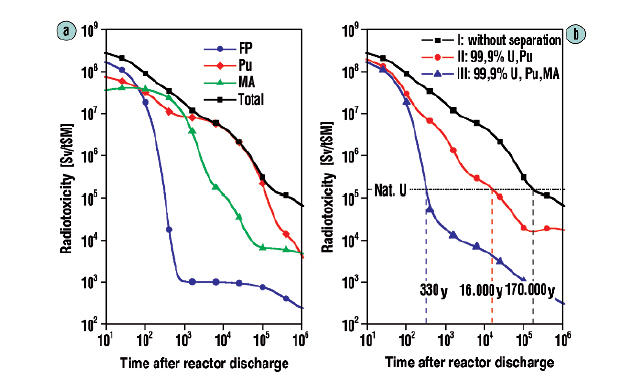
The following figure shows the very different case obtained if one separates the uranium, plutonium and minor actinides (neptunium, americium and curium) and fissions them, whereupon the reduction of radioactivity to a level that is actually below that of the original uranium in a little over 300 years:
The caption:
(Hartwig Freiesleben, The European Physical Journal Conferences · June 2013)
The following figure shows the very different case obtained if one separates the uranium, plutonium and minor actinides (neptunium, americium and curium) and fissions them, whereupon the reduction of radioactivity to a level that is actually below that of the original uranium in a little over 300 years:
The caption:
Fig. 4. – Radiotoxicity (log-scale, unit: Sv/tSM) of 1 t of heavy metal (SM) from a pressurized water reactor (initial enrichment 4.2% U-235, burn-up 50 GWd/t) with regard to ingestion as a function of time (log-scale, unit: years) after discharge. Left-hand frame: contribution of fission products (FP), plutonium (Pu) and minor actinides (MA) to radiotoxicity. Right-hand frame: Modification of radiotoxicity due to separation of U, Pu or U, Pu, MA. The reference value is the radiotoxicity of the amount of natural uranium that was used to produce 1 t of nuclear fuel. Source: [17].
(Hartwig Freiesleben, The European Physical Journal Conferences · June 2013)
I note that as is the case of the evacuation of elderly people from nursing homes in the events following the Fukushima event, in the case of the tunnel, the "solution" to the "problem" of the collapsed tunnel, which almost certainly would have not killed anyone from radiation, the fear of radioactivity caused more damage and likely deaths than the radioactivity itself.
Over 4000 diesel trucks, spewing toxic particulates and other carcinogens, hauled tons upon tons of concrete and grout, created in clinker ovens by heating minerals to high temperatures using dangerous fossil fuels, were used to seal the tunnel albeit hardly to the satisfaction of these radiation paranoid morons who think that every radioactive atom on the planet - except for those extracted to make hydrogen perhaps, is a tragedy.
The "828 Underground Nuclear Tests" post was too long, and this one is too.
It's the Fourth of July as I write, in which we celebrate history.
In 2023 history is under attack, but should history continue to exist, let me close with a remark I often make, my personal chant:
"History will not forgive us, nor should it."
Enjoy the holiday.
26 replies
 = new reply since forum marked as read
Highlight:
NoneDon't highlight anything
5 newestHighlight 5 most recent replies
= new reply since forum marked as read
Highlight:
NoneDon't highlight anything
5 newestHighlight 5 most recent replies
= new reply since forum marked as read
Highlight:
NoneDon't highlight anything
5 newestHighlight 5 most recent replies
Not asking you to do something crazy complex like a paper to submit to a bank for a loan
Hugh_Lebowski
Jul 2023
#5
If nukes are the only way, then this can't be possible. There is no numerical answer to this.
Blues Heron
Jul 2023
#6
OK,I have a few minutes; I'll propose a new energy unit, "A California" corresponding to "homes..."
NNadir
Jul 2023
#7
He answered it - 1 solar exajoule is 8 californias, 1 H2 exajoule is 13.4 californias
Blues Heron
Jul 2023
#10
It's relatively easy to calculate those numbers from the numbers in the post I provided.
NNadir
Jul 2023
#11
All I saw him speaking about is what (I interpreted as) the MAKING of the Hydrogen piece
Hugh_Lebowski
Jul 2023
#14
pretty sure the reference to: liquid hydrogen having an energy content of roughly 120 MJ/kg.
Blues Heron
Jul 2023
#18
And without further clarification I assume 'energy content' refers to a theoretical maximum
Hugh_Lebowski
Jul 2023
#20
Let's stick with Exajoules (1) and Californias, since CAISO gives Solar Output every day.
NNadir
Jul 2023
#23
Yup. I was just curious about the scale involved if you tried to use hydrogen
Hugh_Lebowski
Jul 2023
#24