Scientists Identify Hidden Accelerant in Antarctic Ice Loss [View all]
https://cmns.umd.edu/news-events/news/madeleine-youngs-scientists-identify-hidden-accelerant-antarctic-ice-loss15 May 2026
A new UMD-led study shows that meltwater flowing off ice shelves changes the ocean in ways that drive even faster melting—and most global climate projections don’t even include it.
For years, scientists have warned that melting Antarctic ice could push sea levels dangerously higher by the end of this century. But a new study led by University of Maryland scientist
Madeleine Youngs suggests those warnings may still be too conservative because they leave out a crucial factor: the ocean’s own complex circulatory system.
Youngs’ research team found that when ice melts into the ocean, it doesn’t just raise sea levels—it also changes how the ocean circulates, which in turn changes how much ice melts. The
team’s study, published in the journal
Nature Geoscience on May 15, 2026, revealed that this self-reinforcing chain reaction may contribute as much to rising sea levels as the direct effects of a warming atmosphere.
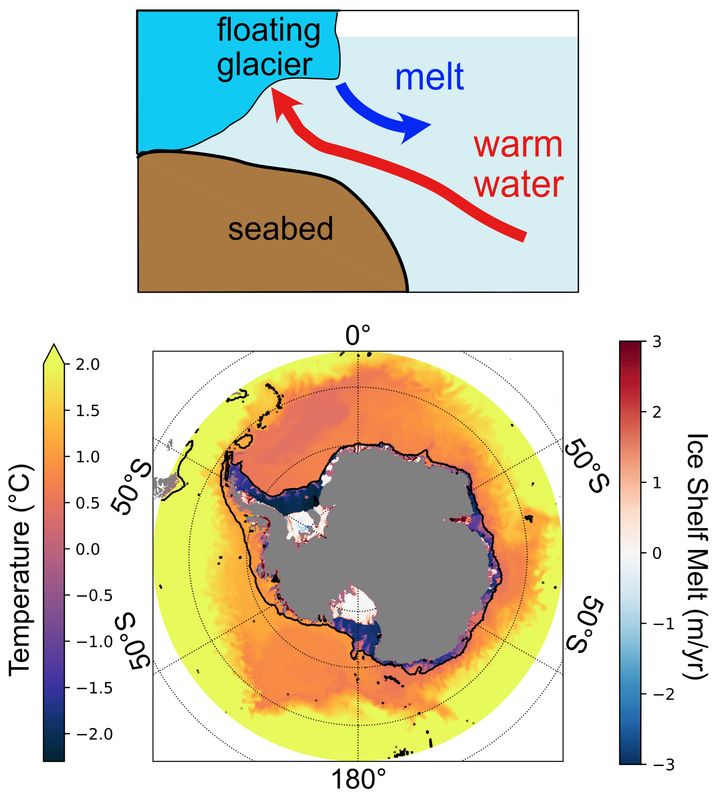
Top: A diagram illustrating the Antarctic ice shelf melt interactions between a floating glacier and warm water. Bottom: A heat map depicting the temperatures of the Antarctic ice shelf. Credit: Madeleine Youngs.
“
Most current climate models that inform international policy don’t consider this feedback loop at all. The Intergovernmental Panel on Climate Change (IPCC) treats melting as a fixed, rather than interactive input,” explained Youngs, the study’s lead author and an assistant professor in UMD’s
Department of Atmospheric and Oceanic Science. “We need to include ice shelf melt feedbacks when we’re estimating future ice shelf melt, the primary component of sea level rise, if we want the most accurate understanding of what’s going on.”
The key to understanding why meltwater has such an outsized effect comes down to water temperature and density. Cold, dense water naturally sinks and forms a barrier layer near the ocean floor that keeps warmer deep-ocean currents from reaching the base of ice shelves. When meltwater flows in, it dilutes and weakens that cold barrier—allowing warmer water to push through and melt the ice from below. More melting produces more freshwater, which further weakens the barrier and lets in more warm water. The cycle feeds itself.
…
Youngs, M.K., Stewart, A.L., Si, Y.
et al. Antarctic ice-shelf basal melt shaped by competing feedbacks.
Nat. Geosci. (2026).
https://doi.org/10.1038/s41561-026-01975-6

 = new reply since forum marked as read