Welcome to DU! The truly grassroots left-of-center political community where regular people, not algorithms, drive the discussions and set the standards. Join the community: Create a free account Support DU (and get rid of ads!): Become a Star Member Latest Breaking News Editorials & Other Articles General Discussion The DU Lounge All Forums Issue Forums Culture Forums Alliance Forums Region Forums Support Forums Help & Search

OKIsItJustMe

(22,164 posts)
8. Those graphs are from the U.S. Energy Information Administration (not the solar industry.)
Wed May 20, 2026, 03:33 PM
Wednesday

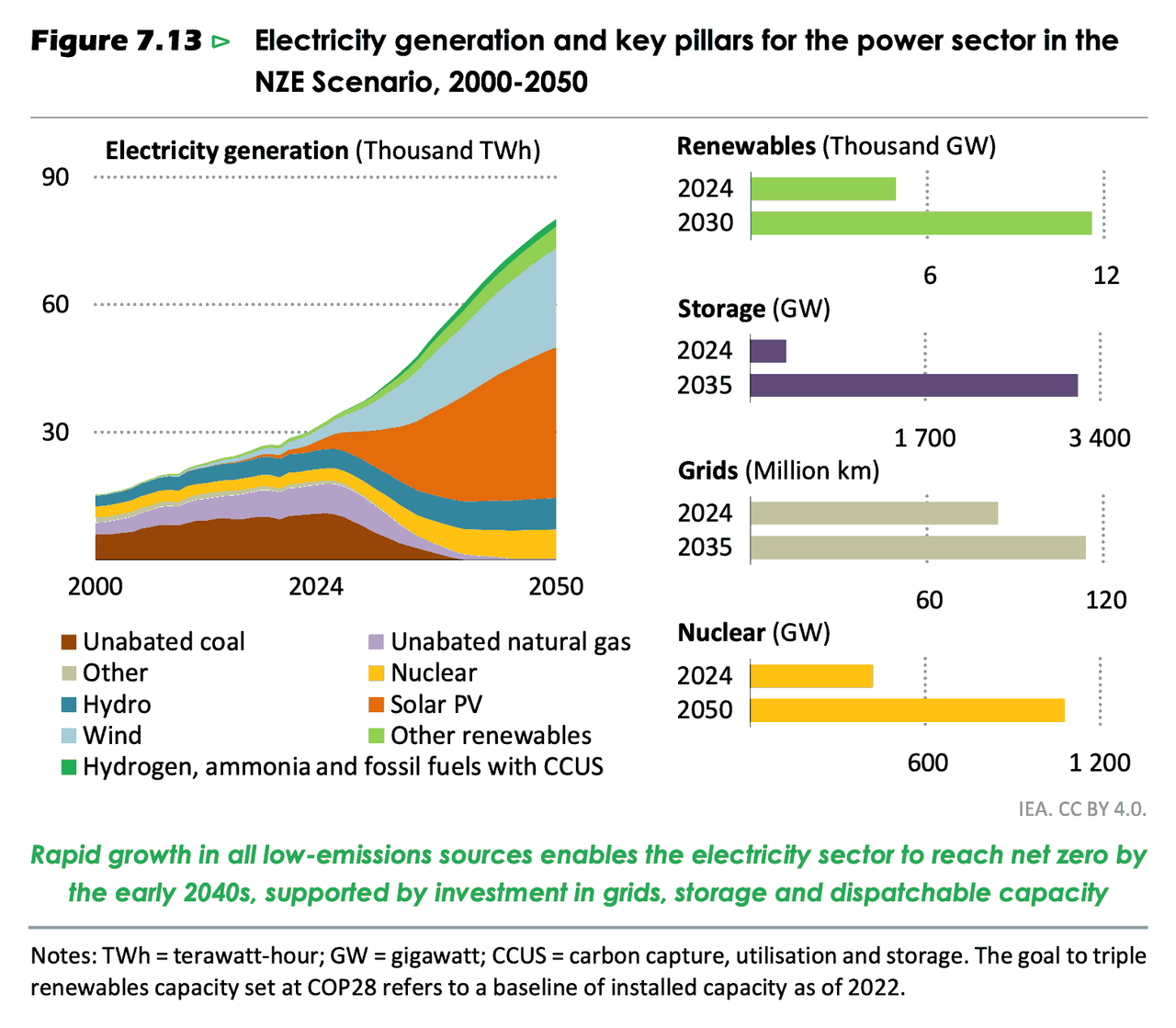
In their “Net Zero” Scenario, the International Energy Association calls for "unabated fossil fuels” (i.e. coal & natural gas) to be used as a support for "variable renewables" (e.g. PV, Wind) for a while, however, "increasingly for flexibility and capacity adequacy" (i.e. those "fossil fuel" plants will be run “as needed" not "24/7/365.”)

IEA (2025), World Energy Outlook 2025, IEA, Paris https://www.iea.org/reports/world-energy-outlook-2025, Licence: CC BY 4.0 (report); CC BY NC SA 4.0 (Annex A)

As variable renewables such as solar PV and wind account for a rising share of generation, dispatchable capacity plays a critical role to ensure electricity security. Long lead-times for nuclear limits its role in the near term, but installed nuclear capacity in the NZE Scenario increases 70% by 2035 from the current level, and by 2050 it is two-and-a-half times higher. By the 2030s, the nuclear industry delivers annual additions of around 40 GW per year (Box 7.3). Hydropower capacity also expands strongly, with generation increasing more than 1.5-times by 2050. Unabated fossil fuel plants are operated increasingly for flexibility and capacity adequacy, and consequently their installed capacity falls more slowly than their output across the Outlook period. Fossil fuel plants equipped with CCUS and plants fired with hydrogen or ammonia are also deployed, providing additional low-emissions dispatchable capacity.

Recommendations

1 members have recommended this reply (displayed in chronological order):

Latest Discussions»Issue Forums»Environment & Energy»Electricity Generation fr...»Reply #8