Last edited Tue Jun 30, 2026, 02:34 PM - Edit history (1)
“The world as we know it” has effectively already been destroyed.
Hansen, J. et al. Target Atmospheric CO₂: Where Should Humanity Aim? The Open Atmospheric Science Journal 2, (2008).
https://pubs.giss.nasa.gov/docs/2008/2008_Hansen_ha00410c.pdf
… If humanity wishes to preserve a planet similar to that on which civilization developed and to which life on Earth is adapted, paleoclimate evidence and ongoing climate change suggest that CO₂ will need to be reduced from its current 385 ppm to at most 350 ppm, but likely less than that. The largest uncertainty in the target arises from possible changes of non-CO₂ forcings. An initial 350 ppm CO₂ target may be achievable by phasing out coal use except where CO₂ is captured and adopting agricultural and forestry practices that sequester carbon. If the present overshoot of this target CO₂ is not brief, there is a possibility of seeding irreversible catastrophic effects.
Hansen, J. E.
et al. Global warming in the pipeline.
Oxford Open Climate Change 3, kgad008 (2023).
https://doi.org/10.1093/oxfclm/kgad008
Published:
02 November 2023
…
Abstract
Improved knowledge of glacial-to-interglacial global temperature change yields Charney (fast-feedback) equilibrium climate sensitivity 1.2 ± 0.3°C (2r) per W/m², which is 4.8°C ± 1.2°C for doubled CO₂. Consistent analysis of temperature over the full Cenozoic era—including ‘slow’ feedbacks by ice sheets and trace gases—supports this sensitivity and implies that CO₂ was 300–350 ppm in the Pliocene and about 450 ppm at transition to a nearly ice-free planet, exposing unrealistic lethargy of ice sheet models. Equilibrium global warming for today’s GHG amount is 10°C, which is reduced to 8°C by today’s human-made aerosols. Equilibrium warming is not ‘committed’ warming; rapid phaseout of GHG emissions would prevent most equilibrium warming from occurring. However, decline of aerosol emissions since 2010 should increase the 1970–2010 global warming rate of 0.18°C per decade to a post-2010 rate of at least 0.27°C per decade. Thus, under the present geopolitical approach to GHG emissions, global warming will exceed 1.5°C in the 2020s and 2°C before 2050. Impacts on people and nature will accelerate as global warming increases hydrologic (weather) extremes. The enormity of consequences demands a return to Holocene-level global temperature. Required actions include: (1) a global increasing price on GHG emissions accompanied by development of abundant, affordable, dispatchable clean energy, (2) East-West cooperation in a way that accommodates developing world needs, and (3) intervention with Earth’s radiation imbalance to phase down today’s massive human-made ‘geo-transformation’ of Earth’s climate. Current political crises present an opportunity for reset, especially if young people can grasp their situation.
…
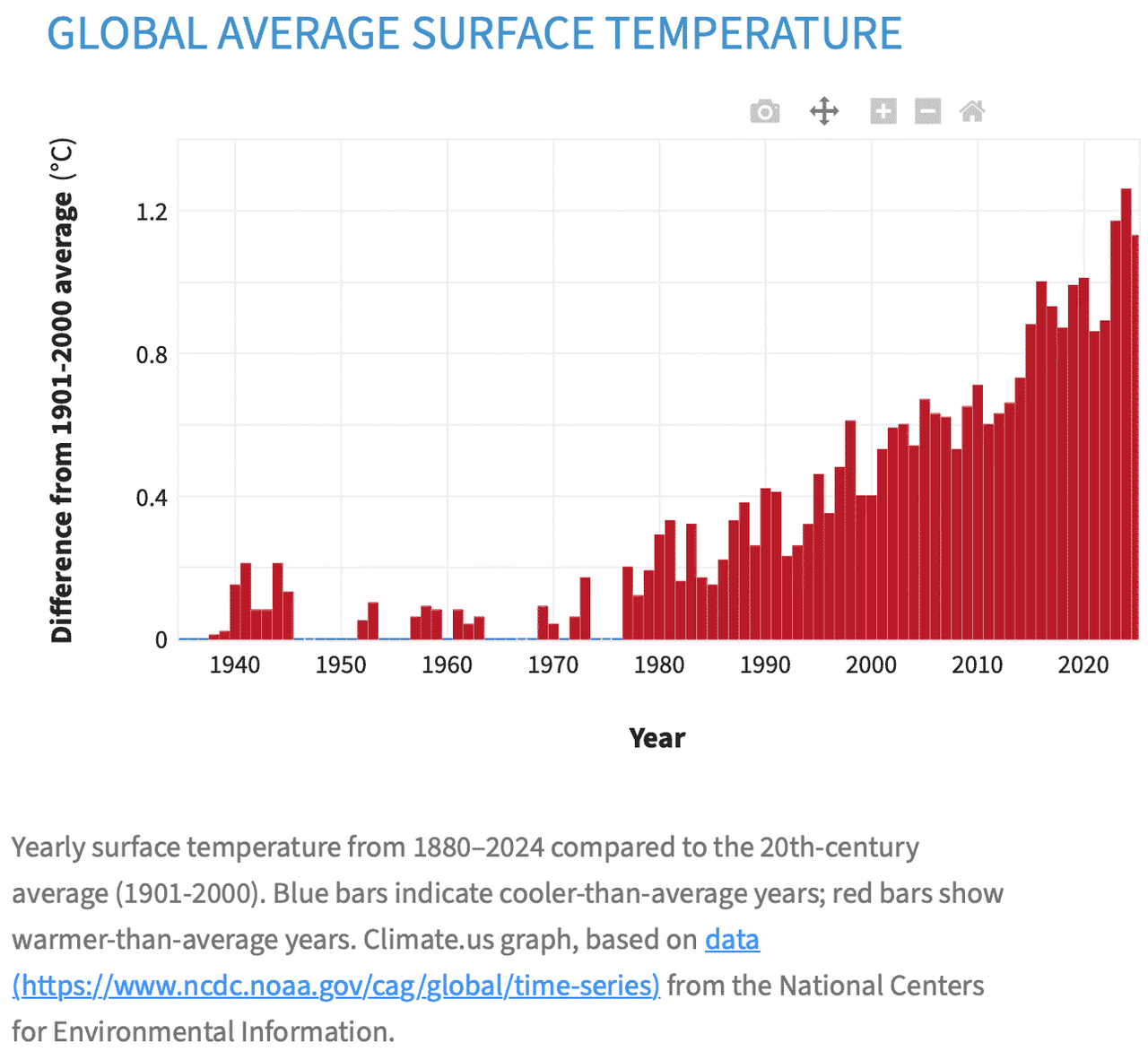
https://www.climate.us/news-features/understanding-climate/climate-change-global-temperature

 = new reply since forum marked as read