Welcome to DU!
The truly grassroots left-of-center political community where regular people, not algorithms, drive the discussions and set the standards.
Join the community:
Create a free account
Support DU (and get rid of ads!):
Become a Star Member
Latest Breaking News
Editorials & Other Articles
General Discussion
The DU Lounge
All Forums
Issue Forums
Culture Forums
Alliance Forums
Region Forums
Support Forums
Help & Search
Environment & Energy
In reply to the discussion: "It's worse than we thought." Sound familiar? [View all]GliderGuider
(21,088 posts)45. RealClimate has some interesting articles (radical understatement)
Including this one on Pacala and Socolow's wedgies:
The high cost of inaction
In 2004 Stephen Pacala and Robert Socolow published a paper in Science in which they argued that a pragmatic, but still difficult, way of stabilizing atmospheric CO2 levels over the long term was via the implementation of seven “stabilization wedges” over the next 50 years. The idea was very simple: each wedge represented one in-hand technology or societal practice that could be implemented, relatively slowly at first and increasing linearly with time, to make a small but growing dent in the rise in CO2 emissions, stabilizing them at 2004 levels (about 7 Gigatons C/Year) over the next 50 years (see figure below).
A couple of weeks ago, Socolow updated this work in a brief commentary piece to show where we are seven years later. The results are not encouraging. First, and most significant, rather than decreasing the emissions rate, the lack of implementation of these strategies has been accompanied by an accelerated rate of emissions, such that annual CO2 output is now just under 9 Gt C/yr, a 2 Gt/yr increase. Accounting for natural sequestration, this represents an increase of about 13-14 ppm CO2 over that time. But this is not the full story by any means. As Socolow notes, if we re-set the clock to 2011 and start the wedge strategy implementation now, it would now take nine wedges implemented at the proposed rate of the original seven, to accomplish the same goal (keeping emission rates constant over the next 50 years).
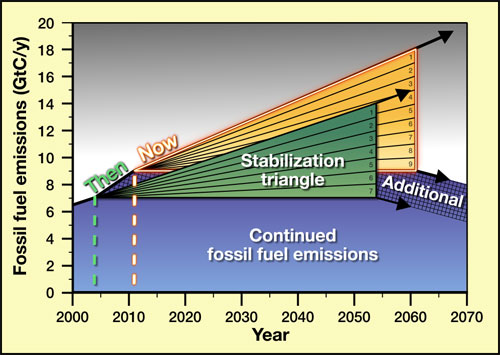
The stabilization wedge concept, circa 2004 vs 2011
Here is the real kicker however. Even if we were to do so, starting today, with stable emissions for 50 years and then falling gradually from there to zero emissions over the following 50 years, an additional ~50 ppm of CO2 would be added to the atmosphere by 2111, relative to what would have been added had the seven wedge strategy been initiated in 2004. This equates to a roughly 0.5 W/sq m forcing increase, and a ~0.4 degree C global temperature increase, assuming an equilibrium sensitivity of 3 deg C per CO2 doubling and that the additional 50 ppm is added on top of the increase that would have occurred even if the 2004 wedge strategy had in fact been initiated. In other words, seven years of inaction, even if we immediately begin implementing the strategy now and fully carry it out over the next century, have larger climatic consequences over the next century than one might expect.
In 2004 Stephen Pacala and Robert Socolow published a paper in Science in which they argued that a pragmatic, but still difficult, way of stabilizing atmospheric CO2 levels over the long term was via the implementation of seven “stabilization wedges” over the next 50 years. The idea was very simple: each wedge represented one in-hand technology or societal practice that could be implemented, relatively slowly at first and increasing linearly with time, to make a small but growing dent in the rise in CO2 emissions, stabilizing them at 2004 levels (about 7 Gigatons C/Year) over the next 50 years (see figure below).
A couple of weeks ago, Socolow updated this work in a brief commentary piece to show where we are seven years later. The results are not encouraging. First, and most significant, rather than decreasing the emissions rate, the lack of implementation of these strategies has been accompanied by an accelerated rate of emissions, such that annual CO2 output is now just under 9 Gt C/yr, a 2 Gt/yr increase. Accounting for natural sequestration, this represents an increase of about 13-14 ppm CO2 over that time. But this is not the full story by any means. As Socolow notes, if we re-set the clock to 2011 and start the wedge strategy implementation now, it would now take nine wedges implemented at the proposed rate of the original seven, to accomplish the same goal (keeping emission rates constant over the next 50 years).
The stabilization wedge concept, circa 2004 vs 2011
Here is the real kicker however. Even if we were to do so, starting today, with stable emissions for 50 years and then falling gradually from there to zero emissions over the following 50 years, an additional ~50 ppm of CO2 would be added to the atmosphere by 2111, relative to what would have been added had the seven wedge strategy been initiated in 2004. This equates to a roughly 0.5 W/sq m forcing increase, and a ~0.4 degree C global temperature increase, assuming an equilibrium sensitivity of 3 deg C per CO2 doubling and that the additional 50 ppm is added on top of the increase that would have occurred even if the 2004 wedge strategy had in fact been initiated. In other words, seven years of inaction, even if we immediately begin implementing the strategy now and fully carry it out over the next century, have larger climatic consequences over the next century than one might expect.
We are doing nothing. We will do nothing effective until after everybody is convinced there is a problem. By then it will definitely be too fucking late. Based on the current evidence, the probability of this approaches 100%. Anyone who pins the hopes of humanity to this piece of horseshit is naive or worse.
Edited to add: Martin Hoffert in a 2010 article (PDF) for Science estimated that we'd need 25 wedges rather than just 7... And two years later, we still haven't begun.
Edit history
Please sign in to view edit histories.
Recommendations
0 members have recommended this reply (displayed in chronological order):
122 replies
 = new reply since forum marked as read
Highlight:
NoneDon't highlight anything
5 newestHighlight 5 most recent replies
RecommendedHighlight replies with 5 or more recommendations
= new reply since forum marked as read
Highlight:
NoneDon't highlight anything
5 newestHighlight 5 most recent replies
RecommendedHighlight replies with 5 or more recommendations
= new reply since forum marked as read
Highlight:
NoneDon't highlight anything
5 newestHighlight 5 most recent replies
RecommendedHighlight replies with 5 or more recommendations
I can agree that negative feedbacks are probably still somewhat poorly understood, but.....
AverageJoe90
Nov 2012
#10
You've never seen any proof that they've been doing research into negative feedbacks?
GliderGuider
Nov 2012
#18
No, I didn't say that research hadn't been done(duh!). I did say NOT ENOUGH research.
AverageJoe90
Nov 2012
#19
"Awhile back?" The fucking NSIDC head said that sea ice won't melt until the 2030s!
joshcryer
Nov 2012
#33
"You are casting uncertainty and doubt on the whole AGW awareness effort through your presence here"
AverageJoe90
Nov 2012
#24
I'm not saying things can't change, I am saying they are unlikely to change.
joshcryer
Nov 2012
#112
You want us to worry more about someone exploring positive feedbacks to their logical conclusion
cprise
Nov 2012
#42
TBH, having read the paper, 25 does seem to be a tad on the high side........
AverageJoe90
Nov 2012
#54
True to a point, but so does your assertion of near 100% probability as well. n/t
AverageJoe90
Nov 2012
#51
Was the Clean Air Act like telling an entire nation they will have to be 10% poorer?
NoOneMan
Nov 2012
#56
No, and look at what happened when CFC production stopped in the mid-'90s.
AverageJoe90
Nov 2012
#57
There's just one problem with your argument: Alternative fuels have been barely implemented at all.
AverageJoe90
Nov 2012
#63
"And we can keep building & developing. We just need to do it in a smarter way,"
NoOneMan
Nov 2012
#74
BTW, philosophically speaking, what is so good about the growth you think we need?
NoOneMan
Nov 2012
#80
Well, it IS true that curbing population growth wouldn't solve this problem alone........
AverageJoe90
Nov 2012
#106
"Ah, you are only thinking in terms of human life and locally." Not really.
AverageJoe90
Nov 2012
#104
What room do we have for reforestation? Where are we going to plant the hemp?
NoOneMan
Nov 2012
#120
Re: "I really wonder if you have taken time to step back and look at the entire system..."
AverageJoe90
Nov 2012
#121
Regarding carbon intensity, that graph painted an incorrectly rosy picture
GliderGuider
Nov 2012
#67
I am one of those who think that the worst-case scenarios are the dominant probability.
GliderGuider
Nov 2012
#64
*Some* of this may be true, but hemp can be grown with food crops, and in fact, is a food crop......
AverageJoe90
Nov 2012
#81
Not in the Tundra itself, but definitely to some extent in the SubArctic north, right around........
AverageJoe90
Nov 2012
#92
So 40%-50% of Sweden's GDP comes from exporting to countries who also cut their emissions?
NoOneMan
Nov 2012
#95
The point is that your example does not illustrate energy reduction resulted in a GDP increase
NoOneMan
Nov 2012
#102
There's a big problem with powering down, though: It's still a "silver bullet" type situation.
AverageJoe90
Nov 2012
#105
Let's hope this report sticks with the science as the others have done.....
AverageJoe90
Nov 2012
#115