Environment & Energy
In reply to the discussion: How overpopulated is the planet, really? [View all]GliderGuider
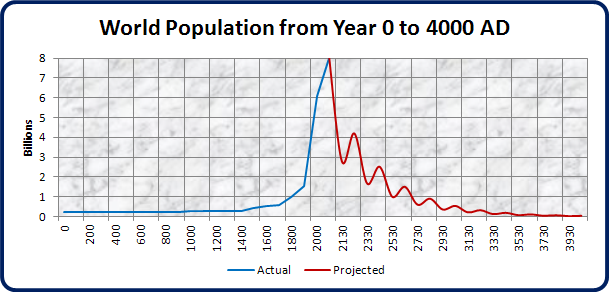
(21,088 posts)It's based on the idea that our population will oscillate down a series of "stair-steps": dropping as we puncture the sustainability limits, falling below them, partially recovering, only to fall again, recover, fall, recover.
I started with 8 billion people in 2030. I assumed each cycle would take three generations (100 years) to complete the fall and then spend three more in recovery, for a total cycle time of 200 years. I then assumed each drop would take out 60% of the population , and each rise would add back half the population lost.
In 2,000 years we would be back to a sustainable population of about 40-50 million. The biggest drop would be in the first 100 years, from 2030 to 2130 when we would lose a net 52 million people per year. Even that is only a loss of 0.65% pa, compared to our net growth today of 1.1% That's easily within the realms of the conceibable, and not necessarily catastrophic - at least to begin with.
It's a lot "better" scenario than a single monolithic crash from here to a hundred million, for example.
Here's what it looks like:
Edit history
Recommendations
0 members have recommended this reply (displayed in chronological order): = new reply since forum marked as read
Highlight:
NoneDon't highlight anything
5 newestHighlight 5 most recent replies
RecommendedHighlight replies with 5 or more recommendations
= new reply since forum marked as read
Highlight:
NoneDon't highlight anything
5 newestHighlight 5 most recent replies
RecommendedHighlight replies with 5 or more recommendations