Environment & Energy
In reply to the discussion: How overpopulated is the planet, really? [View all]GliderGuider
(21,088 posts)Last edited Mon Mar 25, 2013, 04:17 PM - Edit history (1)
However, I do try and justify it this way: it's based on the last year and population numbers I can point to and confidently say, "At that point we were still a sustainable species."
I chose 50,000,000 because it accords well with the high end of H-G population densities, that were maintained with virtually zero growth (less than .007% per year) from the time of the Toba supervolvcano eruption in 75,000 BC until ~10,000 BC (Agriculture Day on Planet Earth). Over the next 9,000 years (to 1000 BC, the day I picked as our sustainability departure point) the growth rate almost doubled to 0.012%. It more than doubled again over the next 3,000 years, to 0.025% from -1000 to 1900. Then we hit the hyperexponential big times. The growth rate rose to 0.9% from 1900 to 1950, then to 1.7% from 1950 to 2010. It's slacked off again now, but only to the rate we were at in 1945, at the start of the baby boom.
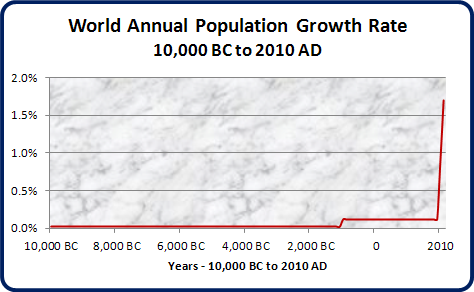
Our growth rate today is about 100 times higher than it was during the H-G and early agricultural eras - the last time IMO we can reliably say that the human presence on the planet was sustainable.
Edit history
Recommendations
0 members have recommended this reply (displayed in chronological order): = new reply since forum marked as read
Highlight:
NoneDon't highlight anything
5 newestHighlight 5 most recent replies
RecommendedHighlight replies with 5 or more recommendations
= new reply since forum marked as read
Highlight:
NoneDon't highlight anything
5 newestHighlight 5 most recent replies
RecommendedHighlight replies with 5 or more recommendations