The robust carbon intensity of global primary energy [View all]
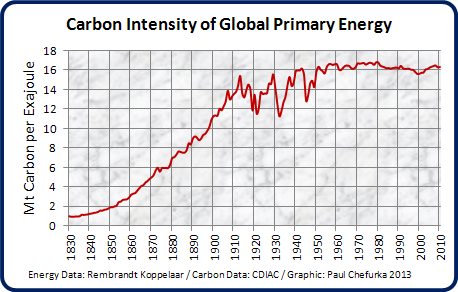
Over the sixty+ years since 1950 the amount of carbon emitted per exajoule of global primary energy consumption (counting both electricity and transportation) has remained constant at ~16 Mt/Ej. This robustness - even with the growing awareness of the climate change threat - indicates that the situation will not be changed rapidly, or easily. Our civilization has apparently recognized that the energy characteristics of fossil fuels are simply too attractive to ignore -
even when we understand that it represents an existential threat to civilization.
One pointer to the psychology around this conundrum is given in the following study conducted by Technische Universität München (TUM), Indiana University, and Oklahoma State University:
Many Entrepreneurs Claim to Care About Sustainability, Yet Make Decisions That Are Harmful to Environment
Many entrepreneurs claim that they care about sustainability, yet they make decisions that are harmful to the environment. Economic researchers from Germany and the USA have discovered that many bosses do indeed have firm convictions when it comes to the environment -- but that they then unconsciously disengage their values from their business actions. The type of entrepreneur most likely to fall into this category are those who perceive themselves as highly influential or who are operating in a challenging industry environment. The researchers' findings have shed new light on the significance of moral values and the subconscious in the context of making business decisions. The study could influence environmental legislation and the training of the next generation of entrepreneurs.
The research team found that even entrepreneurs with a strong respect for nature made decisions with a harmful effect on the environment. These decisions were not reached on the basis of any conscious process, however. "We found that the research subjects unconsciously adjusted the relationship between their values and their actions -- with the effect that their actions seemed to coincide once more with their values," explains Prof. Holger Patzelt of the Chair of Entrepreneurship at TUM.
The researchers noted, however, that not all of the entrepreneurs displayed this disengagement of pro-environmental values. What these entrepreneurs had in common was a high level of entrepreneurial self-efficacy and a challenging business climate. According to the received theory up to now, entrepreneurs with low self-efficacy were thought more likely to experience a conflict with their own values.
Holger Patzelt comments further on the findings of the "I care about nature, but ..." study: "
Entrepreneurs with very high entrepreneurial self-efficacy want to exert influence. This makes them more likely to disengage from values that limit their options. The same principle applies to an unfavorable industry environment, for example if the company is facing sharp competition. In such situations, too, company bosses believe that everything hinges on their decisions."
 = new reply since forum marked as read