Welcome to DU! The truly grassroots left-of-center political community where regular people, not algorithms, drive the discussions and set the standards. Join the community: Create a free account Support DU (and get rid of ads!): Become a Star Member Latest Breaking News Editorials & Other Articles General Discussion The DU Lounge All Forums Issue Forums Culture Forums Alliance Forums Region Forums Support Forums Help & Search
 

GliderGuider

(21,088 posts)
2. The industrial model of civilization requires steadily expanding energy consumption
Sun May 26, 2013, 08:53 PM
May 2013

It doesn't really matter where the energy comes from, so long as the thermodynamic imperative of increasing entropy flow into the environment by increasing exergy consumption within the open system is met. Even if we get rid of both fossil fuels and nuclear power this framework will still operate. That's because it's not humanistic - it's the simple, basic thermodynamic physics of open systems.

It's the growth imperative that has been necessitated by the Second Law of Thermodynamics that's the culprit here.

Efficiency cannot, over the long run, decrease energy use. Efficiency improvements simply increase the amount of work that can be performed by the same energy. As that work is translated into money, civilization keeps expanding.

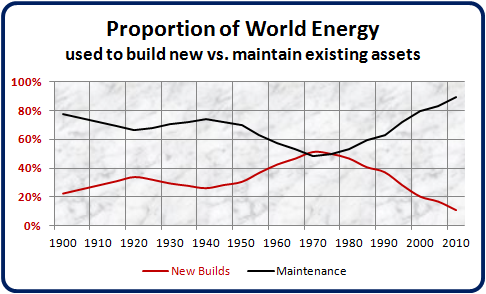
An expanding civilization requires more energy to maintain the cumulative asset base, as well as to build out new assets to drive the expansion. According to Tim Garrett of the University of Utah, just the support of the cumulative asset base requires ~9.7 mw of power per 1990 constant dollar of cumulative GWP (cumulative over at least the last 2000 years). Only once that bar has been met can we devote energy to building out yet more assets. Below that level, presumably, we would fall into something that looks like JM Greer's "catabolic collapse".

The amount of "spare energy" available to grow civilization has been falling since 1970:


If this assessment is correct, we risk falling into catabolic collapse before 2030 unless the amount of energy we can generate increases substantially. Energy efficiency increases of a few percent aren't going to be enough.

Recommendations

0 members have recommended this reply (displayed in chronological order):

Latest Discussions»Issue Forums»Environment & Energy»(British) Coalition to re...»Reply #2