I read the various reports, and apparently they are using a lot more reactive power to handle the grid even when output of renewables is high.
Obviously DU is not a German-language site, which limits the utility of all those reports for us.
The techniques used to handle grids are pretty uniform across most modern nations, so the UK's national grid documents give us something more understandable to look at in terms of concepts:
http://www.nationalgrid.com/uk/Electricity/Balancing/Summary/
Large traditional power producers always had frequency response agreements, so those were used to modulate grid inputs. The problem is totally different when you have a lot of smaller variable sources that are supposed to get first priority in. In times of high generation, some of those may have to be locally dumped in order not to overload local grids, but aside from that these inputs must be taken, so you have to get your reactive power from another contracted source.
And reactive power is a localized demand, so the more traditional power plants have to be ready to provide it:
http://www.nationalgrid.com/uk/Electricity/Balancing/services/balanceserv/reactive/
Another way to think about Germany's current predicament is to consider smaller systems like Denmark or the BPA in the Pacific Northwest. Both of these grid systems balanced higher wind inputs by becoming higher exporters. They used the wind when it was available, but maintained other sources and basically exported the excess power, in some cases reimporting it (pumped storage in Norway, for example). Now Germany is doing the same thing.
It's very easy for Bonneville, because it has huge hydro and it can modulate that down and up quickly, plus there is a big export demand. So it doesn't have much problems handling its wind for the most part:
http://transmission.bpa.gov/Business/Operations/Wind/baltwg.aspx
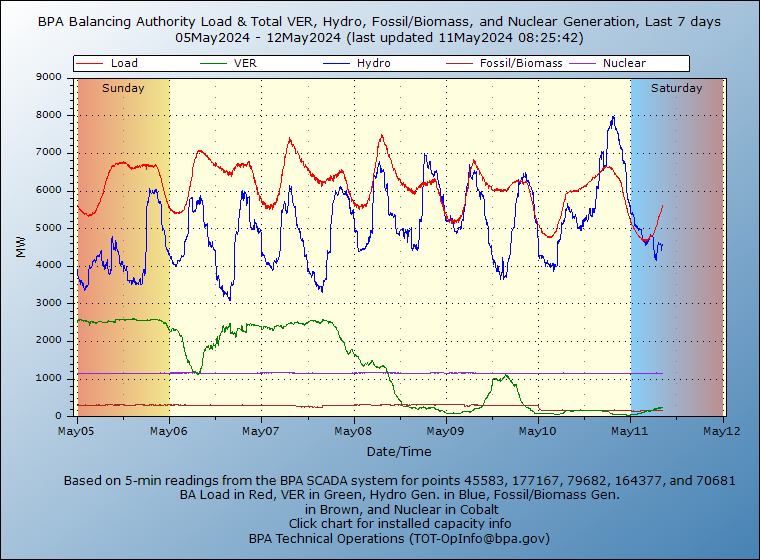
And:
http://transmission.bpa.gov/Business/Operations/Wind/baltwg3.aspx
But Germany doesn't have that, so it is using more thermal power. And nuclear power may be great for baseload, but it is generally not suited well for balancing, plus that's going away anyway, and maybe more quickly than scheduled.

 = new reply since forum marked as read