Environment & Energy
Showing Original Post only (View all)
Nuclear Energy Development and Slowing Climate Change [View all]
[div style="float: left; padding-right: 12px; text-align: center;"]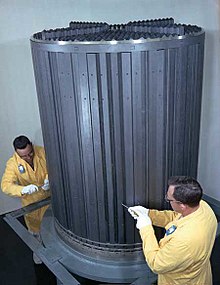 [br]Engineers install moderator blocks for[br]Oak Ridge's Molten Salt Reactor[br]Experiment."For political reasons, the U.S. funding for nuclear power research has been shrinking steadily. This is due to two factors: fear of nuclear power, and a choice made during the Nixon administration. The original development of nuclear fission technology was to enable building bombs, then powering submarines. Using nuclear power to generate electricity came afterword. The design of nuclear power plants of those early days was the light-water reactor (LWR). This design has undergone significant improvements, but in the 1950s and ’60s, scientists at Oak Ridge National Laboratory (ORNL) came up with another reactor design. The new design made meltdown impossible, and the waste was 1,000 times less than the LWR. In fact, this new design could use the waste of the old design as fuel. The new design didn’t need large amounts of water the way the LWR does, and could desalinate water while generating electricity. The new design didn’t even need uranium for fuel. A prototype was built, and ran for five years to prove the design would work.
When the Air Force came to ORNL scientists back in the late ’50s and asked them to develop a nuclear power plant for a bomber, the scientists were forced to create a reactor that was light, small, and safe. It would have to be one that would eliminate some issues of the LWR. The new design they came up with was the molten salt reactor (MSR). The scientists built a small proof-of-concept reactor for the Air Force, but then funding was cut as long-range bombers were replaced with ICBMs. In the 1960s, ORNL received funding for the Molten Salt Reactor Experiment (MSRE). The scientists argued for continuing development of the molten salt reactor but the military and bureaucratic momentum were behind the LWR.
<>
Enter the 21st century and a young NASA scientist who was given the job of finding a way to power a colony on the moon. His name is Kirk Sorensen. He knew this power source would likely have to be nuclear—given that the moon has no wind and two weeks of darkness every month—but the prevailing LWR designs all called for water, lots of water. One day while visiting a colleague’s office, he noticed a book titled Molten Salt Reactors and asked to borrow it. He took it home and became consumed in its 1,000 pages of technical jargon and data. Sorensen was so enthralled with the design that he started a grassroots movement that today has scientists and engineers working on their own time to refine and develop the design. Their design is called the Liquid Fuel Thorium Reactor (LFTR), a type of molten salt reactor that burns thorium, a plentiful and cheap fuel."
http://ansnuclearcafe.org/2013/08/21/nuclear-energy-development-and-slowing-climate-change/
 = new reply since forum marked as read
Highlight:
NoneDon't highlight anything
5 newestHighlight 5 most recent replies
= new reply since forum marked as read
Highlight:
NoneDon't highlight anything
5 newestHighlight 5 most recent replies