Welcome to DU!
The truly grassroots left-of-center political community where regular people, not algorithms, drive the discussions and set the standards.
Join the community:
Create a free account
Support DU (and get rid of ads!):
Become a Star Member
Latest Breaking News
Editorials & Other Articles
General Discussion
The DU Lounge
All Forums
Issue Forums
Culture Forums
Alliance Forums
Region Forums
Support Forums
Help & Search
Environment & Energy
Showing Original Post only (View all)
Global Warming Since 1997 Underestimated by Half [View all]
A new study by British and Canadian researchers shows that the global temperature rise of the past 15 years has been greatly underestimated. The reason is the data gaps in the weather station network, especially in the Arctic. If you fill these data gaps using satellite measurements, the warming trend is more than doubled in the widely used HadCRUT4 data, and the much-discussed “warming pause” has virtually disappeared.
...
It sounds obvious and simple, but it’s not. Firstly, the satellites cannot measure the near-surface temperatures but only those overhead at a certain altitude range in the troposphere. And secondly, there are a few question marks about the long-term stability of these measurements (temporal drift).
Cowtan and Way circumvent both problems by using an established geostatistical interpolation method called kriging – but they do not apply it to the temperature data itself (which would be similar to what GISS does), but to the difference between satellite and ground data. So they produce a hybrid temperature field. This consists of the surface data where they exist. But in the data gaps, it consists of satellite data that have been converted to near-surface temperatures, where the difference between the two is determined by a kriging interpolation from the edges. As this is redone for each new month, a possible drift of the satellite data is no longer an issue.
...
But after filling the data gaps this trend is 0.12 °C per decade and thus exactly equal to the long-term trend mentioned by the IPCC.
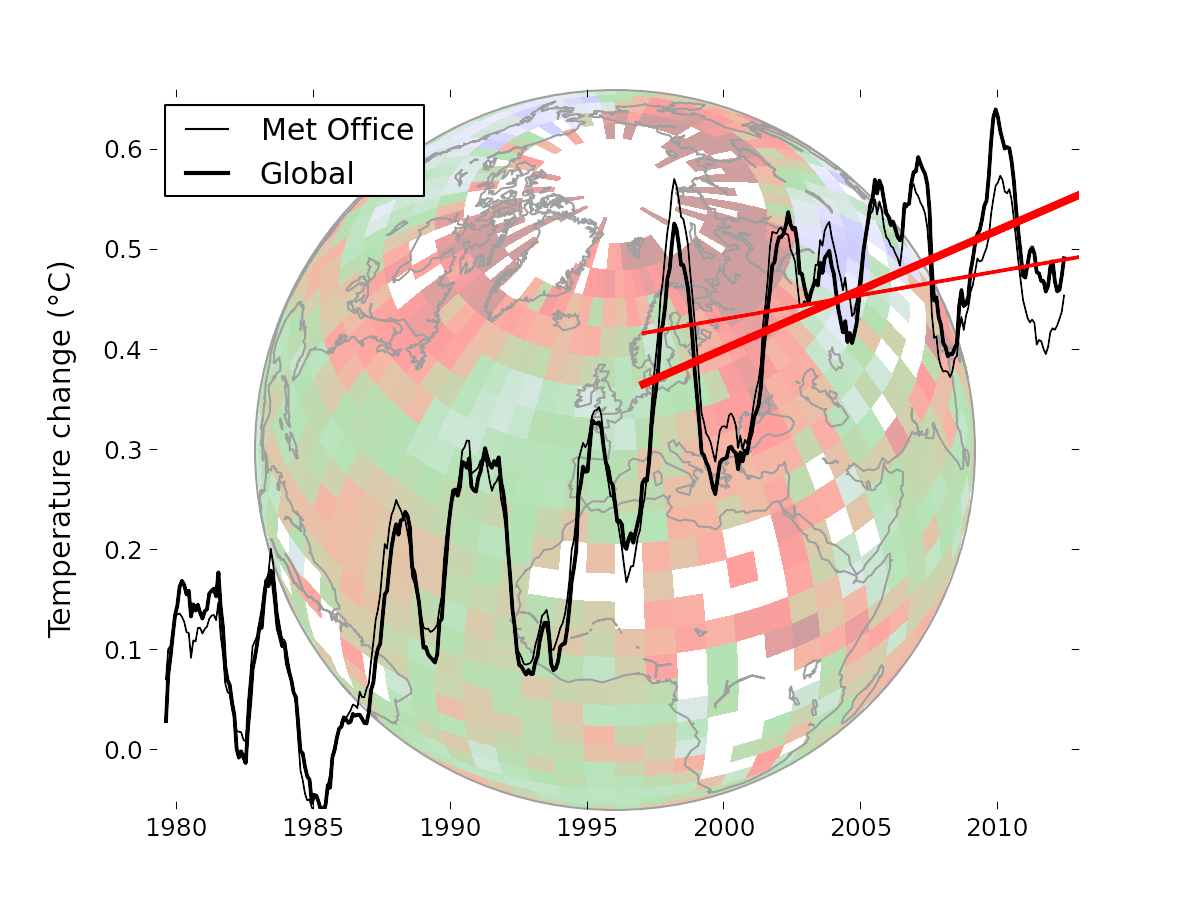
http://www.realclimate.org/index.php/archives/2013/11/global-warming-since-1997-underestimated-by-half/
...
It sounds obvious and simple, but it’s not. Firstly, the satellites cannot measure the near-surface temperatures but only those overhead at a certain altitude range in the troposphere. And secondly, there are a few question marks about the long-term stability of these measurements (temporal drift).
Cowtan and Way circumvent both problems by using an established geostatistical interpolation method called kriging – but they do not apply it to the temperature data itself (which would be similar to what GISS does), but to the difference between satellite and ground data. So they produce a hybrid temperature field. This consists of the surface data where they exist. But in the data gaps, it consists of satellite data that have been converted to near-surface temperatures, where the difference between the two is determined by a kriging interpolation from the edges. As this is redone for each new month, a possible drift of the satellite data is no longer an issue.
...
But after filling the data gaps this trend is 0.12 °C per decade and thus exactly equal to the long-term trend mentioned by the IPCC.
http://www.realclimate.org/index.php/archives/2013/11/global-warming-since-1997-underestimated-by-half/
Coverage bias in the HadCRUT4 temperature series and its impact on recent temperature trends
Incomplete global coverage is a potential source of bias in global temperature reconstructions if the unsampled regions are not uniformly distributed over the planet's surface. The widely used HadCRUT4 dataset covers on average about 84% of the globe over recent decades, with the unsampled regions being concentrated at the poles and over Africa. Three existing reconstructions with near-global coverage are examined, each suggesting that HadCRUT4 is subject to bias due to its treatment of unobserved regions.
Two alternative approaches for reconstructing global temperatures are explored, one based on an optimal interpolation algorithm and the other a hybrid method incorporating additional information from the satellite temperature record. The methods are validated on the basis of their skill at reconstructing omitted sets of observations. Both methods provide superior results than excluding the unsampled regions, with the hybrid method showing particular skill around the regions where no observations are available.
Temperature trends are compared for the hybrid global temperature reconstruction and the raw HadCRUT4 data. The widely quoted trend since 1997 in the hybrid global reconstruction is two and a half times greater than the corresponding trend in the coverage-biased HadCRUT4 data. Coverage bias causes a cool bias in recent temperatures relative to the late 1990s which increases from around 1998 to the present. Trends starting in 1997 or 1998 are particularly biased with respect to the global trend. The issue is exacerbated by the strong El Niño event of 1997-1998, which also tends to suppress trends starting during those years.
http://onlinelibrary.wiley.com/doi/10.1002/qj.2297/abstract
Incomplete global coverage is a potential source of bias in global temperature reconstructions if the unsampled regions are not uniformly distributed over the planet's surface. The widely used HadCRUT4 dataset covers on average about 84% of the globe over recent decades, with the unsampled regions being concentrated at the poles and over Africa. Three existing reconstructions with near-global coverage are examined, each suggesting that HadCRUT4 is subject to bias due to its treatment of unobserved regions.
Two alternative approaches for reconstructing global temperatures are explored, one based on an optimal interpolation algorithm and the other a hybrid method incorporating additional information from the satellite temperature record. The methods are validated on the basis of their skill at reconstructing omitted sets of observations. Both methods provide superior results than excluding the unsampled regions, with the hybrid method showing particular skill around the regions where no observations are available.
Temperature trends are compared for the hybrid global temperature reconstruction and the raw HadCRUT4 data. The widely quoted trend since 1997 in the hybrid global reconstruction is two and a half times greater than the corresponding trend in the coverage-biased HadCRUT4 data. Coverage bias causes a cool bias in recent temperatures relative to the late 1990s which increases from around 1998 to the present. Trends starting in 1997 or 1998 are particularly biased with respect to the global trend. The issue is exacerbated by the strong El Niño event of 1997-1998, which also tends to suppress trends starting during those years.
http://onlinelibrary.wiley.com/doi/10.1002/qj.2297/abstract
This is important.
6 replies
 = new reply since forum marked as read
Highlight:
NoneDon't highlight anything
5 newestHighlight 5 most recent replies
= new reply since forum marked as read
Highlight:
NoneDon't highlight anything
5 newestHighlight 5 most recent replies
= new reply since forum marked as read
Highlight:
NoneDon't highlight anything
5 newestHighlight 5 most recent replies
Meanwhile, below the surface, Greenland Sea found to have warmed 10 times faster than global ocean
muriel_volestrangler
Nov 2013
#2