Global temperature 2013
Filed under:
Climate Science
Instrumental Record
— stefan @ 27 January 2014
The global temperature data for 2013 are now published. 2010 and 2005 remain the warmest years since records began in the 19th Century. 1998 ranks third in two records, and in the analysis of Cowtan & Way, which interpolates the data-poor region in the Arctic with a better method, 2013 is warmer than 1998 (even though 1998 was a record El Nino year, and 2013 was neutral).
The end of January, when the temperature measurements of the previous year are in, is always the time to take a look at the global temperature trend. (And, as the Guardian noted aptly, also the time where the “climate science denialists feverishly yell [...] that global warming stopped in 1998.”) Here is the ranking of the warmest years in the four available data sets of the global near-surface temperatures (1):
EDIT
Quality of the interpolation
How good is the interpolation into regions not regularly covered by weather stations? In any case, of course, better than simply ignoring the gaps, as the HadCRUT and NOAA data have done so far. The truly global average is important, since only it is directly related to the energy balance of our planet and thus the radiative forcing by greenhouse gases. An average over just part of the globe is not. The Arctic has been warming disproportionately in the last ten to fifteen years.
But how well the interpolation works we know only since the important work of Cowtan and Way. These colleagues have gone to the trouble of carefully validating their method. Although there are no permanent weather stations in the Arctic, there is intermittent data from buoys and and from weather model reanalyses with which they could test their method. For the last few decades and Cowtan & Way also make use of satellite data (more on this in our article on underestimated warming). I therefore assume that the data from Cowtan & Way is the methodologically best estimate of the global mean temperature which we currently have. This correction is naturally small (less than a tenth of a degree) and hardly changes the long-term trend of global warming – but if you look deeper into shorter periods of time, it can make a noticeable difference. The comparison with the uncorrected HadCRUT4 data looks like this:
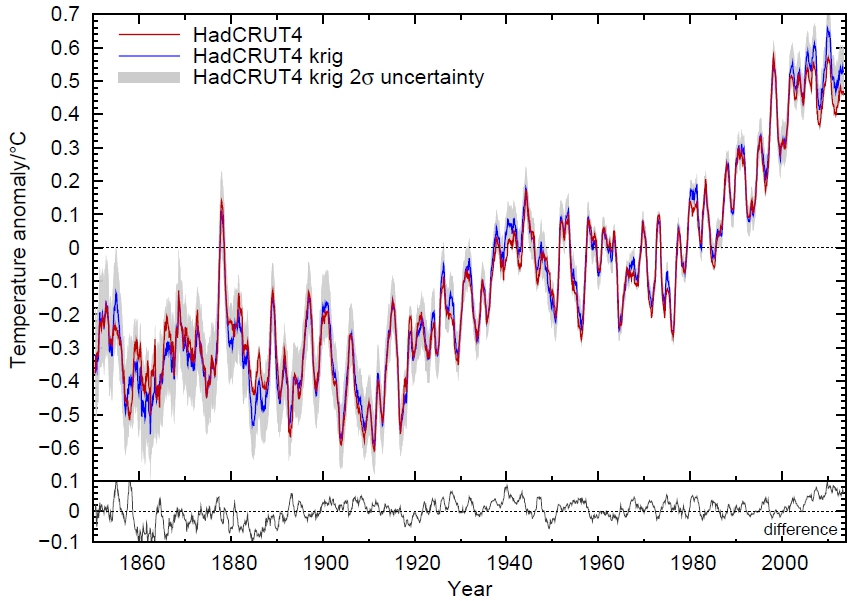
Figure 3: Comparison of interpolated and non-interpolated HadCRUT4 data, as moving averages over 12 months. Source: Kevin Cowtan, University of York.
And here’s a look at the last years in detail:
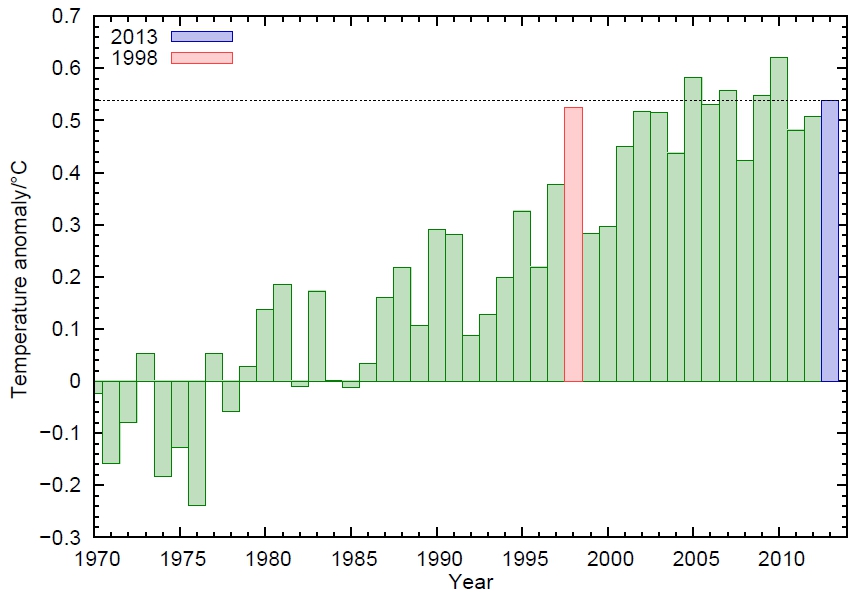
Figure 4: The interpolated HadCRUT4 data (annual average) from 1970. Source: Kevin Cowtan, University of York.
Following this analysis, 2013 was thus even warmer than the record El-Niño-year 1998.
Conclusion
In all four data series of the global near-surface air temperature, the linear trend even from the extreme El Niño year 1998 is positive, i.e. shows continued warming, despite the choice of a warm outlier as the initial year.
In all four data series of the global near-surface air temperature, 2010 was the warmest year on record, followed by 2005.
The year 1998 is, at best, rank 3 – in the currently best data set of Cowtan & Way, 1998 is actually only ranked 7th. Even 2013 is – without El Niño – warmer there than 1998.
The German news site Spiegel Online presents these facts under the headline Warming of the air paused for 16 years (my translation). The headline of the NASA news release, NASA Finds 2013 Sustained Long-Term Climate Warming trend, is thus completely turned on its head.
This will not surprise anyone who has followed climate reporting of Der Spiegel in recent years. To the contrary – colleagues express their surprise publicly when a sensible article on the subject appears there. For years, Der Spiegel has acted as a gateway for dubious “climate skeptics” claims into the German media whilst trying to discredit top climate scientists (we’ve covered at least one example here).
Do Spiegel readers know more (as their advertising goes) – more than NASA, NOAA, Hadley Centre and the World Meteorological Organization WMO together? Or are they simply being taken for a ride for political reasons?
EDIT
http://www.realclimate.org/index.php/archives/2014/01/global-temperature-2013/

 = new reply since forum marked as read