2011 Avg. Arctic Temps 4.1F Above 1951-80 Historic Average; Sea Ice Volume Lowest On Record [View all]
Last year the Arctic, which is warming faster than anywhere else on Earth due to global climate change, experienced its warmest twelve months yet. According to recent data by NASA, average Arctic temperatures in 2011 were 2.28 degrees Celsius (4.1 degrees Fahrenheit) above those recorded from 1951-1980. As the Arctic warms, imperiling its biodiversity and indigenous people, researchers are increasingly concerned that the region will hit climatic tipping points that could severely impact the rest of the world. A recent commentary in Nature Climate Change highlighted a number of tipping points that keep scientists awake at night.
"If set in motion, [tipping points] can generate profound climate change which places the Arctic not at the periphery but at the core of the Earth system," Professor Duarte, a climatologist with the University of Western Australia's Ocean Institute and co-author other paper, said in a press release. "There is evidence that these forces are starting to be set in motion. This has major consequences for the future of human kind as climate change progresses."
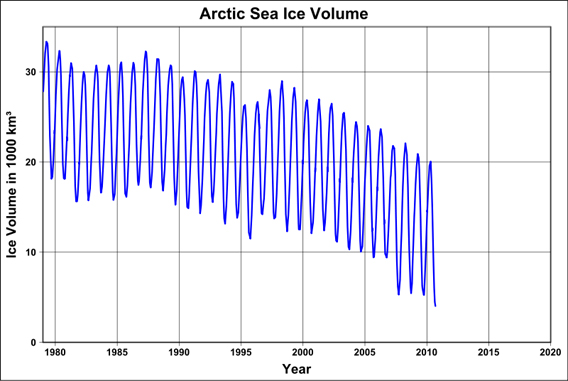
One of the tipping points is sea ice loss. The Arctic wasn't just relatively hot last year—beating the previous record set in 2010 by 0.17 degrees Celsius (0.3 degrees Fahrenheit)—it also experienced the lowest sea ice volume yet recorded, and the second-lowest extent. Sea ice is essential to many Arctic species, from polar bears to walrus, and narwhals to seals. In just over 30 years, sea ice volume has dropped precipitously, declining by 76 percent from 1979 (16,855 cubic kilometers) to 2011 (4,017 cubic kilometers). This loss of sea ice also leads to greater regional and global warming, as the Arctic's sea reflects the sun's light back into space, cooling not only the region but the world.
EDIT
Governments have responded to warming in the Arctic with a resource race. Governments with Arctic territories plan to drastically expand oil and gas exploitation, utilize new shipping routes, and increase mining. The industrialization of the Arctic, according to Duarte, may only accelerate impacts on the fragile region and push tipping points.
EDIT
Read more:
http://news.mongabay.com/2012/0213-hance_arctic_tippingpoints.html?utm_source=dlvr.it&utm_medium=twitter#ixzz1mTZHXBfx

 = new reply since forum marked as read