If you go to Mauna Loa's website, and check annual mean changes in CO2, you'll find this:
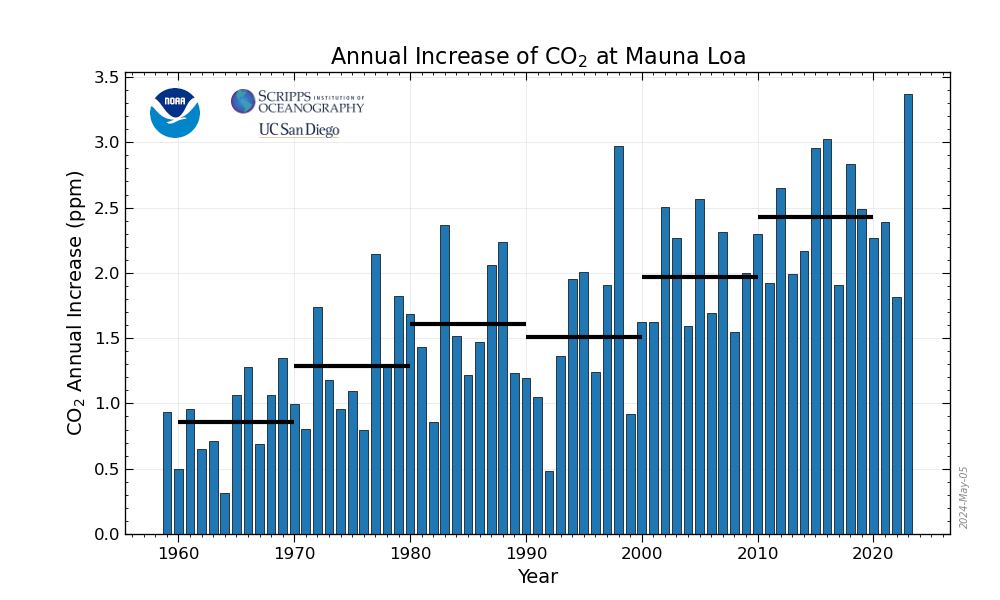
http://www.esrl.noaa.gov/gmd/ccgg/trends/ - (third graph down the page).
A couple of things jumped out at me - first of all, the anomalous years - 1964, 1992 and 1999, when we monitored mean annual CO2 increases of .28, .48 and .93 ppm/yr. The first came during the booming mid-1960s, the second at the end of the Gulf War Recession and the last just when globalization was really getting going. Is there a common thread to explain these relatively low-output years? Recession would seem to explain 1992, but not the others.
Second, the mean annual increase during the 1990s was lower than the decade that preceded it and the decade that followed - not by much, but it was a lower-CO2 decade. Why? Was it the payoff of moves to energy efficiency in technology and industry during the 1980s? The shutdown of massively polluting industries in the East Bloc post 1989? India and China not really moving yet? I suspect all of the above, but absent data won't speculate further.
But the main point is simply this - there's not a single year, going back to the end of the 1950s, in which we do not see a mean annual increase in CO2 content. IOW, there's never been a net negative year in atmospheric carbon dioxide, and though there have been years of slow growth, there's never been even a single flat year. That's what concerns me, especially now, given the scale of coal burning that's about to really get going, and a point that tends to get lost in our review of the inevitable fluctuations in total anthropogenic GHG output year to year.
CO2 - the core GHG - hasn't had a single net negative year in all the time we've been tracking it directly, and that's more than half a century.

 = new reply since forum marked as read