Chinese tree planting reverses global forest loss [View all]
30 March 2015
Chinese tree planting reverses global forest loss
by Will Parker
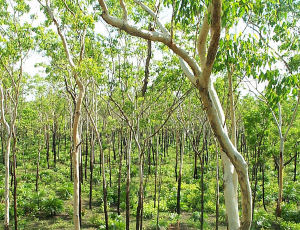
Although massive vegetation loss is still occurring in Asia and South America, an analysis of 20 years of satellite data has revealed that the regrowth of forests in China, Australia, and Africa mean that the total amount of vegetation globally has increased by almost 4 billion tons of carbon since 2003. The new analysis, by an Australian-led international team of scientists, has been published in the journal Nature Climate Change.
According to the researchers, there are several factors to thank for the reversal. "The increase in vegetation primarily came from a lucky combination of environmental and economic factors and massive tree-planting projects in China," said Dr Yi Liu, a study lead author from the University of New South Wales. "Vegetation increased on the savannas in Australia, Africa, and South America as a result of increasing rainfall, while in Russia and former Soviet republics we have seen the regrowth of forests on abandoned farmland. China was the only country to intentionally increase its vegetation with tree planting projects."
The findings come from an entirely new technique to map changes in vegetation biomass over time, using satellite measurements of natural radio waves emitted from the Earth's surface. "Previous analyses of vegetation biomass focused on forest cover change," said co-lead author, Professor Albert van Dijk, of The Australian National University. "With our approach we found unexpectedly large vegetation increases in the savannas of southern Africa and northern Australia. The increase in Australia occurred despite ongoing land clearing, urbanization, and big droughts across other parts of Australia."
The main cause of this strong growth over the savannas came from higher rainfall, particularly in recent years, although higher levels of CO2 in the atmosphere may have helped plants there to grow more vigorously.
More:
http://www.scienceagogo.com/news/20150230185636.shtml

 = new reply since forum marked as read