The therapeutic virtues of venom [View all]
http://www.guardian.co.uk/science/2013/jun/25/venom-medical-treatment-research-project
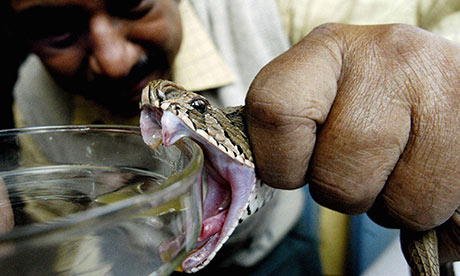
An Indian snake master collects venom. Photograph: Deshakalyan Chowdhury/Getty
Pierre Escoubas, a specialist in venom, does not like to fuel the fantasies frequently conjured up by his calling. When asked what has scared him most, he starts by explaining that handling snakes, spiders, wasps and cone snails is "not that risky" for an experienced operator. He pauses a second, then admits to having felt "a bit queasy" a few years ago in Japan when he took delivery of 50 live scorpions, "each the size of a hand", in an old hessian sack. "I spent quite a while wondering how I was going to catch these beasts one by one," he says.
Escoubas originally trained as a biologist, then started VenomeTech, a spin-off from France's National Centre for Scientific Research (CNRS) and Nice University. He is also the leader of the European Union Venomics research project on using animal venom to develop new forms of medical treatment. But why start with substances produced for hunting and self-defence, or more specifically to kill?
"Above all," Escoubas explains, "because these mixtures, which contain several hundred different molecules and are found in more than 173,000 species, have been selected in the course of evolution to attack very specific cells in a prey."
To produce their neurotoxic, cardiotoxic or hemotoxic effects, certain peptides – miniature proteins comprising between 10 and 100 amino acids that make up 90% of the dry matter in a venom – act on receptors or ion channels in cells, changing the way the latter operate or halting their reproduction.

 = new reply since forum marked as read