Astronomers Stunned by Repeating Fast Radio Burst Detected in Nearby Galaxy [View all]
TOPICS:AstronomyAstrophysics West Virginia University
By WEST VIRGINIA UNIVERSITY JANUARY 6, 2020
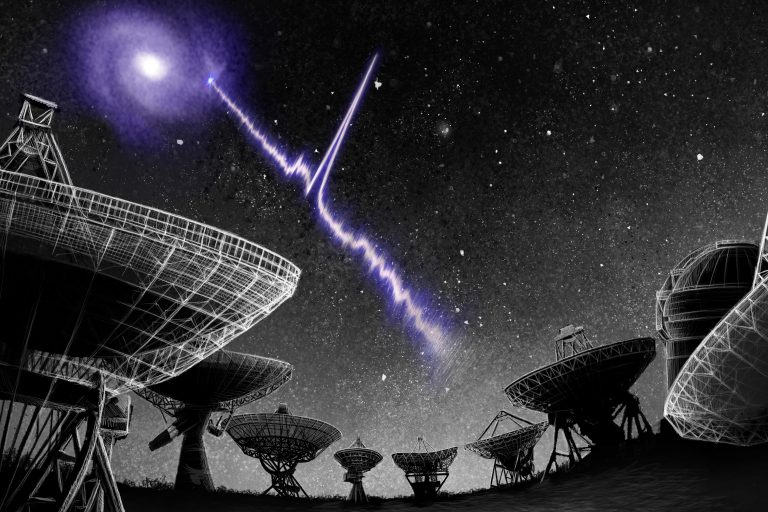
An artist’s conception of the localization of Fast Radio Burst 180916.J0158+65 to its host galaxy. The host galaxy image is based on real observations using the Gemini-North telescope atop Mauna Kea in Hawaii. The impulsive burst emanating from the galaxy is based on real data recorded using the 100-metre Effelsberg radio telescope in Germany. Credit: Danielle Futselaar, artsource.nl
For more than a decade, astronomers across the globe have wrestled with the perplexities of fast radio bursts — intense, unexplained cosmic flashes of energy, light years away, that pop for mere milliseconds.
Despite the hundreds of records of these enigmatic sources, researchers have only pinpointed the precise location of four such bursts.
Now there’s a fifth, detected by a team of international scientists that includes West Virginia University researchers. The finding, which relied on eight telescopes spanning locations from the United Kingdom to China, was published today (Monday, January 6, 2020) in
Nature.
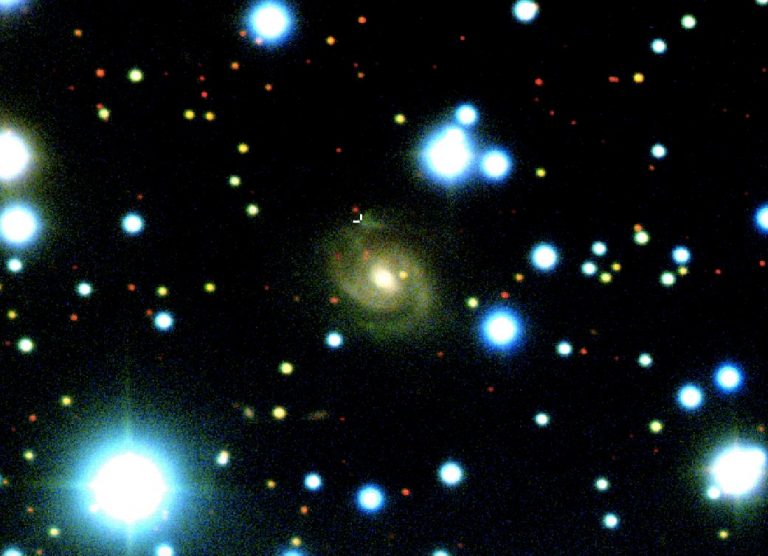
Image of SDSS J015800.28+654253.0, the host galaxy of Fast Radio Burst 180916.J0158+65 – acquired with the Gemini-North telescope. The position of the FRB in the spiral arm of the galaxy is marked by white cross hairs. Credit: Shriharsh Tendulkar/Gemini Observatory
There are two primary types of fast radio bursts, explained Kshitij Aggarwal, a physics graduate student at WVU and a co-author of the paper: repeaters, which flash multiple times, and non-repeaters, one-off events. This observation marks only the second time scientists have determined the location of a repeating fast radio burst.
More:
https://scitechdaily.com/astronomers-stunned-by-repeating-fast-radio-burst-detected-in-nearby-galaxy/

 = new reply since forum marked as read